










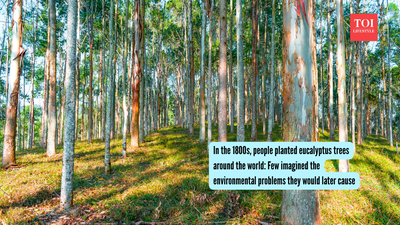
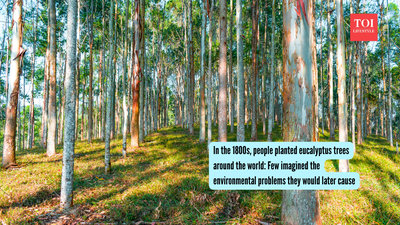
Drive down almost any highway or hill in India, walk through the hill stations of India, or wander the eucalyptus-scented eastern coast of Ethiopia, or drive across California, and you’ll likely run into the same tall, silver-leafed tree with peeling bark and that unmissable minty smell, much of which is famous for its popular scented essential oils.But it is intriguing to think how the Eucalyptus, which is native to Australia, is found on almost every continent across the globe!It seems it all began with a purpose and a long-term goal, but didn’t turn out as expected.
The eucalyptus tree was once considered a miracle
Native to Australia, eucalyptus trees began spreading across the globe in the 1800s, as a part of being planted by colonial governments, foresters, and landowners who saw them as the answer to a lot of problems at once.According to a paper published in the International Review of Social History, eucalypts were once regarded as something close to a wonder plant; for over a century, people believed the trees could even help cure tropical diseases and also generate a steady stream of profit side by side.Following this, they were planted across wildly different climates in Australia, Asia, Africa, Europe, and the Americas. Foresters during that time were attracted to the fact that the trees grew quickly, how tough their wood was, and how easily they took root in places where other trees struggled.
But it was not just limited to physiological aspects
Governments and industrialists wanted the trees for timber, fuel, and poles, and they were happy to plant them at scale wherever there was land and demand. In California, eucalyptus arrived as part of a wave of foreign plants brought over as European settlers moved in; according to the Santa Barbara Independent, the state had roughly 16 non-native plant species by the early 1800s, and then the number jumped to about 134 by 1860 as colonization accelerated.In places like Portugal and Ethiopia, the trees were planted to replace forests that centuries of farming and land pressure had already stripped away, offering fast cover on land that had little left growing on it.
The environmental costs nobody fully predicted
What seemed like a practical solution eventually turned out to be just the opposite. Eucalyptus roots are excellent at finding and pulling up water, which makes the trees specially adaptable in poor conditions but hard on everything around them.A review of eucalyptus’s environmental effects published in the International Journal of Advanced Research in Biological Sciences notes that while some tree species integrated into farmland can actually improve water efficiency, fast-growing plantations like eucalyptus tend to worsen local water shortages instead.Research on eucalyptus in Ethiopia, published in The Scientific World Journal, also suggests a similar pattern: the trees have been linked to reduced surface and groundwater flow, lower crop yields nearby, and soil fertility that degrades over time.
The excessive growth of these trees also became a propeller of wildfire
A study published in the journal PMC describes how the global spread of exotic eucalyptus plantations has become one of the more overlooked threats to biodiversity, since dense, uniform stands of the trees offer little food or habitat for native animals that evolved along with different vegetation.And most noticeably, eucalyptus trees’ famously oil-rich bark and leaves, which burn hot and fast, have also become associated with more severe wildfire behavior in fire-prone regions such as California and Australia.