









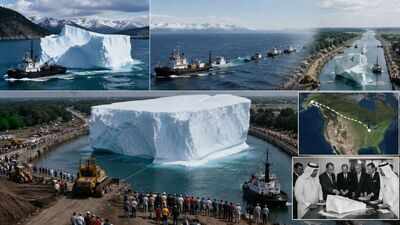
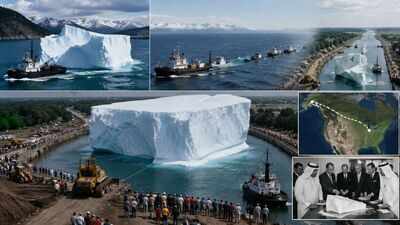
In the autumn of 1977, visitors arriving in Ames, Iowa, encountered something they would never have expected to see in the American Midwest: a massive iceberg sitting inside a refrigerated room at Iowa State University. It had travelled thousands of kilometres from Alaska by helicopter, aircraft and truck, not as a scientific curiosity but as evidence for an ambitious idea. The organisers wanted delegates to examine real glacial ice while discussing whether much larger Antarctic icebergs could one day be transported across oceans to supply fresh drinking water to arid countries. According to the Environment & Society Portal’s Arcadia, the unusual delivery formed part of an international conference backed by Saudi Arabia that explored whether icebergs could become a practical global water resource.
Why Saudi Arabia backed the 1977 Antarctic iceberg conference at Iowa State University
The gathering, officially called the First International Conference on Iceberg Utilisation, took place between 2 and 6 October 1977 at Iowa State University. Reportedly, around 200 participants representing 18 countries attended, bringing together glaciologists, marine biologists, engineers, government officials and corporate representatives to discuss the technical and economic realities of harvesting Antarctic icebergs.Behind much of the event stood Prince Mohammed Al-Faisal, who at the time oversaw Saudi Arabia’s desalination programme. Although desalination was already providing fresh water for the kingdom, the prince regarded it as an expensive approach that required substantial investment in infrastructure and continuous energy consumption. The conference explored whether naturally formed Antarctic icebergs might offer an alternative source of potable water for regions with limited freshwater supplies.Rather than treating the concept as science fiction, organisers framed it as a serious engineering challenge. Discussions ranged from locating suitable icebergs to towing, cutting and melting them safely after arrival.
How a real Alaskan iceberg was transported to Iowa for the 1977 conference
Organisers believed conference delegates should be able to inspect real glacier ice instead of relying entirely on diagrams or photographs. To achieve that, divers from the US Arctic Naval Research Laboratory selected a roughly 2,500-pound (around 1,133-kilogram) iceberg from Alaska’s Portage Lake.Moving it required a carefully planned chain of transport. The block of ice, measuring approximately six by five by four feet, was wrapped in insulation and dry ice before being lifted by helicopter, transferred onto an aircraft and finally carried by refrigerated truck to Ames. The journey reportedly cost about 8,500 US dollars, earning the iceberg the nickname “the most expensive ice cube in the world” in contemporary newspaper coverage.Once it arrived, the iceberg was stored inside a walk-in refrigerator at the Iowa State Memorial Union. Delegates could examine its structure while presentations discussed techniques that might eventually be applied to Antarctic icebergs many thousands of times larger.The conference even embraced the theme visually. According to the source, ice sculptures depicting tugboats capable of pulling Antarctic icebergs were displayed, reinforcing the central concept that floating polar ice could become a transportable natural resource.
Why Saudi Arabia invested in Antarctic iceberg research to secure future water supplies
Prince Mohammed Al-Faisal’s support for the conference reflected long-term concerns about Saudi Arabia’s future water security. While the country possessed considerable oil wealth during the 1970s, planners were also looking ahead to increasing freshwater demand and questioning whether energy-intensive desalination alone would remain the most practical answer.Professor Abdo Husseiny, a nuclear engineering professor at Iowa State University and principal organiser of the conference proposal, worked closely with the prince in developing the event. Their aim extended beyond academic discussion. The meeting sought to establish iceberg harvesting as a credible field of scientific and engineering research that governments and investors might eventually support.Presentations examined subjects including iceberg tracking, weather effects, towing methods and engineering challenges. The organisers also assembled photographs, films and mathematical models intended to build a growing body of evidence around the feasibility of iceberg utilisation.
Why the Antarctic iceberg towing plan never became reality
The plan to tow Antarctic icebergs to water-scarce regions was never carried out on the scale imagined in 1977, but it did not vanish after the conference ended. Proposals for large-scale iceberg towing have continued to surface periodically over the decades, particularly in discussions about supplying freshwater to dry coastal regions.Ruiz argues that the Iowa conference represented more than an isolated scientific meeting. It demonstrated how governments and research institutions attempted to expand ideas about future natural resources by producing technical evidence, visual demonstrations and international collaboration around an unconventional concept. Even though the vision remained unrealised, the conference illustrated how polar environments were increasingly viewed as potential frontiers for solving global resource challenges.Looking back, the image of a two-ton iceberg sitting in landlocked Iowa remains one of the most unusual examples of scientific persuasion from the 1970s. It served as a tangible symbol of an era when engineers, scientists and policymakers seriously entertained the possibility that floating Antarctic ice might one day quench the thirst of some of the world’s driest nations.