







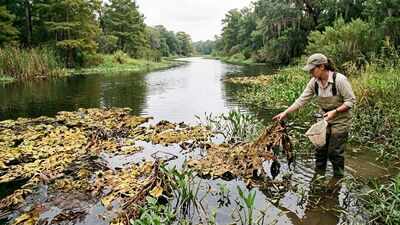
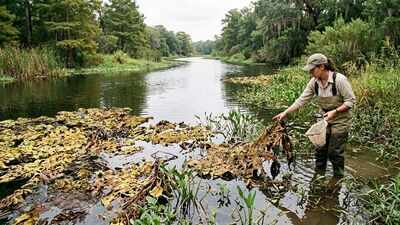
A thick green carpet can make a pond or reservoir appear almost solid, but giant salvinia is a floating fern, spreading across the water rather than growing from the bottom. In Texas and Louisiana, the plant had become difficult to manage, forming dense mats that blocked sunlight, reduced oxygen and interfered with waterways. According to the US Department of Agriculture, in 2001, researchers tried something considerably smaller. They released 880 salvinia weevils at four sites in eastern Texas and western Louisiana. Each adult was only about 2mm long, yet the insect was closely adapted to feeding on giant salvinia. The adults attacked growing tips while their larvae fed inside the plant.By September 2003, giant salvinia covered only about 1% of the water surface at the release sites, while untreated control areas remained completely covered. The experiment offered a striking example of biological control, using one small species to put pressure on another that had spread across large areas.
In 2001, researchers turned to a tiny weevil to fight a giant aquatic weed
The salvinia weevil is native to parts of South America, including south-eastern Brazil, where it occurs alongside giant salvinia. It had already attracted attention as a biological control agent because its life cycle is closely tied to the plant.The US programme did not simply release insects at random. After host-range testing established that the Brazilian population was suitable for use against giant salvinia, permission was obtained for releases in eastern Texas and western Louisiana. The first successful US releases took place on 10 and 11 October 2001, when 880 adult weevils were placed at four sites.The insects were small enough to be easily overlooked. Adults are only about 2mm long, roughly the size of a kiwi seed, and can hide among dense vegetation. Their larvae are even harder to spot because much of their development takes place inside the plant.
The giant salvinia problem grew from 124 acres to more than 3,000
Giant salvinia, Salvinia molesta, is a floating fern rather than a conventional weed growing from the soil. Under favourable conditions, it can spread rapidly across the surface of ponds, canals and reservoirs.The resulting mats can become dense enough to shut out sunlight and reduce oxygen levels in the water. They also interfere with boating and can crowd out native vegetation. By the early 2000s, the plant had become a serious management problem in parts of Texas and Louisiana.At Toledo Bend Reservoir, the scale of the problem was already increasing sharply. As reported by the Texas State Government, giant salvinia covered about 124 acres in 2003, then expanded to more than 3,000 acres in 2004 despite continuing herbicide treatments.The contrast helps explain why biological control attracted interest. Spraying could suppress the plant, but giant salvinia kept growing and could occupy areas that were difficult for treatment boats to reach.
How salvinia weevils slowly starve giant salvinia of nutrients
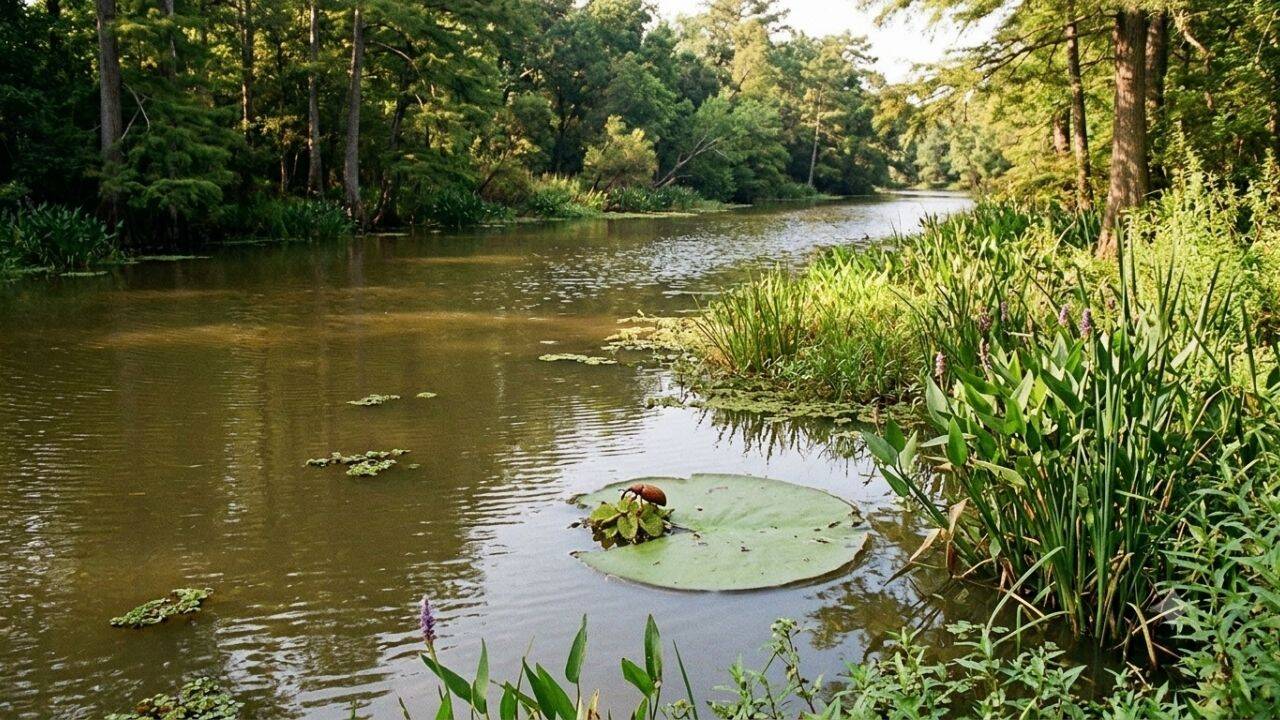
Adult weevils feed on the growing parts of salvinia, particularly nitrogen-rich buds. Females lay their eggs in small crevices around the plant’s growing tips.Once the larvae hatch, they initially feed on the plant’s outer tissues before moving into the rhizome. Their feeding interferes with the movement of nutrients towards new growth. As the damage accumulates, the plants weaken, turn brown and eventually die.That combination gives the insect two ways of slowing the fern. Adults reduce new growth from above, while larvae damage the plant internally.There is a timing element, too. At around 26°C, the journey from egg to adult takes roughly 45 days, and several generations can be produced during a suitable growing season.
How tiny weevils brought giant salvinia under control
The most useful evidence came from comparing sites where weevils had been released with nearby areas where they had not.By September 2003, giant salvinia covered only about 1% of the water surface at release sites. At the untreated control sites, it covered 100% of the surface. At some locations, biomass fell from more than 100 tons of fresh plant material per acre to less than two tons. Two sites, one in Texas and one in Louisiana, had gone from being almost completely covered to having mostly open water.The result was not simply a short-lived effect from releasing hungry insects. The weevils had survived and reproduced.That was important because an earlier attempt had not worked. Weevils released in Texas in 1999 had failed to establish after the experimental plots were affected by herbicide treatments, floods or drought. The later programme used weevils from the Brazilian population and produced a much more durable result.
The 2001 weevil releases survived freezing Texas and Louisiana winters
Getting the weevils established was not guaranteed. In the winter following the 2001 releases, researchers returned to the Texas and Louisiana sites to see whether the insects had survived. Adults were found at two of the four release locations. The observations showed that Cyrtobagous salviniae could persist through temperatures that fell as low as −9.1°C at Toledo Bend and −7.1°C at Lake Texana.Cold remains a limitation for the insect, though. Attempts to establish populations farther north have been unsuccessful in some areas, probably because freezing winter temperatures kill the weevils. Researchers have therefore continued looking at cold-tolerant populations and ways of improving winter survival.So the insect was not a universal solution. Its effectiveness depended partly on whether the local climate allowed it to persist.
Weevil feeding turns giant salvinia brown before the dead mats sink
As feeding weakens a dense stand of giant salvinia, the vegetation turns brown and begins to collapse. Once the floating mat dies, it sinks as it decomposes, allowing sunlight to penetrate the water again. The nutrients held in the plant material are returned to the water column rather than remaining locked in the floating vegetation.The weevils themselves do not need to be manually moved from plant to plant. Adults can walk across dense mats, fly at night and move with floating vegetation or floodwaters. Water managers can also introduce mass-reared insects into newly affected areas.
From Australia to the US, the salvinia weevil spread as a natural control
The US experience became part of a wider history of using the salvinia weevil against giant salvinia. Before the Texas and Louisiana programme, the insect had already been used successfully in Australia and subsequently released in a number of other countries.The early Texas and Louisiana results nevertheless provided a clear demonstration of what could happen when the right insect established itself alongside the invasive plant.A weed that had been covering entire stretches of water was being eaten by a beetle small enough to fit on a fingertip. By 2003, at the monitored release sites, the difference was already measurable: about 1% cover where the weevils had been introduced compared with complete surface cover at the untreated controls.