









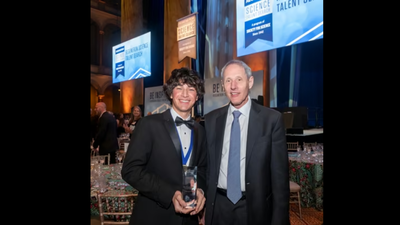
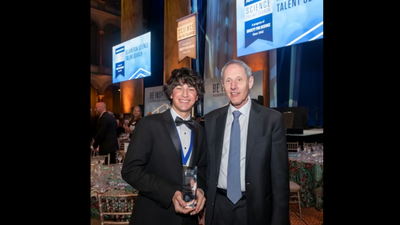
Matteo Paz, a senior at Pasadena High School, has flagged around 1.5 million previously uncatalogued objects in space using an artificial intelligence model he built himself. Working under the mentorship of Caltech astronomer Davy Kirkpatrick during a summer research placement, Paz applied his system to data gathered by Nasa’s NEOWISE mission, a telescope originally built to track asteroids near Earth. According to California Institute of Technology, the archive held close to 200 billion individual measurements collected over more than a decade of continuous sky scanning. Paz’s model, named VARnet, sifted through this dataset and flagged approximately 1.9 million candidate objects, of which roughly 1.5 million had no existing record in prior astronomical catalogues. His single-author paper on the project, later earned him the top prize at the 2025 Regeneron Science Talent Search, an annual competition for American high school seniors organised by the Society for Science.
How did Matteo Paz develop his interest in astronomy at Caltech
Paz’s interest in astronomy began during childhood visits to public stargazing lectures at Caltech, which his mother took him to while he was still in grade school. He later joined the Caltech Planet Finder Academy in the summer of 2022, studying astronomy and computer science under Professor of Astronomy Andrew Howard. The following year, he enrolled in Caltech’s six-week Summer Research Connection programme, which pairs local high school students with mentors working in campus laboratories.During this placement, Paz was mentored by Davy Kirkpatrick, a senior scientist at Caltech’s Infrared Processing and Analysis Centre. Kirkpatrick had spent five consecutive summers mentoring high school students, alongside undergraduates, citizen scientists and visiting graduate fellows. Paz brought an existing grounding in advanced mathematics to the project, having already progressed through Pasadena Unified School District’s Math Academy, a programme in which students complete AP Calculus BC by the eighth grade.
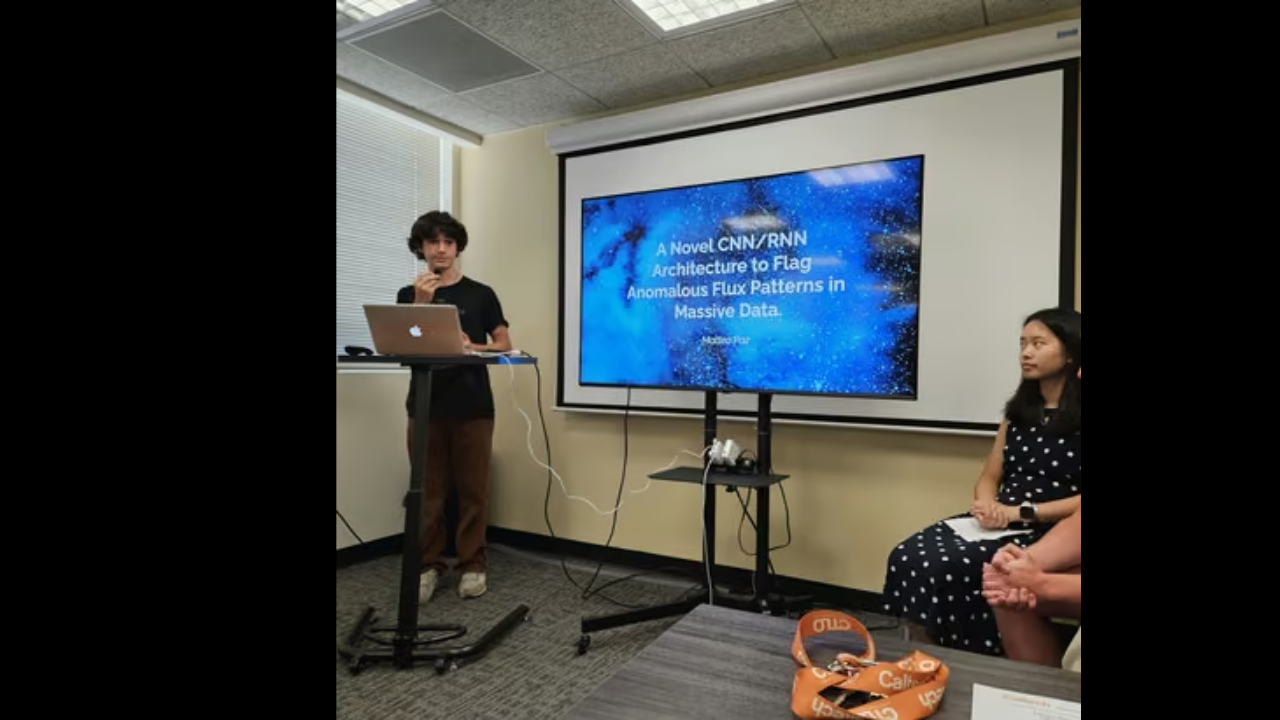
PC: California Institute of Technology
How did Matteo Paz build the VARnet AI model
Kirkpatrick’s original plan for the summer was more modest than what eventually emerged. According to Caltech, he intended for a student to examine a small patch of sky by hand, identifying a handful of variable stars to demonstrate the wider dataset’s potential to the astronomical community. NEOWISE, the reactivated version of Nasa’s Wide-field Infrared Survey Explorer, had by then compiled nearly 200 billion rows of detections gathered over more than a decade of continuous sky scanning in its two shortest infrared wavelength bands.Paz proposed a different approach, choosing to build a machine learning system capable of processing the full dataset rather than working through a limited region. The resulting model, named VARnet, was described in his paper. According to the paper published in The Astronomical Journal, titled ‘A Submillisecond Fourier and Wavelet-based Model to Extract Variable Candidates from the NEOWISE Single-exposure Database’, VARnet combines wavelet decomposition with a novel Fourier-based feature extraction method, together with deep learning, to detect faint variability signals in light curves gathered from NEOWISE’s single-exposure photometry database.
What types of astronomical objects can VARnet detect
VARnet was trained to sort detected light sources into four broad categories based on how their brightness changed over time: static objects, transient events such as novae or supernovae, pulsating variables, and eclipsing systems known as transits. The model was trained on more than a million synthetic light curves generated to simulate the irregular sampling patterns produced by NEOWISE’s scanning pattern, and it achieved an F1 score of 0.91 when tested against a validation set of known variable stars.When applied across the sky, the model flagged approximately 1.9 million candidate objects total. Of these, roughly 1.5 million had no existing record in prior astronomical catalogues. Individual detections described in the paper include a previously uncatalogued eclipsing binary system with a period of 5.877 days, a chemically peculiar star showing a transit signal, a suspected supernova within the galaxy LEDA 358365, and an active galactic nucleus associated with the irregularly shaped galaxy LEDA 340305.
How did Matteo Paz win the 2025 Regeneron Science Talent Search
The research led to Paz being named the first-place winner of the 2025 Regeneron Science Talent Search, an annual competition for American high school seniors organised by the Society for Science, which came with a prize of $250,000. According to Caltech, Kirkpatrick described the moment of the announcement as one of the greatest highs of his career, having invested significant effort in mentoring Paz through the process of turning a summer project into a peer-reviewed publication.Paz and Kirkpatrick have said they intend to publish a complete catalogue of the variable objects identified in the NEOWISE dataset. According to Caltech, Paz now works for Kirkpatrick at the Infrared Processing and Analysis Center while completing his final year of high school, in what is described as his first paying job. The paper itself notes that VARnet is intended as a proof of concept ahead of a planned full-sky variability survey covering the entirety of the NEOWISE archive.