








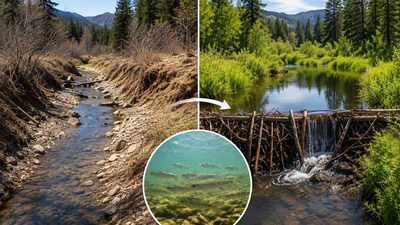
California built beaver-like dams in coho salmon creeks; at one site, mean juvenile survival rose from 8% before restoration to 60% after

California built beaver-like dams in coho salmon creeks; at one site, mean juvenile survival rose from 8% before restoration to 60% after

Representative Image (AI-generated) A restoration project in northern California has shown how structures designed to mimic the work of beavers can create better conditions for threatened coho salmon, particularly during drought. According to a July 2026 study published in Frontiers in Ecology and Evolution, juvenile coho salmon survival in one restored creek increased from a…

Read More
Total solar eclipse on August 12, 2026: When and how to watch the rare ‘sunset eclipse’ and the best locations to see it

Total solar eclipse on August 12, 2026: When and how to watch the rare ‘sunset eclipse’ and the best locations to see it |

Total Solar Eclipse. Image Credit: Bob Linsdell/Wikipedia On 12 August 2026, a total solar eclipse will take place, which will cross the Northern Hemisphere from Siberia to the Mediterranean. This rare celestial event is expected to attract millions of observers from many continents. The path of totality (the narrow track or strip of land where…

Read More
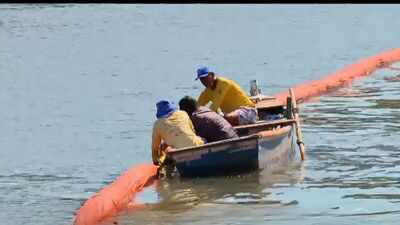
In Rio de Janeiro's Guanabara Bay, discarded salon hair is being transformed into an oil-absorbing barrier that protects mangroves from oil spills

In Rio de Janeiro’s Guanabara Bay, discarded salon hair is being transformed into an oil-absorbing barrier that protects mangroves from oil spills

When scientists have a will, there is always a way. In a shocking yet successful project, leftover hair from haircuts that is not suitable for wigs and would have gone to waste is now being used to prevent oil and other pollutants from getting into the water and the trees.In Rio de Janeiro’s Guanabara Bay,…

Read More
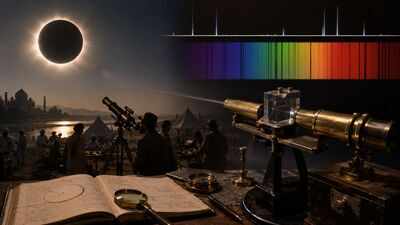
In 1868, a solar eclipse in India revealed a mysterious element in the Sun that would not be found on Earth for 27 years

In 1868, a solar eclipse in India revealed a mysterious element in the Sun that would not be found on Earth for 27 years |

In August 1868, the Sun briefly became a laboratory for astronomers gathered in India to watch a total solar eclipse. Among them was the French astronomer Pierre Jules Janssen, who turned a spectroscope towards the bright prominences rising around the eclipsed solar disc. Their light contained a yellow spectral line that seemed to sit close…

Read More
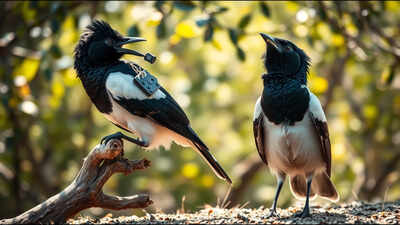
Scientists fitted Australian magpies with GPS trackers, but the birds quickly learned to remove them for each other

Gps: Scientists fitted Australian magpies with GPS trackers, but the birds quickly learned to remove them for each other |

Representative Image of Australian magpies cooperating to remove tracking devices from one another (AI-generated image) Researchers in Queensland fitted five Australian magpies with tiny GPS trackers, hoping to map their movements and understand how age, sex or rank affected the way the flock behaved. The birds had other plans. Within about ten minutes, an untagged…

Read More
Quote of the day by Benjamin Franklin: "What is more valuable than gold? Diamonds. Than diamonds? Virtue."

Quote of the day by Benjamin Franklin: “What is more valuable than gold? Diamonds. Than diamonds? Virtue.” |

Benjamin Franklin (Image: Wikipedia) Two people can spend a lifetime accumulating whatever they consider valuable and end up with completely different kinds of wealth to show for it. One collects money, property, and possessions, each one clearly priced, each one able to be counted. The other spends that same effort building something that resists being…

Read More
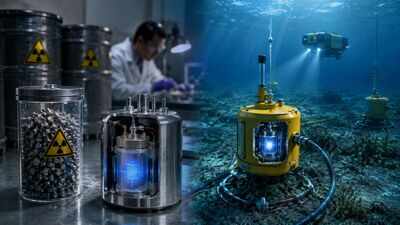
America is turning decades-old radioactive waste into strontium-90 power systems that could keep underwater sensors running for decades

America is turning decades-old radioactive waste into strontium-90 power systems that could keep underwater sensors running for decades |

America is quietly building a network of nuclear-powered nodes on the ocean floor that could charge drone submarines for close to three decades without a cable, a support ship or a single resupply run. The fuel behind this project is strontium-90, a radioactive by-product that has sat in government storage for decades, and the Pentagon…

Read More
Quote of the day by Alexander Graham Bell: “Great discoveries and improvements invariably involve the cooperation of many minds”

Quote of the day by Alexander Graham Bell: “Great discoveries and improvements invariably involve the cooperation of many minds” |

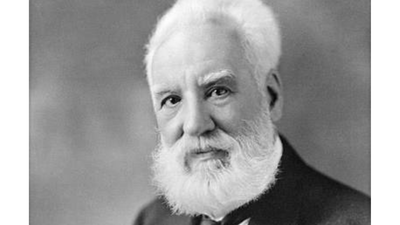
Alexander Graham Bell is best remembered for helping develop the telephone, an invention that transformed how people communicated across distance. Yet Bell himself recognised that major breakthroughs rarely belong entirely to one person. His statement, “Great discoveries and improvements invariably involve the cooperation of many minds”, reflects the collaborative nature of scientific progress. Bell worked…

Read More
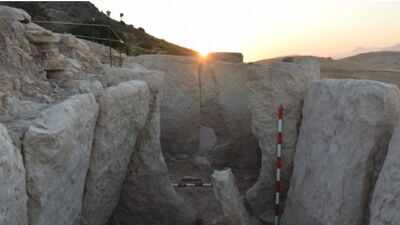
Archaeologists in Málaga uncovered a 13-metre megalithic tomb more than 5,000 years old; ivory, amber and seashells point to long-distance exchange networks

Archaeologists in Málaga uncovered a 13-metre megalithic tomb more than 5,000 years old; ivory, amber and seashells point to long-distance exchange networks

Photo credit: University of Cádiz Archaeologists working near Teba in Málaga, southern Spain, have uncovered a remarkably well-preserved megalithic tomb that is more than 5,000 years old. Announced by the University of Cádiz, the structure, known as Dolmen I of the La Lentejuela necropolis stretches about 13 metres, or roughly 42 feet, and contains multiple…

Read More
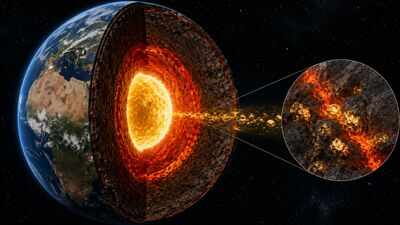
Earth’s core contains most of the planet’s gold, and scientists now find evidence that some core material is leaking into the mantle

Earth’s core contains most of the planet’s gold, and scientists now find evidence that some core material is leaking into the mantle |

Earth’s core holds far more gold than anyone can reach. More than 99.999 per cent of the planet’s stores of gold and other precious metals lie buried under 3,000 kilometres of solid rock, locked away within the metallic core and far beyond the reach of humankind. For decades, geologists assumed this vast reserve was permanently…

Read More
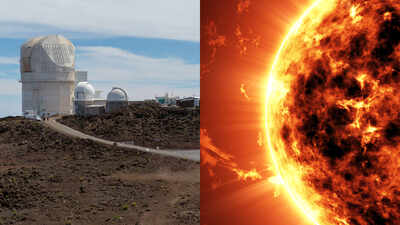
The world's largest solar telescope resolved the Sun at about 19-km scale and revealed ubiquitous plasma vortices that may help explain how magnetic energy moves

The world’s largest solar telescope resolved the Sun at about 19-km scale and revealed ubiquitous plasma vortices that may help explain how magnetic energy moves

The observations were made with the Daniel K. Inouye Solar Telescope (DKIST), a powerful 4-metre class solar telescope operated by the US National Science Foundation. The Sun may appear to us on Earth as a glowing ball of plasma, but its surface is far more active and turbulent than it looks, which has been proven…

Read More