




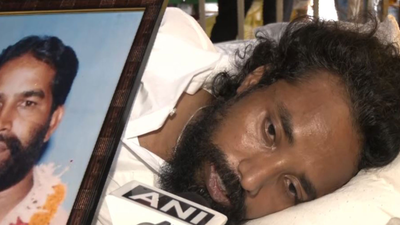
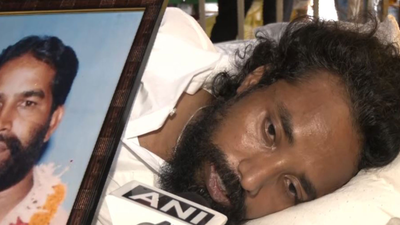
Ranchi’s Jaipal Singh Munda Stadium has, for the past 17 days, functioned as the nerve centre of one of Jharkhand’s largest student-led movements in recent years. At the centre of it is 33-year-old Devendra Nath Mahto, a student leader from Ranchi who has been on an indefinite hunger strike since August 2, demanding the cancellation of recruitment examinations he alleges were compromised by irregularities.On Monday, as the protest enters its 17th day, students are set to march towards the state Assembly for a “Vidhan Sabha Gherao,” rejecting the Jharkhand government’s claim that it had accepted 98 percent of their demands. Police has imposed prohibitory orders under Section 163 of the Bharatiya Nyaya Sanhita (BNS) within a 750-metre radius of the Assembly and installed razor fencing along the route near Jagannath Temple. Most schools in Ranchi remain closed.
From Silli to Satyagraha
Mahto is not new to Jharkhand’s student politics. He completed his higher education in 2020 from Dr. Shyama Prasad Mukherjee University in Ranchi and holds first-division postgraduate degrees in Sanskrit, Kurmali, and Tribal and Regional Languages, along with a Bachelor of Education (B.Ed.) from Hazaribagh.He has contested elections twice. In the 2024 Lok Sabha election, Mahto ran as an Independent candidate from the Ranchi constituency, according to My Neta data. Later that year, in the Jharkhand Assembly election, he contested the Silli seat as a candidate of the Jharkhand Loktantrik Krantikari Morcha (JLKM), the party he continues to represent as a leader.His record of protest predates the current agitation by over a year. In December 2024, Mahto, then identified as a leader of the Jharkhand State Students’ Union (JSSU), was detained after police resorted to a lathi-charge to disperse candidates protesting alleged malpractices during the JSSC CGL document verification process. Students alleged police “took away our leader Devendra Nath Mahto after beating him up.“
The timeline of the current agitation
Mahto has traced the origins of the present movement to the declaration of the 14th JPSC Preliminary Test (PT) results. “The results of the 14th Preliminary Test (PT) were declared on the 2nd of last month, exactly a month ago today, marking the start of this controversy,” he told ANI. According to his account, the students launched their agitation on July 5, met the Governor on July 7, staged an effigy-burning protest on July 8, and met Chief Minister Hemant Soren on July 20 to submit evidence of irregularities.Talks failed to produce results. On August 2, Mahto began his indefinite fast at Jaipal Singh Munda Stadium under the banner of the JPSC-JSSC Reforms Manch, joined by five other protesters. “To uphold the students’ morale and escalate this struggle, I am giving up food starting today,” he said, adding that the primary objective was to secure cancellation of the 14th PT examination and an investigation into all exams conducted by the TDPL agency.
A deteriorating body, an unmoved position
By August 4, five more protesters, including two women, had joined Mahto’s hunger strike. His health began to decline rapidly. Speaking to IANS, Mahto said, “My entire body is in pain. My legs feel very heavy. I am feeling dizzy. I am also having difficulty in my chest and while breathing.”On August 6, climate activist Sonam Wangchuk spoke to Mahto over a video call and urged him to at least drink water, warning that abstaining from both food and water was “tantamount to suicide.” Mahto agreed to take water and salt, though he insisted he would not eat until the government met the protesters’ demands.The gesture was quickly misread in some quarters as an end to his fast. Fellow protester Prem Nayak rejected the suggestion outright, telling ANI, “Several false rumours are being spread claiming that Devendra Nath Mahto has broken his hunger strike. This is completely false.” Nayak said Wangchuk had only advised Mahto to stay hydrated after his lips grew parched. Mahto himself reiterated, “The hunger strike continues; I am not consuming any food, and this will go on until all our demands are met.”By August 9, the 15th day of his fast, doctors treating Mahto found his blood sugar and blood pressure levels critically low and his body dehydrated. “I am facing significant difficulty in speaking. The doctor said my blood sugar and blood pressure are low, and my entire body is dehydrated… My body’s organs are unable to cope,” he said. Around the same time, fellow hunger striker Rahul Kranti was admitted to Ranchi Sadar Hospital after his condition worsened.Despite the toll on his body, Mahto has continued to press for a meeting with Chief Minister Hemant Soren personally, not his ministers. “We want to talk to the CM directly, with the interaction recorded on video, in front of national, international, and state news outlets, and not in a closed room but in an open ground,” he told ANI on August 8.
Talks without a breakthrough
The state government has held multiple rounds of negotiations with student representatives without resolving the standoff. A four-member government delegation met an 11-member delegation of JPSC and JSSC aspirants at the State Guest House in Ranchi, after which Jharkhand minister Sudivya Kumar Sonu announced a dedicated email ID for students to submit recruitment reform suggestions.Students have dismissed the outreach as insufficient. At a press conference, a student leader said, “The Jharkhand government is spreading lies that it fulfilled 98 per cent of our demands. It cancelled only 3 of 13 exams sought by us.” Student leader Ravindra Paswan accused the government of pushing for a CID probe instead of a CBI investigation, calling the CID “known for cover-ups.”By August 9, a sixth round of talks had failed to reach a breakthrough.
The demands on the table
The protesters, under the JPSC-JSSC Reforms Manch, want the cancellation of all JSSC CGL, JSSC JE, and PGT examinations held after 2019, a CBI probe into alleged irregularities, and strict action against what they call the “mafias and agencies involved.” They have also demanded the release of category-wise cut-offs for UR, EWS, BC-I, BC-II, SC, and ST candidates, along with OMR copies and response sheets. A recruitment calendar modelled on the UPSC and SSC systems is among their longer-term demands.Nineteen people have been arrested so far in connection with alleged irregularities in JPSC examinations, and former JPSC panel chairperson L Khiangte has been questioned four times by investigators since July 28.Students have insisted their protest will remain “peaceful and democratic” and have appealed to parents, political parties, and the public to lend moral support without attaching any party banner to the movement. The Akhil Bharatiya Vidyarthi Parishad (ABVP), which held a separate march on Sunday during which eight to ten of its protesters were briefly detained, has announced its own Vidhan Sabha march for August 11.As Monday’s gherao is unfolding under heavy police presence, Mahto, weakened by 17 days without food, remains the movement’s most visible face, even as he has repeatedly said he does not personally attend the negotiation rounds, leaving that task to fellow student representatives while continuing his fast.