









Uttarakhand has long been known for its mountain passes, temples, and forest trails, and stands among those places that people visit for a change of scenery rather than a science lesson. But this time the ‘Devbhumi’ has recently been in the headlines for something far older than any temple or trail here.Let’s dig in to find out.
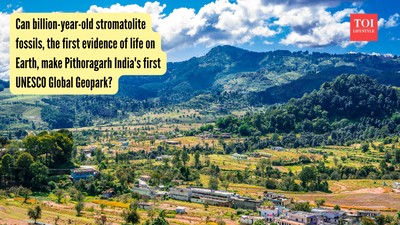
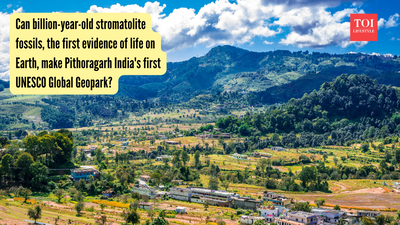
Can Pithoragarh become India’s first UNESCO Global Geopark ?
A research team from Ram Lal Anand College, University of Delhi, has documented the presence of stromatolite fossil colonies in Uttarakhand’s Pithoragarh district, according to the New Indian Express report. These fossils are regarded as among the earliest evidence of life on Earth. The findings were presented at KMSB Himalayan Inter College in Chaukori, along with the documentation of rare fossils, minerals, caves, and several other historically and prehistorically significant sites scattered across the region.
What are stromatolites?
The word stromatolite comes from Greek, combining stroma, meaning mattress, and lithos, meaning rock, meaning layered rock. These living fossils were formed by cyanobacteria, or blue-green algae, which developed the ability to photosynthesise back when Earth was volcanically hostile and unfit for complex life.The oxygen these microorganisms released over millions of years helped gradually change the planet’s atmosphere into what we breathe and live in today, eventually making conditions favourable for more advanced life forms to evolve.
Not just Pithoragarh alone
The discovery isn’t confined to a single spot. Neighbouring areas including Berinag, Gangolihat, and Chaukori reportedly contain similar striking geological formations that researchers say warrant further study. This suggests the region as a whole, not just one isolated site, holds geological evidence stretching back billions of years, making it one of those locations that are of genuine international scientific interest rather than a one-off curiosity.
What is a UNESCO Geopark tag and does it matter?
UNESCO Global Geoparks are unified geographical areas where geologically significant sites are managed through a combined plan of protection, education, and sustainable development. The programme, which began in 2001 and formally launched the Global Geoparks Network in 2004, takes a bottom-up approach that involves local communities directly in conservation and development, by using a model that has gained global attention since. There are currently over 200 such geoparks spread across roughly 50 countries.
India’s absence from the list, and who else is in the running
Despite its geological diversity, India does not yet have a single UNESCO Global Geopark. But Pithoragarh isn’t the only contender vying to change that. Visakhapatnam in Andhra Pradesh has been proposed for its red sand dunes at Erra Matti Dibbalu, rock formations in the Eastern Ghats, and the ancient Borra Caves. Manipur’s Loktak Lake has also been put forward, owing to its distinct Quaternary-era geological setting, as noted in a 2023 paper published in the Journal of the Geological Society of India.