









In one of the busy malls in Tokyo, Ikuko, Japan’s oldest and most famous geisha dances for shoppers in an elegant black kimono with precise movements. Only, the 86-year-old isn’t really there; it’s her hologram, a 3D projection of her, displayed in a life-size white box. “Thank you very much,” she said to passers-by, before bowing and changing to a younger version of herself, created with AI.While she doesn’t think AI is “cut out for this dance” just yet, or to replace their legendary hospitality, with the geisha numbers dwindling in the country, Ikuko has resigned to embracing new things in order to save the country’s most iconic art forms.Once, there were 200 geisha in Akasaka, the area of Tokyo where Ikuko practises. But over the years, she has watched their number fall to about 20. “I felt we had to preserve this culture, so I did it for the sake of that very culture,” she told ABC News. “This is the era we are entering, so I have to go along with it.”After an illustrious career, which includes being the first geisha awarded Japan’s prestigious Order of the Rising Sun, Ikuko feels the responsibility to preserve the tradition. “I’m already at the end of my life,” she said. “My greatest regret is that I hope Tokyo’s geisha districts will truly survive for another few decades.”
Years of hospitality
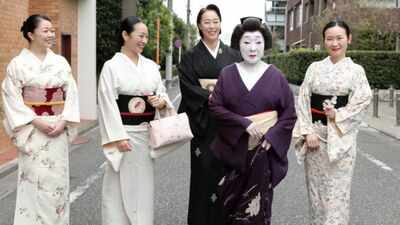
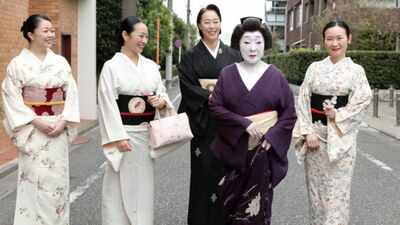
A Geisha is a traditional Japanese female entertainer. Gei means art and sha means person, literally translating to “person of art.” They are professional artists skilled in traditional Japanese music, dance, singing and conversation. They live and work in special districts called hanamachi or flower towns. There were once dozens of them in the city, but today only six major hanamachi remain, while the number of geisha across the city has also fallen from about 13,000 in 1940 to around 200.With their striking white makeup and bold black wigs, geisha have been synonymous with Japan for centuries, but a lot of people, even locals, fail to understand what they do. Geisha operate largely behind closed doors, traditionally catering to an exclusive group of customers. They are artisans who are said to embody omotenashi, the Japanese art of wholehearted, selfless hospitality.They dedicate their lives to perfecting traditional Japanese arts, which they rehearse by day. At night, they host banquets in exclusive, high-end restaurants and specialist teahouses, which have traditionally been run on a referral-only basis, where new patrons must have an introduction from an existing client. At a banquet, they dance, play music on traditional instruments like the shamisen and taiko drum, and ensure conversation flows between guests.“This is the very pinnacle of hospitality,” Ikuko said. “Indeed, perhaps only the most distinguished guests are permitted to enter.” In her career, she has entertained politicians, business leaders and chairmen.But she has also been confronted with the misconception that geisha are prostitutes. Once, during a visit to America, she ended up in hospital and had to spend her convalescence educating the nurses, who mistakenly thought she was a sex worker. Though having sex with clients has never been the job of a geisha, the lines have blurred at times, and Ikuko doesn’t shy away from that history.“In the old days, there were certainly many geisha who sacrificed themselves for their families and their households,” she said. “Nobody wants that sort of thing anymore. There are no sellers and no buyers.”
Worrying for the future
It was in 1964, when Ikuko made her debut as a geisha in Tokyo as the city was hosting the Olympics. In the “busy, old days,” she said, “if a booking for this banquet was 30 minutes, I’d have to rush straight off to the next one.”But soon things began going downhill for the geisha. Iwashita Hisafumi, who was working in a prominent geisha district at the time, also remembers those days. It was 1993, and in an effort to clean up politics and protect confidentiality, then-prime minister Hosokawa Morihiro announced politicians and businessmen should stop using the restaurants, called ryotei, for meetings.“From the very next day, I saw for myself that the customers stopped coming,” Mr Iwashita said. “That was when the decline began.” Ryotei restaurants started closing, and many of the city’s geisha districts ceased to exist.Now a writer and expert on geisha, he is concerned Tokyo’s remaining ryotei have been too slow to find new customers and income sources to keep the tradition alive. “Ultimately, it is culture, but culture cannot flourish where money doesn’t flow,” he said.Evolving with the new nowAt this point, everyone is trying to adapt to the ever-changing world. Geisha are no longer relying on referral or invitation to attend, and are instead advertising heavily on social media and taking bookings online. The experience has been tailored for tourists, with the crowd made up of guests from Mexico, Australia, the United States, Singapore and Germany.“I feel we have to take one step, then another, and keep moving forward,” said Okami Chikage, who became an apprentice geisha at just 15 years old and after 35 years of practising, took on a new role as the owner of Asakusa Miyakadori. “To do that, I think it might sometimes mean stepping slightly outside the tradition rather than sticking to it rigidly.”Three geisha performed for the guests at the banquet, dancing and playing the shamisen, before playing a traditional drinking game called konpira fune fune.Geisha can have children in some areas, and technically they can get married and continue to practise, but many choose to retire to have a family. It’s a life of intense dedication, but there are still young women signing up for it. These days, some geisha houses recruit apprentices online or on social media. Young hopefuls attend meetings with the houses to try to get accepted, and then it can take them anywhere from six months to several years to graduate.Ikuko wants the profession and legacy to continue and is lobbying for all six of Tokyo’s major districts to come together for a joint performance. She believes promotion is key to preserving the tradition, and worries too few Japanese people even know there are still geisha in Tokyo.But first, she needs to persuade the city’s politicians. She’s currently meeting with a member of parliament and wants the Tokyo Metropolitan Government to protect the geisha districts.If the city government could help secure a venue for a joint performance, she believes the event could “bring the geisha world back to life, just like in the old days.” In the meantime, she and her geisha recently took to the stage at the outdoor festival in her local neighbourhood of Akasaka, where they were greeted with loud cheers.