






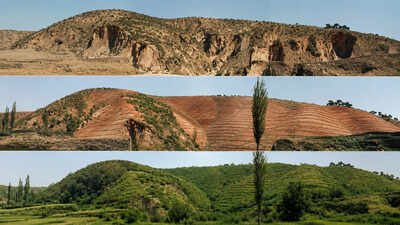
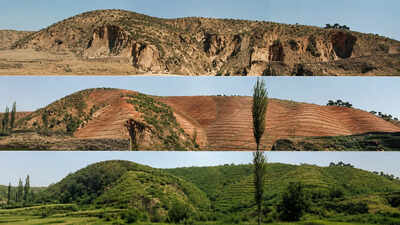
South Korea’s forests were in an exceptionally poor condition after decades of exploitation and the destruction caused by the Korean War. By 1960, the average growing stock had fallen to just 10.6 cubic metres per hectare, compared with about 100 cubic metres per hectare in the early 1900s. Large areas had been stripped of trees, leaving the country’s mountains vulnerable to erosion and communities short of fuelwood.The response was one of the most ambitious reforestation efforts of the twentieth century. Beginning on a large scale in 1959, the South Korean government introduced programmes to restore degraded hillsides, control erosion and increase supplies of wood. Over the following decades, more than 12 billion trees were planted, while more than 4.5 million hectares were reforested between 1962 and 1992. The result was a dramatic transformation. What had once been heavily degraded mountains gradually became some of the country’s defining green landscapes.
The enormous planting campaign that changed South Korea’s hillsides
Rebuilding the forests required more than simply putting seedlings into the ground. The government selected fast-growing species that could establish themselves on degraded land, including Japanese larch, pitch pine and poplar, alongside species such as black locust and alder that could help improve soil conditions.The scale was extraordinary. According to Don Koo Lee, Ho Sang Kang and Yeong Dae Park, authors of the 2004 study Natural restoration of deforested woodlots in South Korea, approximately 12 billion trees were planted over 31 years as part of the country’s reforestation drive.The campaign also evolved over time. Early planting concentrated heavily on fast-growing species that could stabilise damaged hillsides and provide fuelwood. Later programmes increasingly considered the commercial value of forests, introducing species such as Korean pine and Japanese larch.This approach helped restore forest cover on a scale that would have been difficult to imagine in the years immediately following the war.Why planting trees was only one part of South Korea’s forest recoveryThe country’s transformation was not achieved through planting alone. Forest protection became increasingly important as South Korea developed economically and households gradually moved away from relying heavily on wood for fuel.The government’s national reforestation plans introduced clearer targets, stronger forest management and greater coordination between different parts of the state. Research on South Korea’s forest transition has found that the major increase in forest growing stock began in the early 1970s, when government-led reforestation policies were combined with measures that reduced dependence on firewood.That distinction matters because newly planted trees can easily be lost if forests continue to be cut faster than they grow. South Korea’s recovery depended on giving those young forests enough time and protection to mature.
The forests did not simply return to their old state
There is an important complication behind South Korea’s extraordinary success story. Planting millions or billions of trees does not automatically recreate the forest ecosystem that existed before widespread degradation.The 2004 study by Lee, Kang and Park, published in Forest Ecology and Management, examined what happened inside several reforested areas and found that naturally regenerating native species were beginning to replace some of the trees originally planted by people.In areas planted with species such as pitch pine, black locust and alder, oak species naturally regenerated. In other parts of the country, plantations of Korean pine and Japanese larch were also being replaced in some locations by native Korean red pine and oak.The researchers therefore found evidence that natural regeneration could gradually reshape some plantations, although management such as thinning and tending remained important where forests were intended for timber production.
From 10.6 cubic metres of timber per hectare to a dramatically greener landscape
The numbers show just how far the country travelled. When South Korea’s forests were at their most severely degraded, average stock volume had fallen to 10.6 cubic metres per hectare in 1960. By 1999, after decades of reforestation, the figure had risen to 60.3 cubic metres per hectare, while annual growth had reached about 2 cubic metres per hectare.The longer-term transformation was even more striking. South Korean forest statistics show that growing stock reached roughly 29 times the 1953 level by 2020, reflecting decades of planting, protection and forest management.The change is therefore not simply about how many trees were planted. It is about the accumulation of living forest over several generations.Why South Korea’s reforestation success is more complicated than it first appearsSouth Korea is now frequently presented as a model for countries seeking to restore degraded landscapes, but its experience also shows why reforestation cannot be reduced to a simple tree-counting exercise.The early plantations often had simplified species compositions and structures because the priority was to establish forests quickly on severely degraded land. Lee, Kang and Park specifically noted these problems in their study, pointing out that large-scale planting had produced relatively simplified stands.What followed was a gradual transition. As planted forests matured, natural regeneration began altering some stands, while forestry practices continued to influence how others developed. The country’s experience therefore illustrates two different stages of restoration: first getting trees back onto barren hillsides, and then managing those forests as living ecosystems.
The real test is what happens to these forests next
South Korea’s achievement is remarkable because it unfolded within the span of a few generations. More than 10 billion trees were planted, millions of hectares were reforested and the amount of standing timber increased dramatically from the post-war low.But the next chapter is different from the one that began after the Korean War. The challenge is no longer simply to make the mountains green. It is to maintain healthy, diverse and resilient forests as the trees planted decades ago mature, climate conditions change and demands on forest resources evolve.That is perhaps the most important lesson from South Korea’s experience. Reforestation does not end when a landscape turns green. The harder task is ensuring that those forests continue to develop, regenerate naturally and remain capable of supporting people and ecosystems for generations to come.