









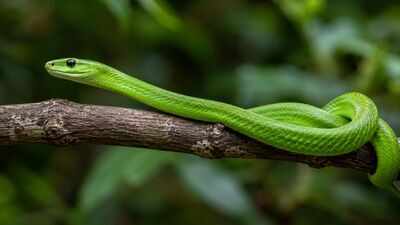
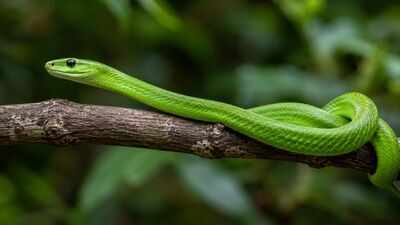
A green mamba specimen from São Tomé Island that dates back to 1885 has been found after decades of being regarded as lost, which gives scientists a rare opportunity to revisit the identity of one of the Gulf of Guinea’s most mysterious snakes. Adolfo Möller found the specimen during an expedition to the island, after which zoologist Jacques Vladimir von Bedriaga examined it. According to the study published in Bio One Digital Library titled ‘The materialization of a ghost: redescription of Bedriaga’s ‘lost’ specimen of Green Mamba (Elapidae: Dendroaspis) from São Tomé Island’, researchers eventually found the specimen in the collections of the Museum and Institute of Zoology of the Polish Academy of Sciences in Warsaw. Its significance became even clearer because other historical specimens from São Tomé had disappeared, which leaves fewer clues to resolve the snake’s identity. The preserved mamba now allows scientists to examine its physical features and revisit more than a century of conflicting classifications.
The ‘ghost’ green mamba was hiding in a Polish museum for decades
The snake was found by Adolfo Frederico Möller between May and September 1885 during an expedition to São Tomé. Möller was primarily a botanist, but he also gathered zoological specimens during his work on the island. According to the study, the green mamba was later examined by Jacques Vladimir von Bedriaga, who described the specimen in the early 1890s. Two other historical green mamba specimens from São Tomé were also lost during the Second World War, leaving researchers with little surviving material to investigate the identity of the island’s mysterious snake. That changed when scientists reviewed natural history collections containing specimens from São Tomé and Príncipe and came across Bedriaga’s mamba in Warsaw. The specimen was preserved under catalogue number MIZ 73634 and had remained in the collection despite being considered lost.
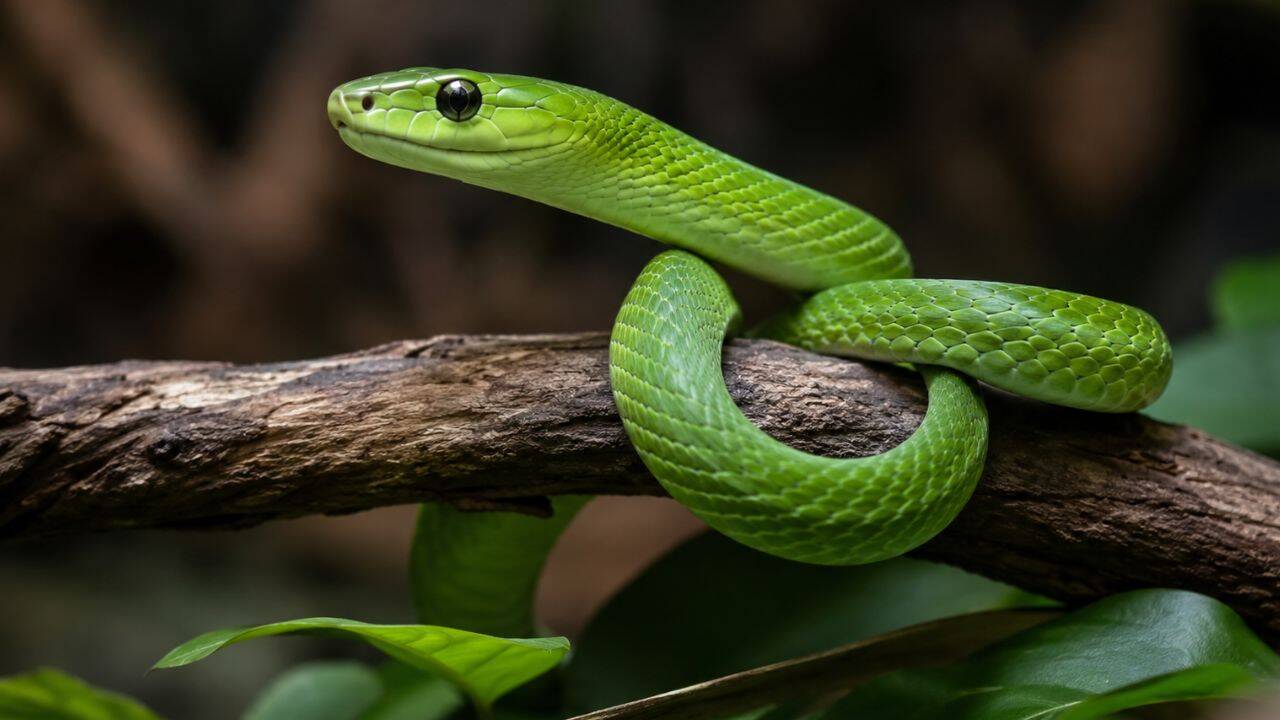
PC: AI Generated
Why the identity of São Tomé’s mysterious green mamba remained a mystery
The identity of the São Tomé green mamba has remained difficult to establish because there was very little historical material available. Bedriaga originally identified his specimen as Dendroaspis angusticeps, the eastern green mamba. Portuguese zoologist José Vicente Barbosa du Bocage later assigned it a different identity, while Johann Georg Fischer had earlier placed another São Tomé specimen in a proposed new genus. The rediscovery of Bedriaga’s specimen has now changed that. Scientists were able to examine its scales, measurements and other external features and compare them with recognised Dendroaspis species. The specimen showed considerable morphological similarity to the western green mamba, Dendroaspis viridis.
What the rediscovered specimen revealed about the mysterious snake
The re-examination also helped explain several unusual features noted in earlier descriptions. Bedriaga had recorded an unusually low number of subcaudal scales and described what appeared to be a scale covering the tip of the tail. The specimen also showed signs of an injury near the abdomen, which researchers said was consistent with the snake that was being shot from a tree before it was preserved. Its scale counts and body proportions were within the ranges documented for Dendroaspis viridis. These physical characteristics strengthen the connection with the western green mamba while also helping explain some of the unusual details in the earlier descriptions.The rediscovered specimen may answer one question about São Tomé’s mysterious green mamba, but it raises another: could the snake still survive on the island? The study does not establish that a living population remains there, and recent searches have not produced fresh specimens. The researchers note that an arboreal snake can be difficult to detect in forested habitats, leaving its present status uncertain.