







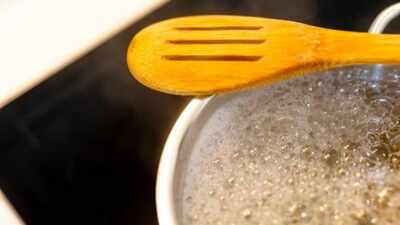
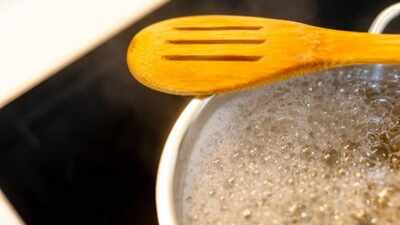
Anyone who’s ever walked away from a pot of pasta water for thirty seconds too long knows the particular panic of hearing that telltale hiss and sizzle as foam races over the rim and onto a hot stove. A trick that’s been doing the rounds on social media for years claims to fix this with almost nothing, just balance a wooden spoon across the top of the pot, and the boil-over supposedly stops in its tracks. It sounds like exactly the kind of thing that shouldn’t work, and yet, according to actual kitchen science research, there’s genuine physics behind it. There’s also an important catch worth knowing before you rely on it completely.Why plain water never actually boils overHere’s a detail that surprises most people: a pot of pure, plain water boiling rapidly generally won’t rise up and spill over the sides, no matter how vigorously it bubbles. The real culprits are the starches and proteins in whatever you’re actually cooking, pasta, rice, porridge, or milk are the classic offenders. When these molecules come into contact with boiling water, their structure changes in a way that stabilises the bubbles forming at the surface, letting them build into a thick, resilient foam that climbs higher and higher until it eventually spills over the edge, something plain water’s simpler, weaker bubbles rarely manage to do.What’s actually happening when the spoon touches the foamThis is where the wooden spoon earns its reputation. As rising foam bubbles reach the spoon and make contact, two things work together to burst them. Wood is a genuinely poor conductor of heat, meaning it stays noticeably cooler than the boiling liquid around it, and when a hot bubble touches that cooler surface, the steam trapped inside it condenses rapidly, causing the bubble’s wall to collapse. At the same time, dry wood has a slightly rough, porous surface texture that physically disrupts the surface tension holding each bubble together, popping it much like a pin would. Once one bubble bursts near the spoon, it tends to trigger neighbouring bubbles to collapse too.Why the trick eventually stops workingThis is the part worth being honest about, since it’s exactly where the viral version of this hack oversells itself. The spoon’s cooling and bubble-popping effect genuinely works, but it doesn’t last indefinitely. As the spoon sits over the pot, it gradually absorbs moisture and heats up from repeated contact with hot foam, and once it’s warm and waterlogged, it loses both of the properties that made it effective in the first place. In practice, this means the trick reliably buys you extra time, often somewhere in the range of thirty seconds to a couple of minutes, rather than preventing a boil-over indefinitely if you walk away and forget about the pot entirely.Getting the most out of itA few small details make a real difference in how well this actually performs. A completely dry wooden spoon works better than one that’s already damp, since dryness is what gives the wood its rough, bubble-popping texture in the first place. A flatter, wider spoon or spatula tends to cover more of the pot’s surface than a narrow one, intercepting more rising foam at once. It’s also worth remembering this works specifically as a delaying tactic rather than a total fix, genuinely useful for buying time while you turn down the heat or grab a bigger pot, rather than something to rely on completely unsupervised.What to do if it’s already boiling overIf foam is already climbing the sides of the pot and a spoon isn’t handy, a quick, direct puff of breath blown across the bubbling surface can knock the foam back down in the moment, a trick some professional cooks reach for even more readily than the spoon itself. Beyond emergency fixes, the more reliable long-term prevention comes down to basics: using a larger pot that gives foam more room to rise before it reaches the rim, and lowering the heat slightly once a rolling boil is reached, since a gentler boil produces far less aggressive foaming to begin with.A real trick, with real limitsThe cooling and bubble-disrupting effect is genuine and has held up under actual scientific scrutiny. What it isn’t is a permanent, walk-away solution, its effectiveness fades as the spoon warms up and gets wet, which makes it best used as one part of a broader approach rather than the only thing standing between you and a messy stovetop.Disclaimer: This article is intended for general informational purposes only. Always exercise caution around boiling liquids and hot stovetops, and never leave a pot unattended for extended periods, even with preventive measures in place.