






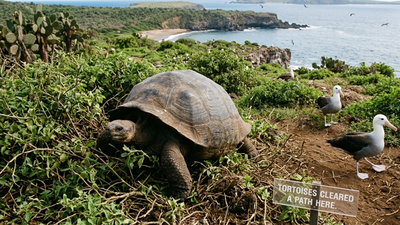
On Española, one of the smaller islands in the Galápagos, the landscape is being reshaped by animals that spend much of their time moving slowly through it. Giant tortoises push through grasses, knock down vegetation and leave broad paths behind them as they travel. Their effect is easy to miss if viewed as ordinary grazing. Across the island, though, those movements can determine which plants dominate, where open ground remains and whether there is enough clear space for one of the Galápagos’ most distinctive seabirds to get airborne.The tortoises are returning to a place where they once disappeared almost completely. Their recovery is changing more than the fortunes of their own species.
How Española’s tortoises came back
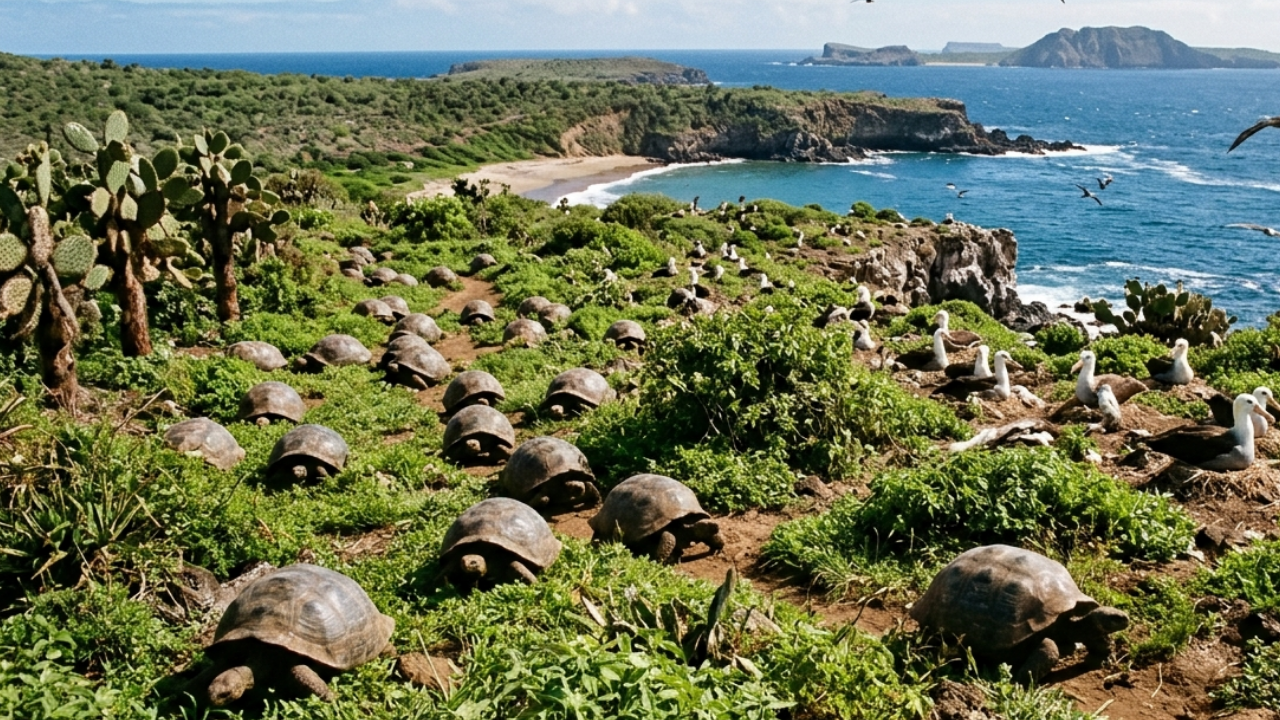
Española once supported thousands of giant tortoises. Human visitors altered that balance badly. Pirates and whalers hunted the reptiles for food during the 19th Century, while goats introduced to the island escaped into the wild and multiplied. Their grazing stripped native vegetation and left much of the island in poor condition.As reported by the BBC, by the 1970s, only 14 Española tortoises remained, 12 females and two males. Conservationists removed them for a breeding programme at the Darwin Research Station on Santa Cruz Island, where the population could be protected and increased.Diego later became an important part of the effort. The male tortoise had been living at a zoo in San Diego before being brought into the breeding programme. He produced hundreds of offspring and helped push the population towards recovery. In 2020, after decades of breeding work, he returned to Española.There are now around 3,000 tortoises on the island, and their presence is beginning to be visible in the vegetation.
How tortoises create space for albatrosses
A giant tortoise does not need to set out with the intention of restoring a habitat. Its normal routine is enough.The animals consume large quantities of vegetation, but they also push through plants that are not eaten. Their heavy bodies flatten smaller growth and create open patches as they wander. Over time, thousands of these movements can alter the structure of the ground beneath them.That matters on Española because the island is home to the waved albatross, a critically endangered seabird that breeds almost entirely in the Galápagos. The birds are awkward on land compared with their effortless flight over the ocean. Their wings can stretch to roughly 2m, so getting airborne requires a clear stretch of ground from which they can run. Historically, tortoise activity helped keep these spaces open.When the tortoises disappeared, shrubs and other woody vegetation were able to spread into areas that had previously remained more open. The vegetation gradually became denser, leaving less of the unobstructed ground that the albatrosses need.The return of the tortoises is reversing some of that change. A 2023 assessment of Española’s vegetation found signs of declining woody plants and a return of more open savanna habitat, consistent with the growing influence of the tortoise population.
What happens when thousands of tortoises roam
The animals also move nutrients around the island in less obvious ways. Galápagos giant tortoises regularly enter muddy ponds to cool themselves. Several animals can gather in the same water, sometimes sharing the pools with birds and other wildlife. As they enter, they carry material from the surrounding land into the ponds. They also leave waste in the water, adding nutrients and altering the conditions for aquatic organisms.When they climb back out, the process works in the opposite direction. Mud sticks to their bodies and dries on their shells and skin before eventually being carried elsewhere. A single tortoise can transport a substantial amount of soil in this way. With thousands of animals repeatedly travelling between land and water, the movement adds up.
The hidden role of tortoises in plant dispersal
Tortoises are also long-distance couriers for plants. They eat fruits and other vegetation, then continue walking while seeds pass through their digestive systems. Some seeds can remain inside a tortoise for weeks, allowing them to be deposited far from the plant that produced them.This changes where plants can establish themselves. Seeds that fall directly beneath their parent plant face competition from existing vegetation and other seedlings. A tortoise carrying them elsewhere gives some of them a chance to reach a different patch of ground.The same pattern can benefit endemic Galápagos plants, including the Galápagos tomato. The tortoise is, in effect, moving pieces of the island’s vegetation around as it travels.
How tortoises help restore other landscapes
The ecological work performed by giant tortoises is not unique to Española. In North America, gopher tortoises excavate extensive burrows that become shelter for many other animals. The reptiles’ digging provides underground refuges that can later be occupied by species ranging from burrowing owls to the Florida mouse and eastern indigo snake.On islands in the Indian Ocean, conservationists have used giant tortoises to restore ecological functions that disappeared when native tortoise species were lost.At the Ebony Forest reserve in Mauritius, Aldabra giant tortoises have been introduced partly because they can graze invasive grasses while allowing native plants to develop. Their movement also creates areas of shorter vegetation, changing the shape and density of the grass rather than simply removing it.The tortoises’ appetite has another consequence. They move between forest and open ground, and that movement carries seeds with them.