







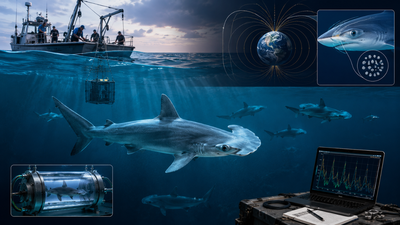
Twenty bonnethead sharks were given an unusual test at a Florida State University laboratory in 2021: could they tell where they were by reading Earth’s magnetic field? The young sharks, caught in the Gulf of Mexico, were placed in a tank where scientists recreated the magnetic conditions of different locations hundreds of kilometres away. When the field was altered to resemble a place about 600 kilometres south of where they had been caught, the bonnetheads turned in a direction consistent with heading back towards their original location. They did not show the same response when the researchers simulated a magnetic field found in the north. The scientists’ evidence suggests that bonnetheads may use differences in Earth’s magnetic field as a kind of map, rather than relying on it only as a compass. The finding also raised questions about how sharks learn, store and use magnetic information as they move through the ocean.
How scientists tested bonnethead sharks’ ability to read Earth’s magnetic field
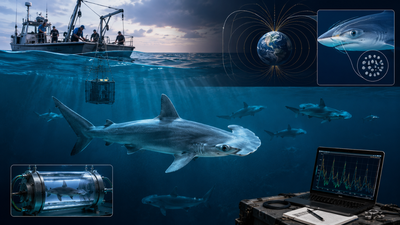
According to the study published in ScienceDirect, titled ‘Map-like use of Earth’s magnetic field in sharks’, the experiment involved 20 juvenile bonnethead sharks collected from Turkey Point Shoal in the Gulf of Mexico. They were taken to the Florida State University Coastal and Marine Laboratory, where researchers could manipulate the magnetic conditions around an experimental tank.According to the study, the sharks were exposed to three different magnetic environments. One reproduced the magnetic field at the place where they had been caught as the control. The other two represented locations roughly 600 kilometres away: one to the south in the Gulf of Mexico and another to the north in the continental United States. The researchers used equipment known as Merritt coils to alter the magnetic field around the tank while a camera recorded the sharks’ movements.The point was not simply to see whether the sharks reacted to a magnetic field. The researchers wanted to know whether they could interpret a particular magnetic field as a clue to where they were. If the sharks possessed something resembling a magnetic map, being placed in a simulated southern location should make them behave as though they had been moved away from their normal area. The prediction was that they would attempt to correct their position by swimming north.
Bonnethead sharks showed a homeward response to southern magnetic fields
That is broadly what happened when the bonnetheads were exposed to the magnetic field representing a location south of their capture site. The sharks showed a significant preference for a particular direction, one that was consistent with an attempt to return towards the area where they had originally been caught.The southern magnetic treatment produced a “significant, homeward orientation”. The researchers interpreted this as evidence that the sharks could distinguish the magnetic conditions associated with different geographical locations and use that information to decide which way to swim.The result matters because a magnetic compass and a magnetic map are not quite the same thing. A compass can tell an animal which direction it is travelling, but it does not necessarily tell the animal where it is. A map-like system would allow an animal to recognise differences in magnetic intensity and inclination across the Earth and use those differences as positional information. The bonnetheads’ response suggested that they were capable of something closer to the latter.The experiment was not a case in which the sharks simply responded to every artificial change in the magnetic field. When the researchers simulated the stronger magnetic conditions found about 600 kilometres north of their capture site, the bonnetheads did not show a clear directional preference.That was an important part of the result. According to the study, the sharks showed no significant orientation in the northern magnetic field, which was outside the normal geographic range represented by the animals’ experience. This meant the experiment did not demonstrate that bonnetheads could use any magnetic field anywhere as a universal navigation system.The researchers offered several possible explanations. The sharks may have been responding most strongly to magnetic conditions that they had encountered during their lives, or perhaps to a range of magnetic information shaped by their evolutionary history. A field stronger than anything they normally experience may simply have fallen outside the useful range of their magnetic map. The authors stressed that further work would be needed to determine exactly how bonnetheads construct and interpret this information.
Why magnetic intensity and inclination matter for shark navigation
Earth’s magnetic field changes gradually across the planet. Two places hundreds of kilometres apart can therefore have measurably different magnetic characteristics. The study focused particularly on magnetic intensity and inclination, rather than treating the field as a simple north-pointing signal.This distinction helps explain why the researchers described their findings in terms of a possible magnetic map. If a shark can recognise that the magnetic field around it resembles the conditions found farther south, it may have some information about its position even when there are no visible landmarks. The study concluded that bonnetheads appeared able to derive spatial information from geomagnetic cues, with the authors writing that the results “suggest that sharks can differentiate geographic locations using map information from the GMF”.For bonnetheads, that ability could be particularly useful because the species is known to return to particular coastal environments. The researchers selected the species partly because it shows site fidelity to estuaries, bays and sounds. A navigation system based on magnetic differences could help explain how an animal maintains a relationship with these places while moving through a changing marine environment.
How magnetic geography may be linked to genetic differences in bonnethead sharks
The Florida experiment was only one part of the 2021 study. The scientists also examined whether magnetic geography might be connected to genetic differences between bonnethead populations.The idea was fairly specific. If sharks tend to recognise and return to places with familiar magnetic characteristics, populations living in areas with different magnetic fields could become more separated over generations. The researchers compared previously published genetic data from bonnetheads in different parts of the north-western Atlantic with differences in magnetic fields, coastal distance and sea-surface temperature.The analysis found that magnetic differences were associated with some of the observed genetic variation. The combination of magnetic differences, temperature and coastal distance accounted for about 43% of the variation in genetic distance in both nuclear DNA and mitochondrial DNA datasets. The authors calculated that magnetic differences uniquely accounted for 12.58% of the variation in the nuclear DNA analysis and 15.83% in the mitochondrial DNA analysis.That part of the research did not prove that magnetic navigation caused the genetic patterns. It instead provided another piece of evidence consistent with the possibility that magnetic geography influences where bonnetheads move and settle. The study treated the relationship as a hypothesis worth investigating rather than a finished explanation.
Scientists caution against treating the shark’s magnetic map as a precise GPS
The phrase “magnetic map” can make the mechanism sound more precise than the experiment actually demonstrated. The sharks were not shown to calculate an exact latitude or longitude, nor did the researchers identify the biological mechanism that allows bonnetheads to detect the magnetic field.What the experiment demonstrated was narrower but still significant: when exposed to a magnetic field corresponding to a familiar type of location south of their capture site, the sharks changed their orientation in a way consistent with trying to return home. They did not respond in the same way to the simulated northern field. The authors therefore cautioned that more experiments are needed to establish how the sharks derive information from the magnetic field and how far they can extrapolate it.The researchers also suggested that the magnetic map of a shark may not need to work equally well in every direction. For a bonnethead living in the Gulf of Mexico, recognising magnetic conditions associated with increasingly southern locations could be more useful than responding to magnetic fields it would never normally encounter. In that sense, the map may be shaped by the animal’s own range and movements rather than functioning like a universal chart of the planet.The 20 bonnetheads tested in Florida therefore offered a glimpse into a navigation system that cannot be seen from the surface. Their movements suggested that the Earth’s magnetic field may provide sharks with information about where they are, not merely which direction they are facing. The study stopped short of explaining exactly how that map is built; it added experimental evidence to the idea that sharks can use the planet’s invisible magnetic landscape to find their way.