








In 1905, a 13-year-old boy exploring Tennessee’s Craighead Caverns squeezed through a narrow, muddy passage and stumbled upon something far larger than he could have imagined: a vast chamber containing an underground lake. His name was Ben Sands, and his discovery would eventually become known as the Lost Sea, today recognised as the largest underground lake in the United States. More than a century later, the cavern remains one of Tennessee’s most unusual natural attractions, with visitors travelling deep underground to see its enormous body of water. The Lost Sea is an American wonder about 140 feet below the surface. The cave itself has an even older history, with evidence of Indigenous use, Civil War-era mining and other human activity. What began with a curious teenager squeezing through an opening has since become a place where geology, history and exploration converge beneath the Tennessee landscape.
Meet Ben Sands, the Tennessee teenager who squeezed through a passage no wider than a bicycle tyre
The story begins deep inside Craighead Caverns, near Sweetwater in eastern Tennessee. According to CBS News’ report, Ben Sands was only 13 when he crawled through a tunnel described by the site’s guide as roughly the size of a bicycle tyre. He travelled through the passage for about 40 feet before emerging into a much larger chamber where water reached around his knees. The chamber was so enormous that the light from his lantern could not reveal its boundaries. Sands apparently had no way of knowing how significant the discovery was. To find out how far the cavern extended, he began throwing balls of mud into the darkness. Instead of hitting a wall or the cave floor, they landed in water, producing splashes in different directions. The discovery was especially striking because the lake had effectively been hidden behind a tiny opening. The official history of the Lost Sea similarly records that Sands entered through a small, muddy opening roughly 300 feet underground and found himself in a huge room partly filled with water. The story also illustrates how different the cave was from the attraction visitors know today. The passage Sands entered was considerably smaller when he found it. The route has since been enlarged, allowing visitors to travel through the cavern safely. What was once an almost inaccessible opening became the entrance to one of America’s most unusual underground attractions.
The Lost Sea is 140 feet underground, but its full extent remains a mystery
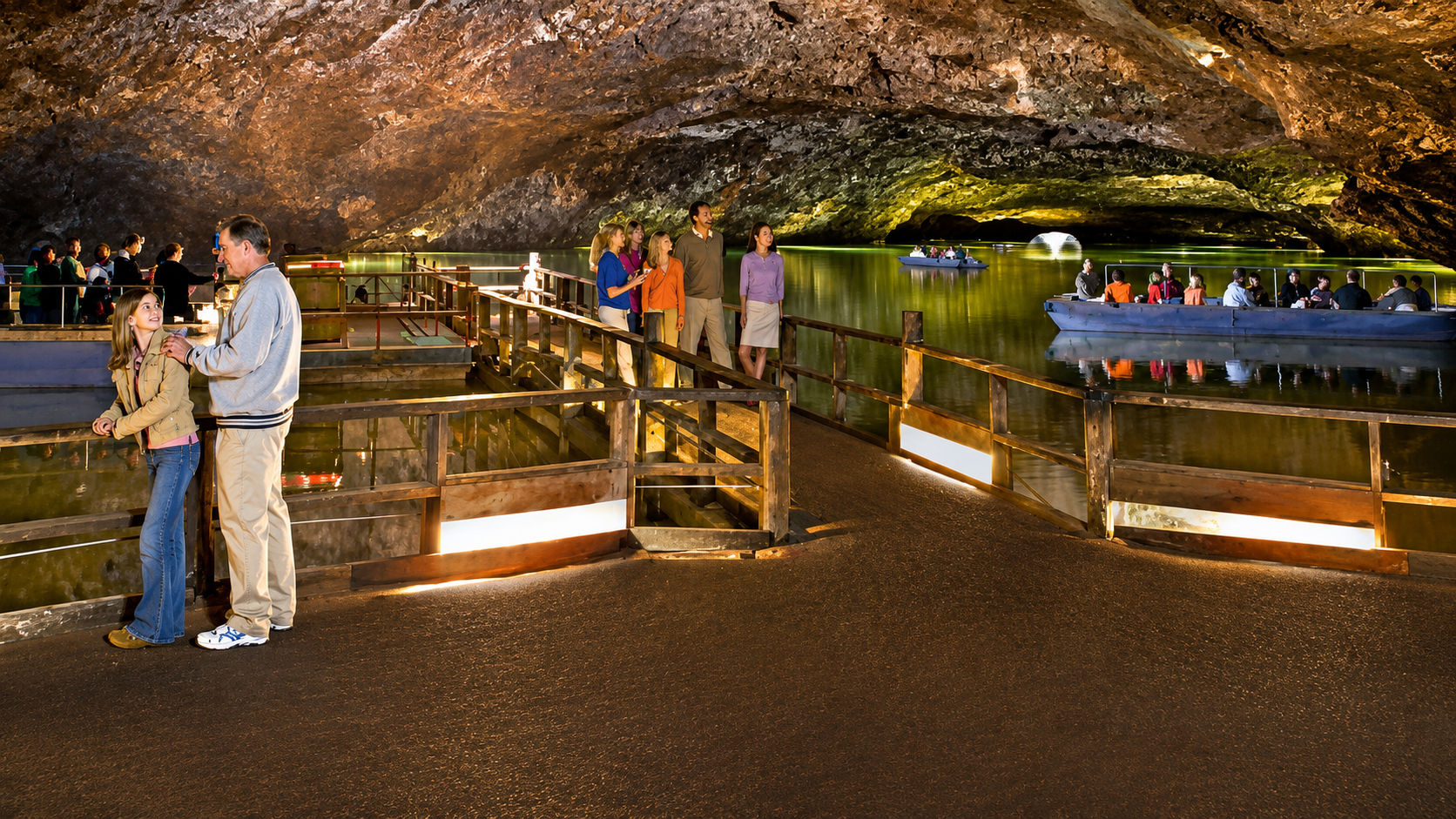
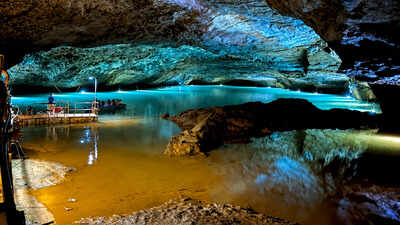
In 1905, a 13-year-old crawled through a tiny Tennessee cave passage and found a hidden underground lake (Image: Tennessee River Valley)
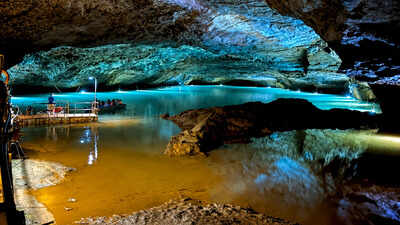
The body of water discovered by Sands eventually became known as the Lost Sea. It sits approximately 140 feet below ground and is part of the much larger Craighead Caverns system. The visible lake covers about 4.5 acres and measures approximately 800 feet long and 220 feet wide, according to information from the Lost Sea attraction. But calling it a “lake” does not fully capture what lies beneath the visible surface. Explorers and divers have discovered additional water-filled chambers extending beyond the main body of water. The Lost Sea’s official records state that more than 13 acres of water have been mapped so far, while the full extent remains unknown. Divers using specialised equipment have explored submerged sections without finding the end of the water-filled system. That uncertainty is part of what makes the Lost Sea unusual. Visitors can see only a portion of a much larger subterranean environment. The lake is at least 70 feet deep and covers around four and a half acres, while modern descriptions of the attraction continue to note that its complete extent has not been established. The Lost Sea is recognised as America’s largest underground lake. The U.S. National Natural Landmarks registry describes the Lost Sea cavern system at Craighead Caverns as containing the largest known underground lake in the country. Craighead Caverns has been designated a National Natural Landmark since 1974.
Before tourists arrived, Craighead Caverns had already witnessed centuries of human history
The underground lake may be the cavern’s most famous feature today, but Craighead Caverns has a much longer human history. The Tennessee State Museum notes that the caves were used by Cherokee people, with archaeological material including projectile points, jewellery and pottery discovered in the cavern system. The cave is named after Chief Craighead, who owned the land in the early 19th century. The caverns later acquired an entirely different role during the Civil War. Confederate soldiers used minerals from the cave to manufacture gunpowder. The official history of the Lost Sea also records that saltpeter was mined inside the cave for this purpose.The cave’s cool and stable environment also made it useful for other purposes. Early settlers used portions of it to store food, taking advantage of the naturally cool temperature. Later, different sections of the cavern were used for activities ranging from entertainment to commercial ventures. There are signs that the cave’s history stretches much further back than human occupation. The Tennessee State Museum notes that fossilised tracks attributed to a prehistoric jaguar, dating to around 20,000 years ago, have been found within the cavern system. Those traces are now part of the attraction’s interpretation of the cave’s ancient past.
From a muddy crawlspace to a boat ride across America’s largest underground lake
For decades after Sands’ discovery, the Lost Sea remained difficult to reach. The tiny passage that had allowed the teenager to enter was not suitable for regular visitors. Eventually, the cavern was developed as a public attraction, with the passage enlarged to make access possible. Today, visitors descend into Craighead Caverns on guided tours before reaching the underground lake. CBS News reported in 2019 that the attraction was drawing roughly 150,000 visitors annually, while the Lost Sea’s current visitor information describes a guided cave tour that culminates in a boat ride across the underground lake. The boats allow visitors to experience the unusual scale of the cavern while remaining on the surface of the water.The lake is also home to rainbow trout. CBS News reported that almost 300 trout lived in the underground water at the time of its visit. The unusual environment affects the fish: because they spend their lives in darkness, the attraction’s guides have observed gradual reductions in both pigmentation and eyesight. Yet the most remarkable aspect remains the scale of what Sands encountered in 1905. He entered through an opening barely large enough for a child to squeeze through and emerged into darkness that seemed to have no visible end. More than a century later, visitors can now travel through the same underground system in relative comfort, but the essential mystery remains: beneath Tennessee’s surface, the water extends into chambers that explorers have still not completely mapped.Ben Sands’ discovery therefore sits at the intersection of childhood curiosity and genuine exploration. A teenager following a tiny opening into the darkness uncovered a hidden body of water that would eventually become America’s largest underground lake and one of Tennessee’s most distinctive natural attractions.