










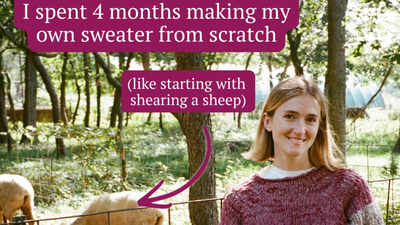
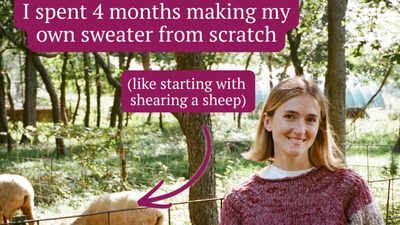
Most of us know where we bought our clothes. We might even remember the brand, the price, and whether we found them online or in a store.But ask how that sweater was actually made, and things get a lot murkier.Content creator Macy Gilliam wanted to change that for herself. So she decided to make a fleece sweater from the very beginning – starting with a sheep and ending, four months later, with something she could actually wear.She called the project “Sheep to Sweater.”It started in May at a sheep farm in New York, where Gilliam collected four pounds of raw fleece from a Merino sheep named Frannie. The wool cost her $48 (Rs 4578).She left the shearing to someone with the proper experience. Everything after that, though, was up to her.And the first step wasn’t exactly glamorous.Gilliam had to sort through the fleece by hand, pulling out dirt, debris and pieces covered in sheep droppings. She then washed the wool in hot water to remove the grease and grime. That process, known as scouring, took about 30 minutes.She also learned a lesson the messy way: don’t pour lanolin down the drain. The waxy substance can clog pipes almost immediately.Once the wool was clean, there was still plenty of work left.Gilliam picked through it again to remove whatever she had missed. One bag alone took her two hours.Then came carding, which separates and aligns the wool fibers so they’re ready to become yarn. Instead of using a modern machine, Gilliam chose a much more hands-on method, pulling the wool between two brushes and repeatedly combing the fibers.After that came drafting – carefully stretching and thinning the fibers so they could move past each other.Then she could finally spin them into yarn.That part took days, even with a modern spinning wheel.The yarn was then wound onto a tool called a knitty knotty to keep it organized, soaked in water and left to dry. Gilliam eventually dyed it using crushed beetles.At that point, she had spent weeks preparing the material and still hadn’t made a sweater.There was another small problem: she’d never knitted before.So she learned.And just when she was getting somewhere, Gilliam discovered she didn’t have enough yarn to finish the garment.That meant starting over and processing more fleece.Four months after she began, she finally had her sweater.The total bill came to $736 (Rs 70300). But the biggest cost wasn’t the wool, dye or equipment. It was time.And that was really the point of the project.Gilliam said the experience gave her a much stronger appreciation for the people who have made textiles by hand for generations. Processes that can now seem almost invisible to consumers were developed, refined and passed down over thousands of years.It also changed how she thought about the people making clothes today.Even a garment produced in a factory still involves plenty of human hands. Someone has to guide the fabric through a sewing machine. Someone attaches the zipper. Someone checks the finished piece for defects.Yet the people doing that work aren’t always paid fairly.After spending four months experiencing just one small part of the process herself, Gilliam came away with a simple message: clothing costs more than the price on the tag suggests.She hopes people will support companies that treat garment workers fairly. But she also wants people to try making things themselves, even if it’s just occasionally.Because once you’ve spent hours turning a pile of dirty fleece into usable yarn, it’s pretty hard to look at a sweater the same way again.Gilliam documented the entire project and created an exhibition where visitors could see and handle the different stages of the process.For her, the project wasn’t really about making the perfect sweater.It was about slowing down enough to understand what goes into the things we normally buy without thinking twice.“We are so separated from the way that things are made that we are incapable of actually appreciating them,” Gilliam said. “So this is my way of reconnecting with the way things are made.”