










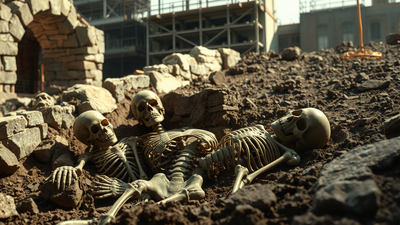
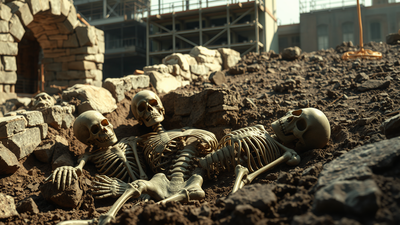
Construction work at Spaanskasteelplein in Ghent has uncovered the remains of a medieval neighbourhood that had been buried for nearly five centuries beneath the site of the city’s former Spanish Castle. The excavation has revealed a cemetery holding more than 200 skeletons, stone church foundations, military quarters, household objects and organic material preserved inside an old waste pit. The find offers a rare, layered look at a district of Ghent that was deliberately destroyed in 1540, after which a fortress was built directly on top of it, sealing much of the earlier settlement beneath its walls for hundreds of years.
Why an emperor ordered this Ghent neighbourhood destroyed
The area now being excavated once stood near St Bavo’s Abbey, before Holy Roman Emperor and Spanish king Charles V ordered the district demolished in 1540. According to VRT NWS, Belgium’s public broadcaster, the fortress was built after the people of Ghent rebelled against higher taxes, and Charles responded by having the rebels walk barefoot through the city with a noose around their neck as punishment, an event that gave the people of Ghent their enduring nickname of noose bearers. The Spanish Castle that replaced the abbey district functioned as a stronghold meant to keep watch over the city’s residents, before it was eventually demolished in the nineteenth century to make way for the Sint Macharius neighbourhood that occupies the site today.
A cemetery holding men, women and children
The excavation uncovered more than 200 skeletons arranged in rows beside the remains of a church, a burial pattern generally associated with a civilian parish cemetery rather than a burial ground built specifically for a fortress garrison. The graves are believed to date from between the thirteenth and sixteenth centuries, placing them before or around the period when the surrounding district was destroyed. Some of those buried may have had ties to religious life at St Bavo’s Abbey, while others likely lived in the neighbourhood and worshipped at the nearby church that once stood alongside the cemetery.
Traces of the soldiers who later occupied the fortress
Above the older medieval layers, archaeologists also uncovered walls belonging to military quarters used during the Spanish Castle period. Lead archaeologist Robby Vervoort told VRT NWS that Spanish soldiers likely stayed in these quarters, adding that plenty of traces point to their presence at the site, though further research is still needed to confirm the full extent of that occupation. Among the richest finds was a cesspit, an underground chamber once used to collect human waste and discarded household material, which Vervoort described as an archaeological treasure trove, noting that objects thrown into pits like this one are often exceptionally well preserved over time.
What the waste pit reveals about daily life at the fortress
According to VRT NWS, archaeologists recovered glass bowls, wine bottle fragments, animal bones, seeds and plant pollen from inside the cesspit. Vervoort explained that animal remains, seeds and plant pollen recovered from the pit should help researchers determine what the soldiers stationed at the fortress actually ate, offering a rare, detailed window into everyday diet and habits within the castle walls centuries after it was built.
Preserved wood and older layers beneath the fortress
Waterlogged soil at the site also preserved a wooden bridge that once crossed the castle’s inner moat. Since saturated ground restricts the oxygen that fungi and microorganisms need to break wood down over time, the same conditions that helped preserve organic material inside the cesspit for centuries. Beneath the medieval layers, archaeologists also found Roman ceramics, metal objects, household pottery and flint tools, indicating that people had been using this same stretch of land long before either the abbey district or the Spanish Castle were ever built.
St Bavo’s Abbey and its long history before the fortress
According to Visit Gent’s official history of St Bavo’s Abbey, the abbey traces its origins back to the seventh century, when Amand of Ghent founded a religious community there as part of an effort to convert the local population to Christianity. The abbey later grew into a larger complex containing a Romanesque church and reached the height of its influence during the eleventh century. Visit Gent notes that part of what is now considered the city’s oldest surviving wall still stands at the abbey site, though the original church itself no longer exists, its outline today marked only by shrubs and a row of hornbeam columns.
What happens to the site now
According to VRT NWS, excavation work at the site concluded in early March 2026, and construction of new apartments is now planned for the property. However, part of the plot will deliberately remain free of basements so that any remaining archaeological material beneath the surface can stay undisturbed. Vervoort described this decision as leaving the untouched section in place for the future, expressing confidence that archaeologists working decades from now will have considerably better tools available to study whatever still lies buried beneath that part of the site.