








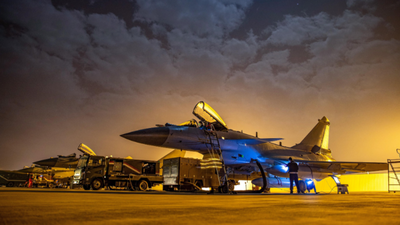
Bangladesh is moving closer to becoming the second confirmed export customer for China’s J-10CE fighter jet, in a development that is being watched closely in New Delhi. A government panel in Dhaka is preparing a draft agreement to open formal negotiations with Beijing for the aircraft. If it goes through, the deal would rank among Bangladesh’s biggest defence procurements in years and further deepen its military relationship with China, already Dhaka’s largest arms supplier.Local media has been reporting that Bangladesh is looking to acquire up to 24 J-10CE jets, with earlier estimates from October last year pegging the cost of the airframes alone at around USD1.2 billion. The complete aircraft package, including weapons, spares and training, will be closer to USD2.2 billion. Payments as per the same reports were expected to be spread across a decade, running until 2035-36, as part of Bangladesh’s broader Forces Goal 2030 modernisation plan aimed at replacing its ageing fleet of Chengdu F-7s and MiG-29s.What makes this development particularly significant is the reasoning behind it. Rahman was candid in pointing to the J-10CE’s performance during last year’s clashes between India and Pakistan, where Islamabad claimed the jet was used to down Indian fighters, claims India continues to dispute. Pakistan remains the only confirmed operator of the export variant so far, having inducted the aircraft in 2022, but the reported combat record appears to have shifted Dhaka’s calculus meaningfully.This is not Bangladesh’s first attempt at procuring a modern fighter aircraft, having been exploring the option since 2024, while also weighing the French Rafale and, more recently, signing a Letter of Intent for the Eurofighter Typhoon. The Bangladeshi air force is seeking a modern aircraft under a programme titled ‘Forces Goal 2030’. The aim of the project is to improve the combat capabilities of the Bangladeshi armed forces across the spectrum. The last aircraft procured by the Bangladeshi air force was the Chinese origin F-7, which itself is a derivative of the MiG-21. The Bangladeshis have not been able to procure a western fighter aircraft due to financial constraints. Bangladesh had in December signed a Letter of Intent with the Italian firm Leonardo to procure the Eurofighter Typhoon.For India, the implications are straightforward but uncomfortable. A second South Asian air force operating the same Chinese jet already in Pakistani service would give Bangladesh its first credible beyond-visual-range combat capability, backed by a modern AESA radar and networked systems, right along India’s eastern border, more crucially along the Siliguri border. It also underscores Beijing’s expanding footprint in South Asia’s defence landscape, with China yet to lock in a second confirmed J-10CE customer anywhere else in the world despite interest from countries including Egypt, Indonesia and Iran, making Bangladesh’s potential purchase a genuine milestone in China’s fighter export ambitions.This move also comes at a time when China’s share of the global defence market has dropped according to a report by Stockholm International Peace Research Institute (SIPRI). China’s defence exports have dropped despite the fact that the global arms procurement has increased in the same time, partially buoyed by increased arms procurement by Europe in response to the conflict in Ukraine. A significant portion of China’s defence exports head to Pakistan, with Bangladesh also having a small share of Chinese exports.