







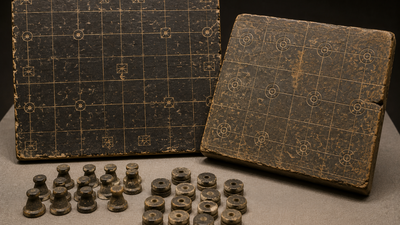
Centuries before chess spread across Asia, another board game captivated people throughout ancient China. Known as Liubo, it was played by emperors, nobles and ordinary families during the Han Dynasty, appearing so frequently that complete game sets were buried alongside the dead. Yet despite its popularity more than 2,000 years ago, the game’s rules have almost entirely vanished. A recent archaeological discovery of rare Liubo game boards carved into Han Dynasty tombs has renewed interest in one of China’s greatest historical mysteries. The find not only highlights the game’s importance in everyday life and burial traditions but also underscores a remarkable paradox: archaeologists know what the board looked like, what pieces players used and where the game was played, yet no one can say with certainty how a match actually unfolded.
Rare Liubo game boards discovered inside Han Dynasty tombs
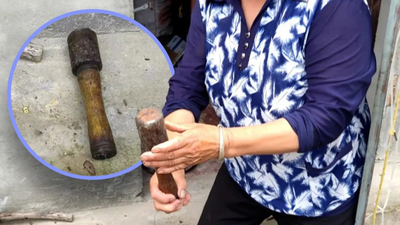
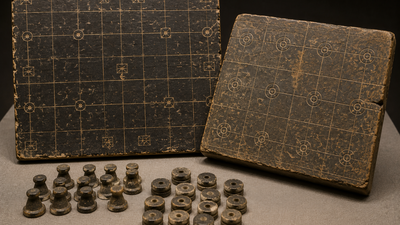
Archaeologists identified two Liubo boards engraved directly onto square bricks inside Han Dynasty tombs dating to around 2,000 years ago. The discovery formed part of a larger excavation that also revealed pottery figurines, ceramic vessels and other funerary objects.Although Liubo boards have been discovered before, archaeologists rarely find them preserved in their original burial context. Their placement inside tombs suggests the game held lasting significance beyond recreation. During the Han Dynasty (206 BCE–220 CE), objects interred with the deceased often reflected activities or possessions considered valuable in the afterlife.Evidence from the Metropolitan Museum of Art supports this interpretation. Its well-preserved Liubo Board and Pieces, dating from the 1st century BCE–1st century CE, includes gaming pieces made from earthenware and bone. The museum notes that Liubo was “a popular game in the Han dynasty” and that such sets embodied wishes for the continuation of life after death.
What was Liubo, and why are its rules still unknown
Liubo emerged no later than the Warring States period and remained one of China’s most widely played board games for several centuries before gradually disappearing after the Han Dynasty.Players competed on a square board decorated with a distinctive TLV pattern, using gaming pieces and throwing six casting sticks or, in some versions, dice, to determine movement. Beyond these basic elements, certainty quickly disappears.In his influential study, ‘A Tricky Game: A Re-evaluation of Liubo Based on Archaeological and Textual Evidence,’ Dr Armin Selbitschka of Ludwig Maximilian University of Munich argues that modern scholarship has often overstated the game’s supposed mystical or divinatory nature. After examining archaeological discoveries alongside surviving historical texts, he concludes that Liubo was primarily a game of entertainment, even though symbolic and religious associations emerged in certain regions during the later Eastern Han period.Crucially, no ancient instruction manual explaining the rules has survived. Historians have proposed several reconstructions based on excavated boards, gaming pieces and literary references, but none has achieved scholarly consensus. As a result, Liubo remains one of the few major ancient board games whose equipment is well documented while its gameplay remains largely unknown.
Archaeology suggests Liubo was played at banquets as well as in tombs
The new discovery fits a broader archaeological pattern seen across Han Dynasty China. Selbitschka’s research examined dozens of excavated tombs containing Liubo equipment and found that game boards frequently appeared alongside food vessels, drinking cups, musical instruments and figurines. Rather than representing isolated ritual objects, these groupings resemble scenes of banquets and social gatherings recreated inside tombs.The study argues that Liubo occupied an important place in elite entertainment. Historical writings by authors such as Sima Qian also refer to the game in descriptions of court life, competitions and leisure, reinforcing archaeological evidence that it was a familiar pastime rather than an obscure ceremonial practice.This interpretation contrasts with older theories that viewed Liubo mainly as a tool for divination because of the board’s distinctive TLV design. According to Selbitschka, archaeological evidence indicates that recreational play remained its principal role throughout most of the Western Han period.
Why Liubo remains one of archaeology’s greatest unsolved puzzles
Few ancient games present such an unusual challenge to historians. Archaeologists have uncovered exquisitely crafted lacquered boards, ceramic playing pieces, bronze fittings, carved stone examples and complete Liubo sets from royal mausoleums, aristocratic burials and Han Dynasty tombs across China. Museums, including the Metropolitan Museum of Art, preserve these remarkable artefacts. Paintings, stone reliefs and funerary objects even depict people gathered around Liubo boards, confirming that it was far more than an obscure pastime.A carved board inside a Han Dynasty tomb or a complete gaming set recovered from an ancient burial may appear modest compared with spectacular treasures of gold or jade, yet each provides another clue about a game that dominated Chinese society for centuries before disappearing almost completely by the end of the Tang Dynasty. Future excavations may eventually uncover an illustrated manual, an inscribed game board or a more detailed written account capable of solving the mystery.Until then, Liubo remains one of archaeology’s most intriguing unsolved puzzles. It is a rare example of a game whose equipment, artwork and cultural significance have survived for more than two millennia, while the knowledge required to play it has quietly slipped out of history.