










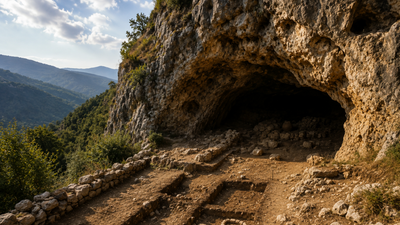
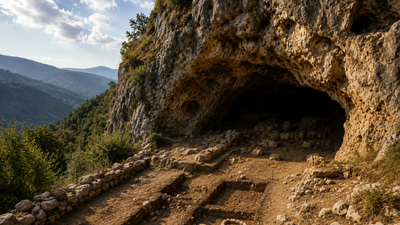
In 2019, researchers identified Koskarlı Cave near Trabzon, in Türkiye’s eastern Black Sea region. According to a study published in the journal Antiquity, later excavations at the cave revealed a 12,900-year-old hunter-gatherer layer containing a hearth, stone tools and personal ornaments. The findings provide rare archaeological evidence of human activity in the region during the Epipalaeolithic period, offering researchers a glimpse into the lives and activities of communities that lived there thousands of years ago.The discovery is significant because the cave provides the first systematic archaeological evidence of an Epipalaeolithic occupation in this part of the eastern Black Sea region. The excavated layer contains traces of a fireplace, stone tools and personal ornaments, giving researchers a rare glimpse into how prehistoric people lived in a region that has received comparatively little archaeological attention for this period.
Cave identified in 2019
Koskarlı Cave is located in the Söğütlü Valley, about 40 kilometres south of Trabzon and at an elevation of approximately 1,030 metres above sea level. The cave sits close to the Söğütlü Creek, an important watercourse in the area. According to the Antiquity study, the site was recorded during archaeological surveys in 2019, while systematic excavations began in 2024 under the joint direction of the Trabzon Museum and Karadeniz Technical University.The cave developed within a pyroclastic geological formation. Its location is particularly interesting to archaeologists because the eastern Black Sea region lies at a geographical junction between Anatolia and the Caucasus. This position could have made the area important for the movement of prehistoric groups, technologies and ideas.During the first excavation season in 2024, researchers investigated several areas, including trenches inside the cave and deposits outside it. A total of 16 square metres was excavated in the main trench. The upper deposits contained disturbed archaeological material attributed to different prehistoric periods.Beneath this disturbed material, however, archaeologists encountered something much more significant: an intact occupation layer associated with the Epipalaeolithic period.
A 12,900-year-old living layer
The intact layer was between about 20 and 40 centimetres thick and contained fine grit, ash, carbonised material, burnt sediment and pieces of flint that had been altered by heat. Together, these remains indicate that people had used fire inside the cave.Researchers identified what they interpret as an in-situ hearth, meaning the evidence appears to have remained close to where the original activity occurred rather than being transported from elsewhere. Radiocarbon dating of bone and charcoal placed the occupation toward the end of the 13th millennium cal BC. One charcoal sample produced a date range of 12,916–12,183 cal BC, while a bone sample was dated to 12,413–12,070 cal BC.The dates place the occupation roughly 12,900–12,000 years ago, during the closing stages of the Late Pleistocene and around the transition toward the Early Holocene. The archaeological material also provides clues about the activities carried out inside the cave. Researchers recovered a range of stone artefacts made from differently coloured flint, along with obsidian and a small number of blades made from dacitic rock.The collection includes end-scrapers, backed blades and bladelets, points, perforators, burins and small crescent-shaped tools known as lunates. The presence of cores, blades and knapping debris suggests that at least some tool production took place at the site itself.
Tools, ornaments and regional links
The tools found at Koskarlı Cave are important not only because of their age but also because of their technological characteristics. Researchers found similarities between the assemblage and Epipalaeolithic industries elsewhere in Anatolia, the Levant and the Caucasus. The cave’s position between Anatolia and the Caucasus therefore gives the site particular importance. The similarities in tool-making techniques could help researchers investigate patterns of movement, interaction and the transmission of technological traditions among prehistoric communities.The discoveries also reveal a more personal side of life inside the cave. Among the finds were a grooved fragment of antler and a perforated animal tooth. Researchers interpret these objects as evidence of personal adornment, suggesting that the people who occupied Koskarlı were not simply producing tools and using the cave as a practical shelter but also engaged in forms of personal decoration.Faunal remains and mollusc shells were also recovered, although researchers have not yet completed their identification. Future analysis of animal and plant remains could provide more information about what these hunter-gatherers ate, how they used the surrounding environment and how they adapted to conditions in the eastern Black Sea region.For archaeologists, Koskarlı Cave therefore represents more than an old campsite. The researchers describe it as a new reference point for understanding Late Pleistocene hunter-gatherers in a region where evidence for this period has been comparatively limited. Continued excavations and analysis could reveal more about their technology, subsistence, mobility and connections with neighbouring communities.The cave’s identification during archaeological surveys in 2019 and the later excavations have established it as an important archaeological site for studying prehistoric life in the eastern Black Sea region. The 12,900-year-old layer preserves evidence of hunter-gatherers using fire, making stone tools and wearing personal ornaments, leaving behind traces of their activities that have survived for thousands of years.