











AI is becoming a part of finance but governance has to catch up
What if your next financial advisor is an AI?You could ask how much tax you owe, whether a particular investment is too risky, whether you can afford a home loan, or which financial product suits your needs.For companies, the questions get bigger: Can AI forecast cash flows? Which customers are likely to default? Where is fraud happening? What tax risks are sitting in the books? Which business decision could hurt margins?Much of this is no longer theoretical. AI is moving from being a simple tool used by finance teams to becoming a widely incorporated element through which financial information is analysed, and parts of the work are executed.The scale of the shift was highlighted in KPMG’s 2026 Global AI in Finance report, based on 1,013 senior finance leaders across 20 countries and 13 sectors. Active AI use in finance has more than doubled since 2024, from 30% to 75%, with 76% of organisations now using AI in financial planning.The report also found that 70 per cent of organisations reported improved decision-making quality, 71 per cent faster decision-making and 64 per cent better forecasting accuracy.So what does a world of finance with AI actually look like? Let’s understand it with the help of experts- humans and artificial.
Human view
Major uses of AI
Simplifying numbers
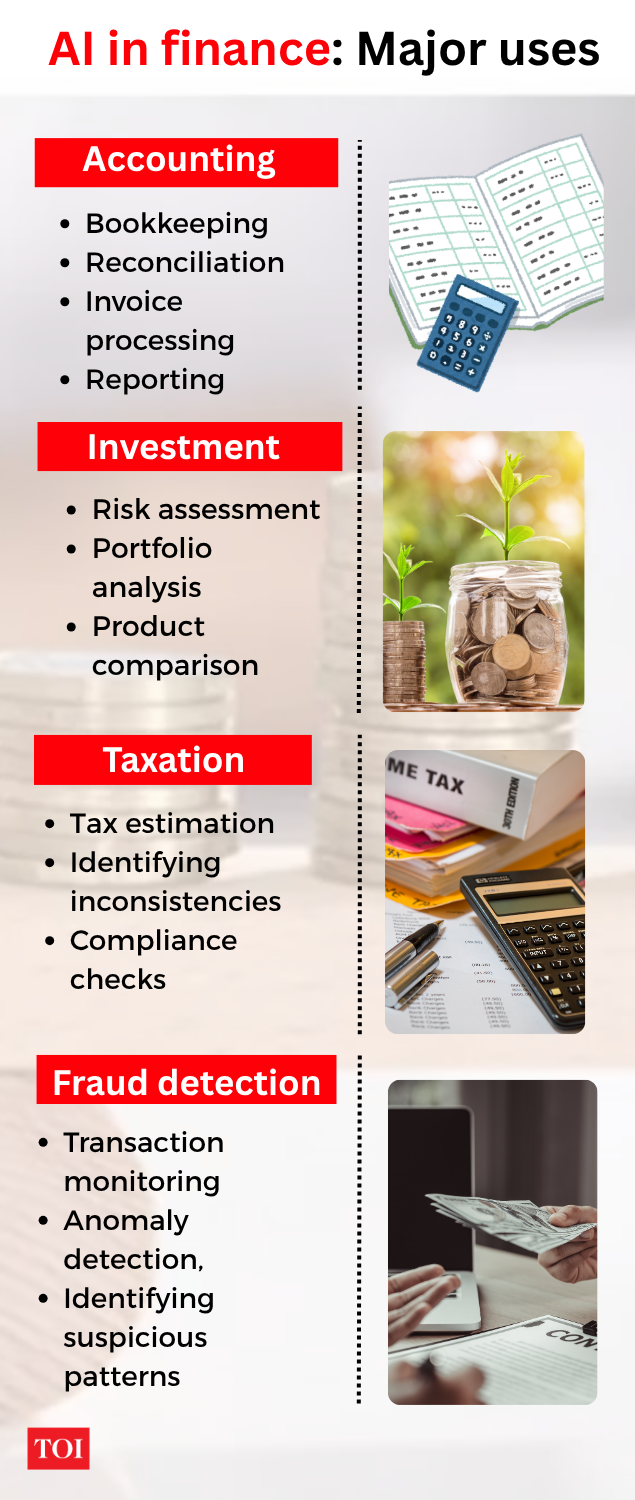
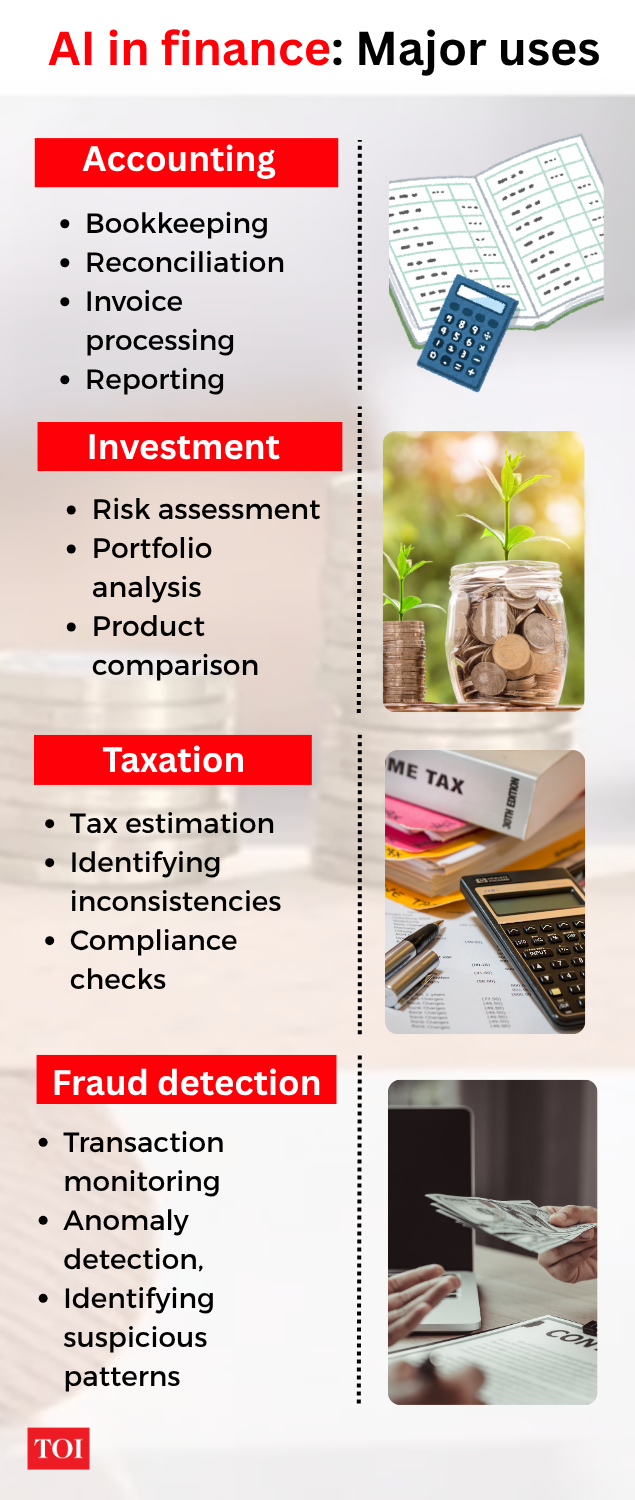
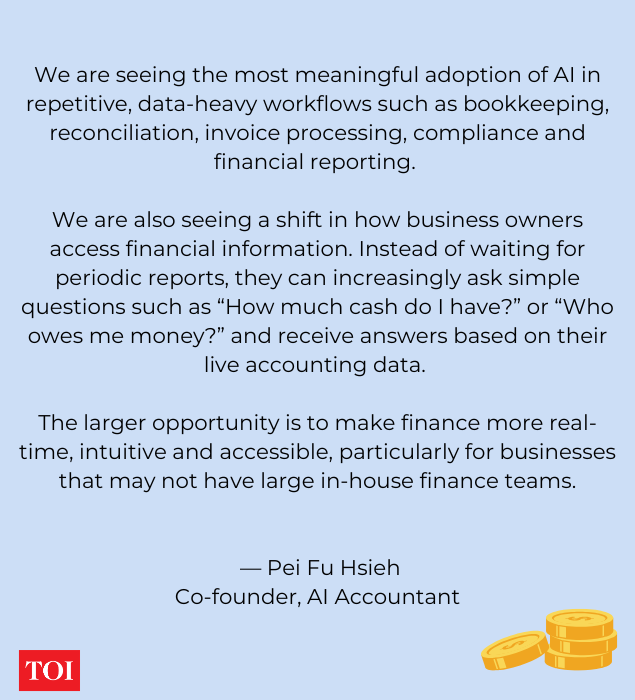
The first layer is the least dramatic but perhaps the easiest to scale: the routine work.AI can increasingly handle data-heavy finance tasks such as bookkeeping, reconciliation, invoice processing, reporting and compliance, identifying anomalies and producing summaries with less human intervention.As Pei Fu Hsieh, Co-founder of AI Accountant, noted, businesses his company works with are already seeing finance teams spend less time on data entry, transaction categorisation and reconciliation. “The gains can be measured through faster processing, fewer manual interventions, quicker book closures and more timely financial information,” he said. Hsieh also sees a larger shift in how businesses access financial information, with owners increasingly able to ask simple questions such as “How much cash do I have?” or “Who owes me money?”.
Ai is being used in bookkeeping, reconciliation, invoice processing, compliance and financial reporting
That changes what a finance team can do with its time. Instead of waiting for information to be compiled, professionals can spend more time on analysis, forecasting, cash-flow planning and business decisions.The same principle applies to an individual. An AI system could take a person’s income, deductions and financial records and help estimate a tax liability. It could explain why the number has changed from the previous year or flag information that appears inconsistent.“The pattern is consistent, and it has an order to it,” said Swaroop Repaka, VP Product at ClearTax. He said the first wave of AI adoption has focused on “tax notices, litigation support and tax research”, while the bigger impact is now emerging in high-volume, rule-bound work based on structured data. But AI’s role remains limited in judgement-heavy areas. “Tax positions, treaty interpretation, transfer pricing: anything that needs a defensible view rather than a fast answer” still requires greater human involvement, Repaka said.Repaka added that the next phase will be about moving from individual tasks to achieving larger goals, with AI potentially enabling continuous monitoring of cash leakage, vendor risk and audit processes. He also said the biggest gains are being seen in areas such as faster reconciliations, higher input tax credit realisation, fewer notices and greater automation, although fragmented data, poorly defined use cases and treating AI as a software licence rather than an operational capability remain key barriers.Thus, there’s an important distinction – an AI system can assist with preparing or understanding a tax position; it does not automatically become the authority responsible for the taxpayer’s final filing.
Financial analysis
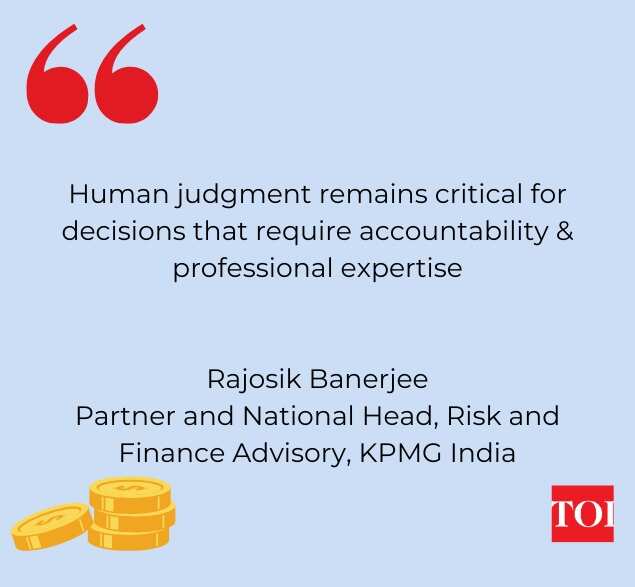
Imagine getting instant answers to questions like: Which investments carry the highest risk? What happens to portfolios if interest rates rise? Can I afford to take on another loan? Which customers are becoming more likely to default?These are questions that require analysing multiple variables rather than simply retrieving information.KPMG Global’s 2026 research suggested this is increasingly where AI is creating value, with timprovements reported in decision-making quality, decision-making speed and forecasting accuracy, rather than just transactional automation.Rajosik Banerjee, partner and national head, risk and finance advisory, KPMG India also highlighted this. “AI is moving beyond automation in finance and becoming a catalyst for process transformation. The strongest adoption is in areas such as reconciliations, invoice processing, financial reporting and planning, where AI can enhance speed, accuracy and insight generation,” he said.Further highlighting need for human intervention, he added, “While organisations are already seeing productivity gains, the greater value will come from redesigning end-to-end finance processes around AI-enabled workflows. At the same time, human judgment remains critical for decisions that require accountability and professional expertise. As adoption accelerates, CFOs must ensure AI operates within a robust governance framework supported by clear accountability, transparency, strong controls and regulatory compliance.“
Human judgement is crucial while using AI
Deloitte’s research this year also showed nearly 40 per cent of Indian respondents reporting significant or full AI use, compared with 28 per cent globally, with India ranked first among 15 countries for AI use in strategic decision-making. But adoption remains uneven, with finance and HR among the functions reporting lower levels of scaled implementation and more organisations saying they have no plans to deploy AI.Meanwhile, Krishna Dev Pathak, an investment banker and advisor to early-stage startups, sees “productivity, accuracy and the ability to process information more comprehensively” as the clearest gains. But he cautions against equating speed with better decisions. In finance, he says, the objective should not simply be to make decisions faster, but to make “better and more accurate decisions with the same or better level of control.”That distinction matters because an AI-generated investment recommendation can look sophisticated while still being wrong or unsuitable. AI can only work with the data it receives, which may itself be flawed, and it cannot fully understand an investor’s needs, goals and preferences.
Financial co-pilot
In wealth management, the emerging model is less about replacing advisors and more about giving them an analytical assistant.Tushar Bopche, co-founder and CEO of InvestValue, called this “HI + AI” — Human Intelligence combined with Artificial Intelligence. AI can analyse thousands of data points, identify patterns and surface relevant insights in seconds, but the human advisor still brings an understanding of a client’s goals, risk appetite, family needs and changing circumstances.As Bopche put it, “AI brings speed, scale, data and analytical capability. Human Intelligence brings judgement, context, trust and empathy.”
Human intelligence with AI combined is the future
The result could be an advisor who spends less time searching for information and more time interpreting it, while AI handles more of the research, product comparison and administrative work. If that reduces the time required per client, advisors could potentially serve more families while offering more personalised advice.
Risk detection, fraud and compliance
Banks and financial institutions can use AI to examine transactions, detect unusual patterns, identify potential fraud and assess risk. In customer-facing operations, AI can also analyse complaints, conversations and feedback to identify problems before they become larger events.Sameer Narkar, Founder and CEO of Konnect Insights, said that banks are increasingly able to monitor customer conversations across social media, support channels and review platforms, identifying complaint patterns, churn signals and emerging customer concerns.The opportunity, he added, is not just operational efficiency but “AI that converts customer intelligence into strategic decisions, not just operational efficiency.” That could give banks earlier warning of reputational problems, customer dissatisfaction or changing demand.Tax and compliance are also similarly moving towards more continuous monitoring, including examining financial records, identify inconsistencies and assist teams in tracking regulatory requirements.
Tough ask: Who controls AI?
Now comes the one of the toughest question to answerIf AI is helping decide whether someone gets a loan, identifying a potentially fraudulent transaction, assessing an investment or preparing a financial statement, who is responsible when something goes wrong?In this context, Animesh Sharma, CTO at Indifi Technologies, argued that AI adoption should be treated as “a governance exercise as much as a technology one” because efficiency gains only compound when the underlying controls can be trusted.For AI-generated outputs that materially affect financial statements, credit decisions or regulatory filings, Sharma said companies should retain human-in-the-loop checkpoints rather than treating automation as fully autonomous from day one.
AI needs oversight
The governance challenge is particularly important because adoption is moving faster than the systems designed to control it. Pallav Chaturvedi, Partner at Deloitte India, cited Deloitte’s research saying while India ranks highly on strategic AI adoption, governance maturity is lagging. Fewer than one in 10 organisations in India currently have the governance structures Deloitte considers necessary for trustworthy AI. At the same time, 92 per cent of Indian executives cite security vulnerabilities as a primary obstacle, while 91 per cent flag privacy risks and 89 per cent cite regulatory uncertainty.Chaturvedi emphasised efficiency should not come at the cost of cybersecurity and privacy, with trust being essential to scaling AI safely.
Deloitte says governance needs to be enhanced when it comes to AI
The regulatory environment is moving in the same direction. The RBI’s 2025 FREE-AI framework says governance should cover the entire AI lifecycle, with model validation, ongoing monitoring and stronger safeguards for higher-risk applications. Its “People First” principle says AI should “augment human decision-making but defer to human judgment”, while its accountability principle makes clear that “Accountability cannot be delegated to the model and underlying algorithm.” The framework also calls for risk-based AI audits and, for high-risk applications such as credit decisions, mechanisms to “stop, pause or unwind AI-driven processes”, alongside human oversight and override mechanisms.Data protection is another layer. India’s Digital Personal Data Protection Act, 2023 and the Digital Personal Data Protection Rules, 2025 create obligations around the processing and protection of digital personal data. For financial institutions handling sensitive customer information, AI deployment therefore sits at the intersection of data protection, cybersecurity, financial regulation and consumer protection.
Who pays if AI loses
Suppose an AI recommends an unsuitable investment, wrongly rejects a loan, misses a fraudulent transaction or produces an incorrect tax calculation that a company relies upon.The answer cannot be: the AI made a mistake.As Rahul Katariya, founder of Divya Financial Services, argued, that important financial decisions cannot be left entirely to a system. “There has to be someone who understands the numbers, checks the result and takes responsibility for the final call,” he said.
AI cannot e trusted blindly
That makes accountability a human and organisational responsibility, even when AI is involved in the process. Companies need clear rules around what AI can do and who is responsible when output proves wrong.It also changes what it means to “check” AI. Companies cannot meaningfully ask whether an AI has good intentions; they have to test its behaviour. That means checking the data it uses, testing outputs against known scenarios, monitoring for errors and bias, maintaining audit trails and tracking performance over time.
AI speaks for itself
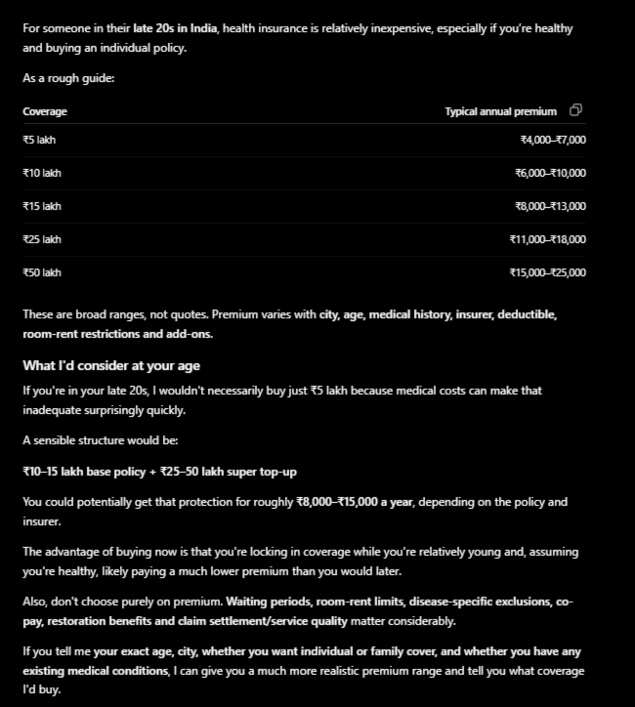
As we understand AI, it becomes crucial to see what AI itself has to say. So, 3 widely used tools – ChatGPT, Grok and Claude were asked for different financial advicesHere’s the rundown of what they said when asked for advice. Different questions were asked to different bots to show what they said.ChatGPTAsked: “If I want a health insurance policy, how much premium will I have to give as someone in their late 20s.”Gave: : A useful starting point, but somewhat generic. It gave me a broad idea of what premiums could look like at my age, suggested a reasonable coverage structure and flagged important factors such as waiting periods, co-pay and exclusions. However, the price ranges were not based on current insurer-specific rates and could give a false sense of certainty. Premiums and suitable coverage vary significantly by city, medical history, policy terms and insurer, so more personalised and verified advice would be needed before making a decision.
ChatGPT’s response
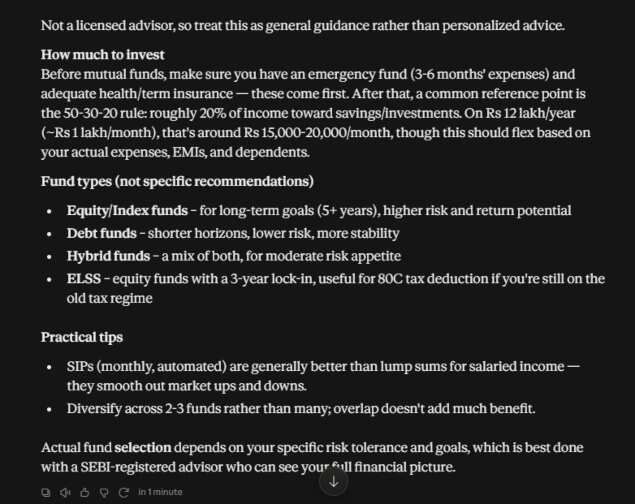
ClaudeAsked: “With an annual income of Rs 12 lakh, how much should one invest in Mutual fund and which one?” (The figure used for example purpose only)Gave: The response stuck to safe, general principles (emergency fund and insurance first, SIPs over lump sums, diversification) rather than pretending to know the specifics, and it was honest about not being a substitute for a real advisor — which matters for financial decisions. It also correctly flagged that ELSS’s tax benefit only applies under the old regime, a detail people often miss. However, It’s still fairly generic — the 20% and Rs 15-20k figures are back-of-envelope, not tailored to actual expenses, debts, or goals. It also didn’t address risk tolerance or investment horizon at all, both of which materially change what “how much” and “which type” should actually look like, and it stayed silent on real trade-offs like expense ratios or direct vs regular plans.Another drawback is the limited response Claude gives in its free version, that might leave the conversation incomplete.
Claude’s response
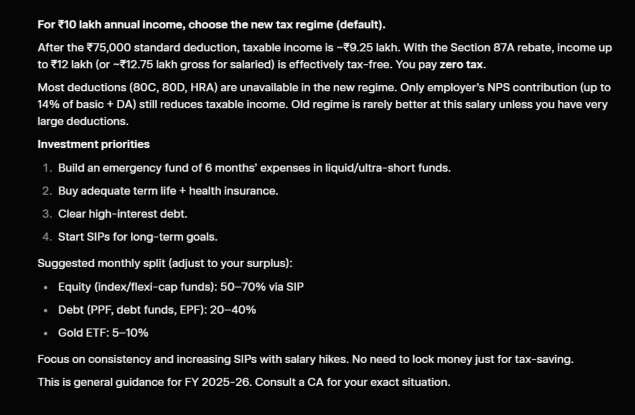
GrokAsked: “I earn Rs 10 lakh a year. How should I plan my taxes and investments?” (The figure used for example purpose only)Gave: It correctly highlighted zero tax under the new regime and a sensible investment priority order. However, it oversimplified by treating all Rs 10 lakh earners the same and omitted any mention of other income sources or state professional tax. It usefully stressed emergency funds and SIPs first, yet the suggested equity-debt split lacked age or risk-profile nuance and could mislead conservative investors.
Grok’s response
All three AI tools offered useful, broadly sensible starting points and avoided making overly aggressive recommendations. However, their advice remained fairly generic, with limited personalisation and important variables often left unaddressed, meaning their responses were better suited for initial guidance than actual financial decisions.
Finance with AI
The likely end state is not a finance department run entirely by machines. It is a layered system.AI handles the high-volume work: bookkeeping, reconciliation, document processing, transaction monitoring and routine reporting.It then becomes an analytical layer: forecasting cash flows, identifying risks, comparing scenarios, analysing investments and surfacing patterns.And finally comes the layer where human judgement remains hardest to replace: deciding what the information means, weighing consequences, understanding individual circumstances and taking responsibility.Thus, the question for finance is therefore no longer whether AI will enter the function. It already has.The question is how far the industry will allow it to go; from answering questions, to recommending decisions, to eventually carrying out parts of those decisions itself, and whether governance, accountability and human judgement can keep pace.