








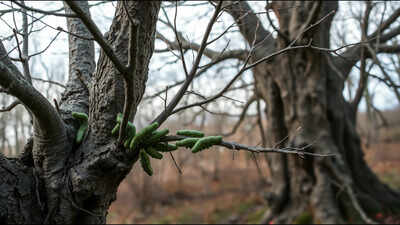
In temperate forests, spring timing can determine whether newly hatched caterpillars find a feast or almost nothing to eat. Many herbivorous insects emerge around the time trees produce their first young leaves, when the foliage is soft and especially nutritious. Now, a study using five years of satellite radar observations across 60 oak-dominated forest sites in southern Germany has found that trees exposed to greater insect herbivory in one year tend to delay their budburst by about 3 days the following spring. That seemingly tiny shift disrupted the timing between emerging caterpillars and newly opened leaves, reducing subsequent herbivory by about 55%. The researchers say the pattern suggests that changing the timing of leaf emergence may function as a form of plant defence, adding another factor to the climate-driven changes already affecting when forests turn green each spring. The finding offers a new example of how plants can respond to ecological threats by changing not what they do, but precisely when they do it.
Why a 3-day delay in leaf growth can leave newly hatched caterpillars without food
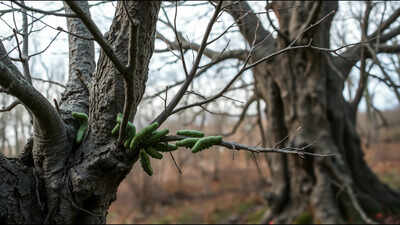
The strategy works by disrupting the synchrony between insects and the trees they feed on. In temperate forests, many leaf-eating insects emerge shortly after budburst, when young leaves are available and highly nutritious. If a tree delays opening its buds, caterpillars can emerge before their food becomes accessible, increasing their chances of dying before the leaves appear. The researchers describe this as an “enemy escape in time”: rather than physically repelling an insect, the tree changes when its vulnerable foliage becomes available.The study found that the 3-day delay was associated with a 55% reduction in subsequent herbivory. The researchers note that experimental studies have found mortality of up to 90% among some herbivores that hatch 3 days before budburst, helping explain how such a seemingly small difference in timing can have a large ecological effect. The paper also compares the effect with chemical defence, noting that achieving a similar reduction in herbivory through increased tannin concentrations would require a substantially larger investment in chemical defence.
How satellite radar revealed oak trees changing their spring timing across a landscape
Earlier research into tree leaf timing relied mostly on scientists tracking individual trees by hand, a method that could never capture patterns across an entire forest landscape. For this study, titled Satellite data show trees delay budburst across landscapes to escape herbivores and published in the journal Nature Ecology and Evolution, researchers instead used Sentinel-1 radar satellites to monitor canopy conditions across 2,400 square kilometres of forest in Northern Bavaria, Germany. Radar was key to the approach because it can capture reliable canopy data even through thick cloud cover, unlike standard optical satellite imagery. Over 5 years, from 2017 to 2021, the team gathered 137,500 separate observations at a resolution of 10 by 10 metres per pixel, roughly the size of a single tree crown, ultimately analysing 27,500 pixels spread across 60 different forest sites.The satellite-derived measures were designed to track both budburst and leaf damage. The researchers validated the approach against optical satellite observations and terrestrial laser-scanning data, allowing them to use radar measurements to identify differences in canopy development and defoliation at approximately individual-tree-crown scale. That made it possible to compare trees that experienced different levels of insect damage and determine whether their spring timing changed the following year.
What the 2019 spongy moth outbreak revealed about the trees’ response
The strongest test came in 2019, when a major outbreak of the spongy moth (Lymantria dispar) occurred across the study region. The outbreak created a particularly useful natural experiment because some sites experienced high herbivore pressure, while defoliation at other sites was experimentally suppressed with aerial insecticide treatment. Researchers could therefore compare how different levels of herbivory were associated with budburst in the following spring.The results showed that trees experiencing greater herbivory subsequently delayed budburst, while the benefit of delaying budburst was greatest in landscapes where the shift most effectively reduced later insect damage. The researchers say this pattern is consistent with an adaptive tree defence, although they stop short of claiming that the study has established the precise biological mechanism by which trees detect previous insect attacks and alter their spring timing.The finding also adds a new complication to the way scientists think about forests under climate change. Warmer springs generally push trees toward earlier budburst, while insect pressure can push them toward later budburst. The researchers argue that these opposing forces could help explain why spring leaf emergence in some forests has advanced less rapidly than expected from warming alone.