








This article is authored by Pratik Kamdar, Co-founder and CEO, Neuron Energy.India’s electric vehicle revolution is often framed as a metro-led transition, with cities like Delhi, Bengaluru and Mumbai dominating the narrative. Yet the real acceleration is unfolding beyond these urban centres. Tier-2 and Tier-3 cities are emerging as the decisive growth engines of EV adoption, driven by practical mobility needs, favourable ownership economics and expanding local ecosystems. What began as early experimentation in metros is now translating into scalable demand in smaller cities, where electric two-wheelers and three-wheelers are becoming integral to daily transport and local commerce.
A Surging Base Beyond the Metros
Recent market indicators reveal a decisive shift in India’s EV adoption curve. Tier-2 cities have seen penetration rise from approximately 4.16% in FY2022 to 10.67% by FY2025, while Tier-3 markets expanded from about 1.69% to 8.68% during the same period. These growth trajectories are outpacing several Tier-1 markets, signalling that EV adoption is no longer metro-centric but is diffusing rapidly across smaller urban clusters. In 2023 alone, EV sales grew by 51% across 70 Tier-2 cities and by 30% across 131 Tier-3 cities, underscoring the scale and consistency of this expansion.Cities such as Surat, Jaipur, Lucknow, Kota and Udaipur are emerging as EV strongholds, in some cases outperforming larger metros in segments like electric two-wheelers. This momentum reflects a broader decentralisation of India’s e-mobility landscape, where growth is increasingly powered by the mobility needs, cost sensitivities and infrastructure realities of smaller cities rather than the consumption patterns of megacities.
Why Smaller Cities Are Leading the Charge
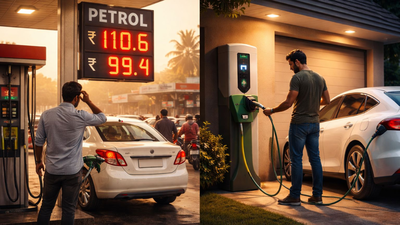
Several factors explain why smaller cities are well-suited to EV adoption, particularly in the affordable segments.1. Cost Economics Fit Local RealitiesEVs, especially two- and three-wheelers, offer compelling economic value in smaller markets. Compared to petrol vehicles that can cost around ₹2–₹2.5 per km, EVs typically run at just ₹0.15–₹0.20 per km. For daily commuters or delivery riders in Tier-2 and Tier-3 towns, this can transform household budgets and business economics, often translating into savings of ₹25,000–₹30,000 annually.2. Charging Works Well with Residential PatternsUnlike densely packed metros with limited personal parking or charging access, smaller cities often have detached homes, easier parking and stable overnight electricity. As a result, many owners can charge EVs at home, reducing reliance on public infrastructure and mitigating typical range anxiety issues.3. Policy Support and Local IncentivesCentral and state-level schemes, including PM E-Drive initiative, production-linked incentive initiatives, tax rebates and road-tax waivers, have effectively lowered adoption barriers in smaller markets. States like Uttar Pradesh, Gujarat and Rajasthan are actively packaging incentives to boost EV sales, particularly for commercial vehicles like e-rickshaws.4. Commercial and E-Commerce LinkagesEV adoption in Tier-2/3 cities is also tied to the expansion of e-commerce and last-mile delivery services. Electric scooters and three-wheelers are attractive for fleets serving logistics hubs or delivery businesses due to their low operating costs and high utility for short-haul trips.
The Infrastructure Backdrop: Opportunity and Challenge
Charging infrastructure, especially public charging, still lags behind EV growth in smaller cities. National figures show that public charging stations are heavily clustered in a few states, leaving wide areas underserved.This gap has created unique opportunities for solar-powered and decentralised solutions, particularly in Tier-2 and Tier-3 markets. Because these towns lie in regions with abundant sunshine, solar-EV charging has emerged as a complementary approach to grid-based stations, reducing operating costs and providing power reliability where grid supply may be inconsistent. Early pilots from standalone solar charging kiosks in Madhya Pradesh to hybrid solar and battery hubs near Bengaluru demonstrate that even small distributed solar installations can support local EV mobility economically.The infrastructure conversation is also widening beyond charging points. Battery localisation and domestic cell manufacturing are gaining traction to reduce import dependence, while battery swapping ecosystems are being tested for high-utilisation segments such as e-rickshaws and delivery fleets. At the same time, distributed storage models, including community battery banks, are emerging as integrated solutions that strengthen both charging access and local energy resilience.Despite this progress, high upfront costs for solar arrays and storage, maintenance demands, and limited awareness among rural stakeholders remain significant barriers. Overcoming these constraints through innovative financing, standardisation, and local capacity-building will be essential to ensuring equitable EV infrastructure growth beyond metropolitan regions.
A Transformative Narrative, With a Long-Term Pulse
The rise of EVs in Tier-2 and Tier-3 India points to a democratised transition in sustainable mobility — one that is driven less by luxury appeal and more by practical economics and everyday utility.Smaller cities are not simply incremental markets; they are proving to be structural growth engines. Their adoption patterns show that EV uptake, particularly in the two- and three-wheeler segments, can scale rapidly when vehicle economics, consumer behaviour and infrastructure align. As this ecosystem deepens, Tier-2 and Tier-3 markets may collectively drive EV penetration in India well beyond current projections, shaping not only national EV targets but also the contours of green transportation policy, infrastructure deployment and manufacturing strategy.In essence, the narrative of India’s electric mobility future is not waiting in the corridors of cosmopolitan metros. It is unfolding on the streets of smaller cities where every commuter journey, delivery route and solar-powered charger creates momentum for tomorrow’s clean mobility pathways.Disclaimer: Views and opinions expressed in this article are solely those of the original author and do not represent any of The Times Group or its employees.