








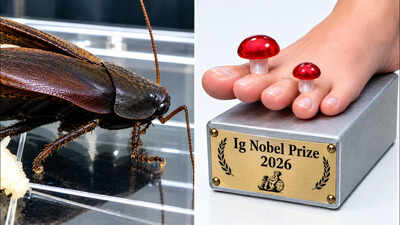
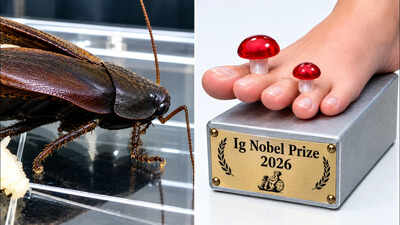
A cockroach producing something resembling milk sounds like an unlikely subject for serious scientific research. Yet one species has developed a remarkably unusual way of nourishing its young. The Pacific beetle cockroach, Diploptera punctata, gives birth to live offspring rather than laying eggs, and its developing young feed on a milk-like secretion produced by the mother. Scientists investigating this substance discovered that it does not remain simply as a liquid inside the young cockroaches. Instead, it forms tiny crystals containing proteins, fats and other nutrients, creating an unusually concentrated food source. The strange discovery has now earned the researchers an equally unusual honour, the 2026 Ig Nobel Prize in Chemistry. Scientists studying cockroach milk were among the research teams recognised at this year’s ceremony for investigations that are humorous at first glance but can reveal genuinely fascinating aspects of science.
The cockroach that feeds its young milk
The Pacific beetle cockroach, Diploptera punctata, has an unusual reproductive strategy, it gives birth to live young and nourishes its developing embryos inside a brood sac. The mother produces a milk-like secretion containing proteins, carbohydrates, lipids and other nutrients. But the remarkable part happens after the embryos consume it. As described in the study ‘Structure of a heterogeneous, glycosylated, lipid-bound, in vivo-grown protein crystal at atomic resolution from the viviparous cockroach Diploptera punctata,’ the milk proteins rapidly crystallise inside the embryos’ midgut. Rather than simply passing through as a liquid meal, they form tightly packed structures that allow the developing young to store nutrients. The embryos can therefore draw on this concentrated reserve throughout development, providing a remarkably efficient way for the mother to supply nourishment before birth.
Tiny crystals contain a concentrated nutritional supply
The crystals are extraordinary because they combine several essential components of the cockroach’s diet in an unusually compact form. The study also found that the structures contain milk proteins with a lipocalin-like fold that bind lipids and assemble into a tightly packed crystalline lattice. A single crystal was estimated to contain more than three times the energy of an equivalent mass of dairy milk. The researchers also found that the crystals are highly heterogeneous, containing differences in their protein sequences, attached sugars and bound fatty acids. This structure allows the cockroach embryos to maintain access to a steady supply of protein, carbohydrates and lipids while they develop inside the mother.
The 2026 Ig Nobel Prize celebrates the bizarre discovery
The research received its unusual scientific spotlight in 2026, when the scientists were awarded the Ig Nobel Prize in Chemistry. The prize is deliberately different from the traditional Nobel awards, recognising research that can make people laugh before encouraging them to think more deeply about the subject. According to PBS, ten research teams were honoured at the 2026 ceremony, covering investigations ranging from cockroach milk to the science of nose-blowing and other unconventional questions. The cockroach study fits the spirit of the awards particularly well. At first, the idea of spending years studying cockroach milk seems amusing. But behind that unusual premise is detailed work examining proteins, crystals and biological nutrition. The award therefore draws attention to how even seemingly bizarre questions can produce legitimate scientific insight.
Why scientists are interested in cockroach milk
The fascination with cockroach milk is ultimately less about drinking it and more about what its molecular structure can teach researchers. The crystals demonstrate an efficient natural method for storing and delivering nutrients, and scientists can investigate the proteins responsible for creating them. Such biological structures can potentially inspire research into protein engineering, biomaterials and other areas where scientists need to control how molecules assemble and store energy. The discovery also illustrates why researchers sometimes investigate phenomena that initially appear trivial or strange. Nature has evolved countless solutions to problems such as reproduction, nutrition and survival, many of which remain poorly understood. The Pacific beetle cockroach happens to provide one particularly unusual example. Its milk-like secretion may never become a human food, but the microscopic crystals inside it have shown scientists that even one of the world’s most disliked insects can harbor surprisingly sophisticated biology.
What the Ig Nobel Prize really says about the research
The Ig Nobel Prize may sound like a joke, but its purpose is to draw attention to research that sparks curiosity. The cockroach-milk study demonstrates exactly why that approach can work. A bizarre question, how does a cockroach feed its developing young? led scientists towards the discovery of nutrient-rich crystals with an unusual molecular structure. This year’s collection of research initially provokes amusement but ultimately invites closer thought. What makes the story memorable is therefore not simply that scientists studied cockroach milk. It is that an apparently strange biological curiosity revealed an elegant nutritional strategy that evolved naturally. The 2026 Ig Nobel recognition gives that discovery a fitting headline, while the underlying science offers the more serious takeaway, some of nature’s most interesting secrets can be found in the creatures we least expect.