








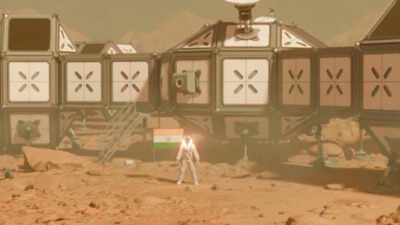
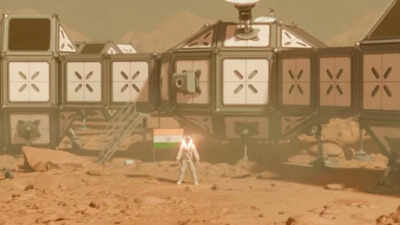
NEW DELHI: Indian astronaut and ISS-returned Group Captain Shubhanshu Shukla has shared details of his academic research project exploring how future Indian astronauts could live on Moon, Mars and other extraterrestrial destinations, proposing a concept called Bharatiya Habitable Expandable Extraterrestrial Habitat (BHEEM).The habitat concept emerged from research undertaken during the Indian leg of Shukla’s astronaut training in Bengaluru, following his return to India in March 2021 from Russia after nearly a year of training with three other astronaut-designates for India’s maiden human spaceflight mission Gaganyaan.Astronaut Grp Capt Shukla, who spent 18 days on the International Space Station during a landmark scientific mission as part of Axiom last year, said on X, “My area of research was extraterrestrial habitats—the technologies and concepts that could eventually allow humans to live and work beyond Earth. That work eventually resulted in BHEEM at the Aloke lab in Indian Institute of Science, Bangalore.”He said that “there are enormous challenges to solve before humans can establish a sustained presence on the Moon, Mars, or other extraterrestrial destinations. From radiation and extreme temperatures to life support, energy, construction and the simple question of where do we live. The first step towards building a habitat on another world may not be laying its first brick. It may simply be daring to imagine what that habitat could look like.”Explaining BHEEM, the Indian astronaut, in his research paper, said, “BHEEM is a modular panel-based extra-terrestrial habitat. The structural rigidity of each module of BHEEM was determined by using numerical analysis and further validated by analytical methods. A single payload of the starship is sufficient to deploy the proposed layout providing twice the volume of the ISS. BHEEM’s modular nature and shape design ensure comfort for astronauts to conduct daily activities while making mission logistics and transportation with payloads of lesser capacities easy. The panel-based architecture allows for easy construction, repair, and maintenance of the habitat.”“We have used Nasa’s ‘RIDGE’ framework to identify the key areas of focus that BHEEM will address, thus establishing our brief for the design. RIDGE identifies five classes of human hazards in space namely space radiation, isolation and confinement, distance from Earth, gravity fields and hostile/closed environments. BHEEM’s design focuses on isolation and confinement and sets an architectural tectonics that can be scaled well with human activities,” his research papers said.“One of the foremost important parameters we considered for an enclosed habitat is the volume that is to be enclosed. This volume allows for all the activities to take place along with the appropriate placement of relevant equipment, furniture, and life support systems. To be able to determine the volume for various activities, we identified the activities that would take place inside the habitat. The activities include tasks such as mission planning, habitat monitoring, or extra-vehicular activity (EVA). Other activities such as meal consumption, exercise, and dedicated hygiene areas are also important and are considered,” it said.Admitting that there is scope of improvement in BHEEM’s design, astronaut Grp Capt Shukla said, “The design presented in the paper is the initial direction to pave the way for India’s extra-terrestrial habitat system. The materiality of the panel design is one of the key areas where substantial future research is planned. Sealing of the habitat within and in between the panels is the next problem that can be tackled. A double redundancy system with soft inflatable could be proposed to be installed inside the outer hard shell once it is deployed.”In the conclusion of his research project, he said, “BHEEM is one of the first steps towards establishing a long-term human base on the harsh extra-terrestrial environments of the Moon or Mars. The habitat has been designed with first principles and using the human-centred design approach. By considering the volume requirement for all activities, the habitat allows for sufficient volume making mission objectives efficient and more astronaut friendly.”“The combination of three types of unique panels and seven types of unique joinery allows for several modules to be made that provide a flexible layout which can evolve during the lifetime of the mission. The modular architecture makes it possible to transport the habitat in rocket payloads of lesser capacity making transportation cheaper and the logistics easie,” he said.