










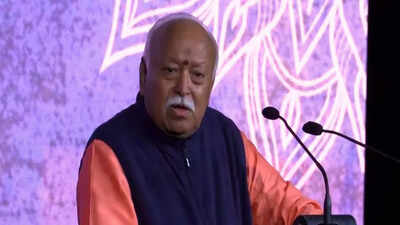
NEW DELHI: Rashtriya Swayamsevak Sangh (RSS) chief Mohan Bhagwat, addressing around 5,000 members of Indian-American organisations at Madison Square Garden in New York, spoke about unity, pluralism, individual responsibility and the obligations of the Indian diaspora, while arguing that material success alone cannot define a fulfilling life.Bhagwat was speaking at the “Universal Oneness Celebration”, organised by American Hindus for Engagement and Dialogue. He framed his address around the idea of “oneness”, drawing parallels between the pluralism associated with the United States and what he described as Bharat’s “unity in diversity”.“When we say America, United States of America, one word is often discussed frequently. That is pluralism,” Bhagwat said. “And when we say Bharat, another word, another phrase is discussed: unity in diversity.”“For Bharat, this unity and diversity, both are in their DNA,” he said.Bhagwat said differences between people were a natural feature of life, but argued that these differences existed alongside an underlying sense of oneness.“So many styles of living. We appear different. We are different,” he said, pointing to differences in people’s everyday needs and circumstances.“But there is innate oneness. That is why we feel for each other,” he added.He described diversity as the “decoration of oneness”, presenting unity not as the absence of differences but as something that exists beneath them.Bhagwat also linked this idea to what he described as the responsibilities of individuals, societies and nations. Nations, he said, should not be seen merely as geographical entities but as having a larger purpose.“These nations are not merely geographical entities. In the design of this universe, nations have to carry out a duty,” he said, quoting Swami Vivekananda’s formulation that every nation has a message, a mission and a destiny.
‘Be true to America’: RSS chief message to diaspora
Turning to the Indian diaspora in the United States, Bhagwat said Indians living abroad had a primary responsibility towards the country where they lived and worked.“So we are Americans, and we should be true to America,” he said.He described this as a duty towards one’s “karma bhumi” — the land where a person lives and works.“The diaspora, Indian diaspora, they have a duty to their karma bhumi. They must fulfill that. They should be loyal to their karma bhumi,” Bhagwat said.At the same time, he said Indians abroad could maintain a connection with Bharat as their “janma bhumi”, or birthplace, and could contribute to the country if they wished to do so after fulfilling their responsibilities to their adopted home.“But it is not obligatory,” he said.Instead, he said, the connection with Bharat should be reflected in the values carried by the diaspora.“Your janma bhumi expects you to live the values it has imparted on you,” Bhagwat said.Bhagwat also questioned the idea that professional success should be measured primarily through earnings and material possessions.“How much we earn is not important. How much we distribute is important,” he said.He asked whether a career could be reduced to money and material happiness, while acknowledging that material aspirations had a legitimate place in Hindu philosophy.“You think of career? Is career only money? Is career only material happiness?” Bhagwat asked.He referred to the four Purusharthas, saying that Artha and Kama represented important material dimensions of life alongside spiritual pursuits.“It is not denied. In four Purusharthas, Artha and Kama are two important Purusharthas related to material life,” he said.Bhagwat also referred to the traditional four stages of life — Brahmacharya, Grihastha, Vanaprastha and Sannyasa — arguing that people acquire different responsibilities as they move through life.“So you have to learn, you have to sustain life, and you have to give the advice, your experience to next generation,” he said.He argued that material abundance by itself could not guarantee fulfilment.“So the material happiness is transient, cannot satisfy,” Bhagwat said. “And if abundance of material happiness is there, it may fail also. And therefore there is no satisfaction.”
Highlights responsibility towards others
Bhagwat’s broader argument centred on the idea that human intelligence carried with it a responsibility towards others.Using the example of a hungry person watching someone eat, he said people instinctively recognise another person’s suffering and cannot simply ignore it.“A simple experiment you can do, or I can challenge you to do. When you are taking your lunch or dinner, let a hungry man stand before you, and let him stare at your full platter with hungry eyes,” he said.“You can try; you will not do. Because we are human beings.”He contrasted human beings’ ability to think and plan with the instinctive behaviour of animals, but said the ability to think also brought a responsibility to use that capacity correctly.“If you think in the right way, you go nearer to God. If you think in the wrong way, you go nearer to the animal kingdom,” he said.
Bhagwat offer interpretation of Dharma
Bhagwat also offered a broader interpretation of “Dharma”, saying it should not be understood simply as religion or worship.“Dharma is not religion. It is not worship. It is beyond all this,” he said.He described Dharma as a sustaining principle that allows people and society to manage competing aspects of life and maintain balance.“It is the balance which sustains everything at once, simultaneously, and simultaneously everyone can progress,” Bhagwat said.He similarly argued that progress should not require either individuals or society to be suppressed.“Individual, society and environment, they have to proceed together, progress together,” he said, adding that different aspects of an individual’s own life — body, mind and intellect — also had to advance together.
Share your thoughts in the comments
Be respectful · TOI community guidelines
Bhagwat concluded by returning to the idea of responsibility towards both one’s place of work and birthplace.He called on people to fulfil their duties towards their “karma bhumi” as well as their “janma bhumi”, saying such an approach could help a world struggling with multiple challenges.“To that destiny and fulfill our duties in our karma bhumi as well as our janma bhumi,” he said.“If we do that, that will be a boon for the world struggling with all these problems and stumbling at every step.”