








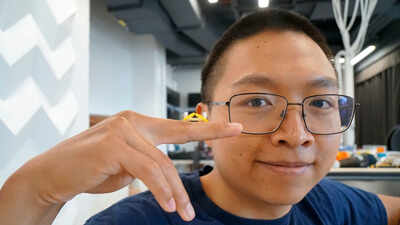
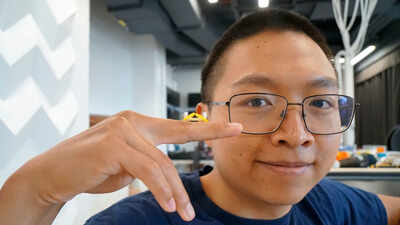
At Princeton Engineering, a team led by Glaucio Paulino has answered a question few people ever think to ask: what makes a ketchup bottle cap snap open and stay open rather than flopping shut? The hinge on a typical flip-top ketchup cap attaches a thin, flexible shell to a thicker, rigid base along a curved edge, creating 2 distinct stable positions separated by an energy barrier that the cap must overcome to switch between them. That simple piece of everyday plastic engineering helped reveal something much bigger: how curved, folded shells can hold multiple stable shapes without conventional locking mechanisms. Working from that insight, the team developed mathematical rules for predicting how these structures behave, then used those principles to build a magnetically controlled robot capable of rolling, crawling and changing shape through geometry rather than motors or complex internal mechanisms.
How curved-crease origami helped researchers understand the shells
The study, published June 15, 2026, grew out of work on curved-crease origami, which uses curved folds to turn flat sheets into three-dimensional structures. Unlike ordinary origami, where straight creases are usually the starting point, curved folds can create complicated shapes while allowing a thin sheet to remain lightweight. The researchers first used mathematics to work out how a shell would behave when one of its curved edges was fixed. Their calculations indicated that 2 stable configurations should be possible without stretching the shell. In simple terms, the structure could settle into one shape or another, much like the open and closed positions of a ketchup cap. But the physical models did not behave quite as simply as the equations suggested.
Why the researchers found 6 stable shapes instead of 2
When the team built and tested the shells, some could settle into 6 or more different stable configurations. The extra shapes appeared because the material developed a narrow band of concentrated deformation that acted much like another crease. The researchers called this feature a pseudocrease. Unlike a crease deliberately put into a sheet, it forms as the structure responds to the forces acting on it. The shell effectively finds another way to bend and settle into a stable position. That unexpected behaviour led the researchers back to their mathematical model. By accounting for the pseudocrease, they were able to explain why the physical structures had more stable states than the original calculation predicted and how the effect changed with the geometry of the shell.
How the shells became a robot without a motor
The team then used those different stable positions to make a robot that could change its shape on command. Instead of installing motors and gears inside the machine, the researchers used magnets to trigger transitions between the shell’s different configurations. Once a magnetic force pushed the structure past the point where one configuration was stable, the shell could snap into another. The resulting movements allowed the robot to roll and crawl while relying on the structure itself to provide much of the motion. That approach could make certain robots considerably simpler. A conventional moving robot needs motors, gears, batteries and other components to create and control movement. Here, much of that work is built into the shape of the robot before it even moves.
Why the ketchup cap connection matters
The ketchup cap is a simple example of the same principle. Its curved hinge is designed so that the cap has 2 positions it naturally wants to occupy. Pushing the cap past the point between them makes it snap into the other position. The Princeton researchers found that more complicated curved shells can do something similar, but with several possible positions instead of just 2. That gives engineers another way to design objects that can fold, deploy or change shape without adding a complicated mechanical system. The researchers suggest the idea could eventually be useful for reconfigurable structures, deployable architecture and small mechanical devices, as well as robotics. The immediate result, however, is much simpler: a structure inspired by an everyday bottle cap that can change shape and move using magnets, with no motor inside.