








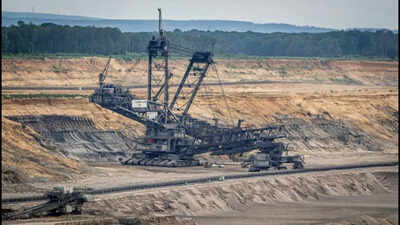
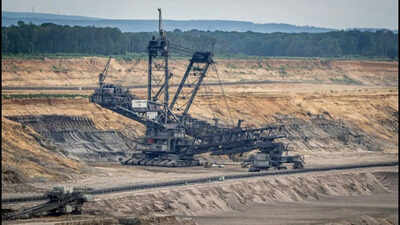
What does it take to give a landscape carved by decades of coal mining back to nature? The answer in Czechia, however, is becoming more complicated. The huge open-cast lignite mines in the Ústí Region were to be turned into artificial lakes after mining was completed. But as climate change brings less water and more evaporation, officials are reconsidering whether filling every giant mining pit with water is practical, or even sustainable. Now the debate is impacting the future of four major mines: ČSA, Nástup–Tušimice, Bílina and Vršany, states a 2023 news report by O Energetice CZ.
Most the world’s biggest artificial lake
A particularly striking example is Lake Most, created in the huge crater left by the transformation of the landscape by coal mining and the demolition of the old city of Most. The flooding started in 2008, and by 2014 the former mine had filled with about 70.5 billion liters of water, forming a lake 309 hectares in area and a maximum of 75 meters deep. Eventually the lake was opened for public recreation. But the experience had revealed an unexpected problem: a large artificial lake can require a heavy and constant flow of water to maintain it. Natural inflow to Lake Most is not enough to keep the desired level. It relies on extra water brought through an industrial pipeline from the Nechranice reservoir, costing several million Czech crowns a year.
Climate change is changing reclamation plan
The idea of flooding old mines was conceived decades ago, when the climate and water availability were different. Today the rivers and streams that might have filled the future lakes are less full. At the same time, warmer conditions are boosting evaporation from large bodies of water. Maintaining the planned water levels across several giant lakes could mean bringing in hundreds of millions of Czech crowns a year in extra water supplies, experts say. This has led authorities to challenge the conventional method of mine reclamation that involved re-contouring and rehabilitating mined landscapes to preset designs.
Letting nature run its course
The Czech Ministry of the Environment is now more and more supporting ecological restoration, where nature can reshape former mining areas. Authorities at the ČSA and Vršany mines have decided certain parts of the landscape will be allowed to flood naturally. The water levels will vary depending on rainfall, groundwater and wider climatic conditions rather than being at a fixed constant level. The government has also supported plans to develop some 11 square kilometers of specially protected land at ČSA. This area is already becoming a habitat where rare plants and animals can live. The emerging landscape has even been described as a kind of wilderness that nature made after mining.
New energy plans meet with conservation
The intention in leaving portions of the former mines to natural processes is not to abandon the entire landscape. Authorities and companies are considering several possible uses – photovoltaic power plants, industrial areas and other energy infrastructure. The state is also holding land at ČSA that could be used for a pumped-storage hydropower plant. The concept of combining economic uses with areas where natural succession can occur without intense human intervention has been applauded by conservation groups.
New idea: turn mines into water infrastructure
There might be a future for artificial lakes at some places, but experts are considering a different role for them. The future Libouš lake in the Nástup–Tušimice mine could be combined with the existing Nechranice reservoir on the Ohře River. Such a system could turn the former mining pit into a large additional space for water storage. Currently Nechranice has about 290 million cubic meters of water. Combined with the Libouš pit, the total capacity could reach as much as 550 million cubic meters, approaching the size of some of the country’s major reservoirs. The proposed connection could be a tunnel or an open channel, but an open channel could cost about CZK 20 billion. The feasibility will be apparent after further geological studies. Another challenge is Bílína. The Bílina mine could also be of water management benefit when flooded, but the situation is more complicated. Another option would be to connect it with the Most Lake, which would reduce the need for expensive water replenishment now required there. Water from the lake could be used to supplement the Bílina River in times of low flow. But it could take about 14 years to fill the pit as existing water users have preference on the river’s supply.There is another obstacle: the state does not own the land in Libouš or Bílina. This means that any big water infrastructure project could involve negotiations with landowner ČEZ.
From coalpits to new landscapes
The former lignite mines in the Czech Republic are no longer just about filling holes with water in the future. Authorities are weighing in on water security, climate change, biodiversity, renewable energy and the economics of reclamation. Natural flooding may be a cheaper and more environmentally responsive alternative to engineered restoration at some sites. Elsewhere, giant mining pits could be integrated into new water management systems. That’s a change that shows us that landscapes created by industry can be repurposed in very different ways in the future. Czechia is moving away from coal, and the country’s former mines could become wetlands, forests, wildlife refuges, recreation areas, energy sites—and even important parts of future water infrastructure.