










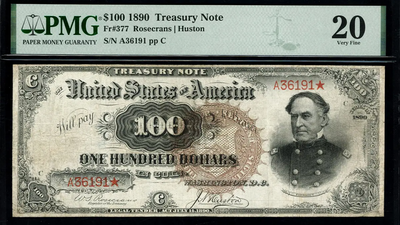
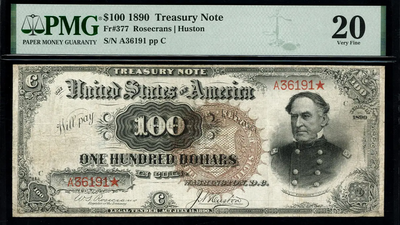
An extremely rare 1890 $100 Treasury Note, known to currency collectors as the “Watermelon” note because of its unusual back design, is set to go under the hammer in October. Only about 35 of the original 120,000 notes are believed to survive today, according to research published by CoinWeek. The auction, scheduled for Sunday, 4 October 2026, through GreatCollections, will offer an example from the Schwenk Family Collection. The note is certified and graded PMG Very Fine 20, with a Restoration notation.
A monetary experiment born from political compromise
The Series 1890 $100 Treasury Note, listed by collectors as Friedberg 377 (Fr. 377), was created after a major political fight over US monetary policy. On 14 July 1890, Congress passed the Sherman Silver Purchase Act. The law required the US Treasury to buy 4.5 million ounces of silver bullion every month. To pay for the large silver purchases, the government created a new type of paper money called Treasury Notes, also known as “Coin Notes”. Unlike earlier Silver Certificates, these notes could be exchanged for either gold or silver coins, depending on the Treasury Secretary’s decision. They were also legal tender for public and private debts. The front of the $100 note shows a detailed portrait of Civil War naval officer Admiral David Glasgow Farragut on the right. It also features a large brown spiked Treasury Seal, decorative corner designs and the signatures of Register of the Treasury William Starke Rosecrans and Treasurer of the United States James Nelson Huston.
How the famous nickname emerged
While the front honoured an American naval hero, the back gave the note its famous nickname. The reverse of the 1890 $100 note has a heavy green geometric design dominated by two huge zeros in the number “100”. Their rounded shapes, combined with fine lines made using lathework, made them look like watermelons. The name “Watermelon Note” quickly became popular among bankers and collectors. Its $1,000 counterpart, which had three large striped zeros on the back, became known as the “Grand Watermelon”. In their book 100 Greatest American Currency Notes, authors Q. David Bowers and David M. Sundman ranked the $1,000 Grand Watermelon as the greatest American paper currency trophy, while the $100 “Baby Watermelon” ranked 18th. The unusual back design did not last long. Treasury officials found that the dark, detailed patterns made it harder for bank tellers to spot fake notes, pen marks and other changes. When the Treasury prepared the Series 1891 notes, it replaced the dark pattern with a much simpler design containing more open white space. Collectors call these notes the “Open Back” series. This meant the “Watermelon” design appeared for only one series, making it a rare one-year experiment.
Surviving against extreme odds
The Bureau of Engraving and Printing produced 120,000 Series 1890 $100 Treasury Notes. Over the years, most were returned to banks, sent to the Treasury and destroyed in government incinerators as they left circulation. Track & Price census data cited by CoinWeek shows that only about 35 Fr. 377 notes are known to survive worldwide. Seven or eight of those are believed to be held permanently by institutions, museums and government collections, including the Smithsonian Institution. That leaves fewer than 30 examples in private hands around the world. The survival rate is about 0.03 per cent, meaning roughly one note has survived for every 3,400 originally printed.
Details of the upcoming auction
The note being offered by GreatCollections carries certification number 1998552-001 from Paper Money Guaranty (PMG). It is the official “Watermelon” entry in the registry set of the Schwenk Family Collection, considered one of the leading private collections of historic American bank notes. Online bidding will close at 7:11:50 p.m. Pacific Time on Sunday, 4 October 2026. The sale will offer collectors a rare chance to buy one of the most recognisable notes in American paper currency history.