









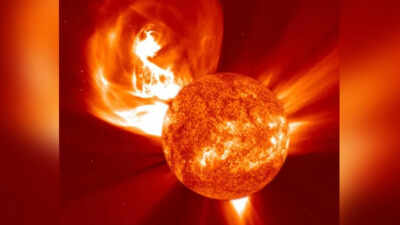
BENGALURU: Scientists have developed a computer model that could help predict how quickly powerful eruptions from the Sun will travel towards Earth, potentially improving warnings for disruptions to satellites, power grids and communication systems.The three-dimensional model was developed by researchers at the Indian Institute of Astrophysics (IIA), an autonomous institute under the department of science and technology, in Bengaluru, along with collaborators in the US and Finland.The team comprised Samriddhi Sankar Maity, a postdoctoral researcher at Nasa and Georgia State University, Piyali Chatterjee of IIA, Ijas S Mytheen, a PhD student at Eötvös University, Hungary and Ranadeep Sarkar of the University of Helsinki, Finland.The study focuses on Coronal Mass Ejections (CMEs), huge clouds of electrically charged, magnetised material that the Sun can hurl into space at millions of kilometres per hour. When a CME is directed towards Earth, it can interfere with satellites and communication systems and, in severe cases, affect power infrastructure.Researchers used computer simulations to track what happens inside the Sun’s outer atmosphere as magnetic energy builds up before an eruption. At the centre of the process is a twisted bundle of magnetic fields called a magnetic flux rope.As this structure rises through the Sun’s atmosphere, it stretches and compresses the magnetic field around it. Eventually, opposing magnetic fields begin to reconnect, releasing energy and driving the eruption.The simulations showed that this process doesn’t start as a sudden explosion. Instead, a thin region carrying a strong electric current gradually develops as the magnetic fields are pushed together. The process then intensifies, leading to the rapid expulsion of the magnetic structure as a CME.The team found that the speed at which magnetic reconnection occurs is closely linked to how quickly the CME accelerates. In other words, faster reconnection was associated with faster and more energetic eruptions.Researchers also compared their computer simulations with observations of the Sun. The observational analysis, carried out with Sarkar, used data from instruments aboard Nasa’s Solar Dynamics Observatory, including its Helioseismic and Magnetic Imager and Atmospheric Imaging Assembly.The comparison supported the link between magnetic reconnection and CME acceleration, suggesting that measurements of the magnetic changes taking place on the Sun could provide useful information about the eventual strength and speed of an eruption.The computational work was carried out using the NOVA high-performance computing facility at the IIA. The study, published in the Astrophysical Journal, provides a clearer picture of how a slowly developing magnetic structure on the Sun can turn into a powerful eruption. Researchers said the findings could help bring scientists closer to forecasting the arrival and impact of CMEs before they reach Earth.