








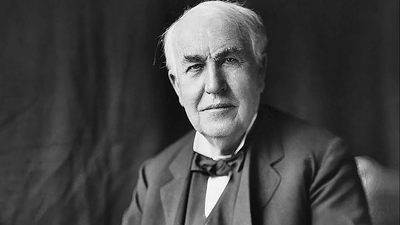
Two people can rack up an enormous number of failed attempts at the same problem and describe that experience in completely different terms. One counts every dead end as a defeat, a growing pile of evidence that the goal might not be reachable at all. The other counts each one as information, a single ruled-out possibility that narrows the remaining search space by exactly one option, no more discouraging than crossing an item off a list. Thomas Edison, the inventor credited with the practical incandescent light bulb, the phonograph, and hundreds of other devices, insisted on the second framing even when the number of dead ends climbed into the thousands. He wasn’t describing optimism as a mood he chose to feel. He was describing a specific redefinition of what failure actually meant, one that made an enormous volume of unsuccessful attempts compatible with the claim that nothing had actually failed at all.
Quote of the day by Thomas Edison
“I have not failed. I’ve just found 10,000 ways that won’t work.”
Written during the search for a working light bulb filament
What gives this line extra weight is the scale of testing it actually describes. In the search for a durable, practical material to use as the filament inside an incandescent light bulb, Edison and his team at Menlo Park reportedly tested thousands of different materials, various metals, carbonised paper, and eventually a wide range of plant fibres, before settling on carbonised bamboo as a filament that could burn reliably for over a thousand hours. Each failed material meant discarding an assumption, adjusting the method, and starting the next test, a process that continued for months without the payoff most people would need to keep going.Edison’s broader career reflected the same pattern at a larger scale. He held more than a thousand patents by the end of his life, a rate of output that required treating experimentation itself, including its enormous share of unsuccessful attempts, as the actual mechanism of invention rather than an unfortunate cost of it. His Menlo Park laboratory was deliberately organised around this principle, staffed and funded specifically to run large numbers of parallel experiments, because Edison understood that most of them would not work, and had built a process that depended on that being fine.
A simple way to actually use this idea
The useful move here is treating a failed attempt as data rather than as a verdict on the underlying goal, since the two are easy to confuse in the moment a failure actually happens. A method that doesn’t work is information about the method, not proof that the goal itself was unreasonable, and confusing the two is often what causes people to quit long before they’ve actually exhausted the realistic options. This reframing matters most precisely when the count of failures gets large enough to feel embarrassing or discouraging on its own, since a rising tally of failed attempts can start to feel like evidence against the whole project, even when each individual failure is genuinely just as informative and just as survivable as the first one was.A fair test, in the middle of a frustrating run of failed attempts, is to ask whether what just happened ruled out one specific approach or ruled out the entire goal, since those are very different conclusions that get mistaken for each other constantly. That question won’t make ten thousand failed attempts feel pleasant. It usually keeps them from being mistaken for the end of the search rather than simply a large, necessary part of it.
Other famous quotes by Thomas Edison
- “Genius is one per cent inspiration and ninety-nine per cent perspiration.”
- “Many of life’s failures are people who did not realise how close they were to success when they gave up.”
- “Our greatest weakness lies in giving up. The most certain way to succeed is always to try just one more time.”