









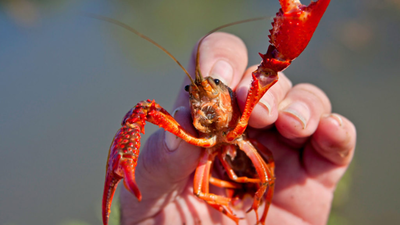
European conservationists have started targeted eradication efforts against newly discovered populations of self-cloning marbled crayfish in the Czech Republic. They are trying to remove the species before it can spread through local waterways.The work in Moravia is part of a wider European Union effort to stop invasive alien species while their populations are still small enough to remove completely.The Nature Conservation Agency of the Czech Republic is leading the local project, which targets two newly discovered groups of marbled crayfish. Unlike almost all other freshwater crustaceans, marbled crayfish reproduce through parthenogenesis. This means a single female can produce genetically identical offspring without mating.The species can therefore increase its numbers quickly. It also carries crayfish plague, a fungal disease that has badly reduced native European crayfish populations.
Fast funding targets small populations
The Czech project is among the first 20 projects supported by the European Invasive Alien Species Rapid-Response Fund. Co-funded by the European Union and carried out through IUCN Save Our Species, the fund provides grants of €10,000 to €50,000.The money allows government agencies, research institutes, and conservation groups to act quickly when new invasive species are discovered.The European Environment Agency (EEA) said in a briefing published in June 2026 that although the EU is making progress against biological invasions, non-native species continue to spread into new areas.The report stressed that finding invasive species early and removing them quickly is one of the best ways to prevent long-term environmental damage.Across Europe, non-native species are estimated to cause about USD 28 billion in environmental damage, lost economic activity, and management costs every year. Worldwide, invasive alien species have contributed to 60 percent of recorded animal and plant extinctions and were the only recorded cause in 16 percent of those cases.
Experts say prevention is better than control
In the past, much conservation funding has focused on controlling invasive species after they become widespread. At that stage, removing them can be extremely difficult, expensive, or impossible.Professor Helen Roy, Co-Chair of the IUCN SSC Invasive Species Specialist Group, explained why early action is important. Every invasive species that becomes a major problem started as a small population somewhere. Removing new populations while they are still limited to small areas gives conservationists a much better chance of preventing damage that could last for decades.The Convention on Biological Diversity also published a practical toolkit in 2025 to help countries meet Target 6 of the Kunming-Montreal Global Biodiversity Framework. Developed with IUCN specialists, the guidance explains how governments can create monitoring systems and rapid eradication plans.
Projects target many invasive species
The first round of funding supports projects in nine European countries. The projects cover marine, freshwater, forest, and urban environments.In Croatia, the Hippocampus Association for Environmental Protection is using divers and marine scientists to remove venomous lionfish from protected areas in the Adriatic Sea before they damage native fish populations.In Belgium, the Province of Antwerp, the Research Institute for Nature and Forest (INBO), and other authorities are using environmental DNA (eDNA) testing and targeted traps to remove isolated populations of American bullfrogs and African clawed frogs from wetlands in Flanders and Wallonia.Some projects also involve cooperation across national borders. National Park Thayatal in Austria and Podyjí National Park in the Czech Republic are working together to remove non-native raccoons. The effort aims to protect ground-nesting birds and native European wildcats.In the Czech Republic, the Czech Society for Ornithology is removing the Oriental turtle dove from its only known non-native breeding site in Europe.
Other projects include:
- Removing common myna populations through the National Research Council of Italy (CNR-IRET).
- Eradicating red-billed leiothrix from coastal dune habitats in Flanders through INBO.
- Protecting the native Cretan wall lizard from invasive Italian wall lizards through the University of Crete.
- Removing Japanese knotweed from Austria’s Dürrenstein-Lassingtal Wilderness Area.
- Controlling Turkish warrantcabbage in species-rich grasslands on Italy’s Asiago Plateau.
- Removing invasive Ludwigia and alligator weed from Portuguese rivers through the Comunidade Intermunicipal da Região de Coimbra.
Local communities are also helping
In Finland, local residents are taking part directly in invasive-species monitoring. People in Vantaa are using a mobile app to record and confirm the manual removal of Himalayan balsam along the Mätäoja urban stream.Technical support for these projects comes from the global network of the IUCN SSC Invasive Species Specialist Group. Lessons from the first 20 projects will also help shape IUCN’s wider Invasive Alien Species Strategy.The European Invasive Alien Species Rapid-Response Fund will accept more applications until 10 February 2027, or until its available funding runs out. Conservation groups and research organisations across the EU are being encouraged to apply by September 2026 so they can respond to new invasive species before the populations become permanently established.