









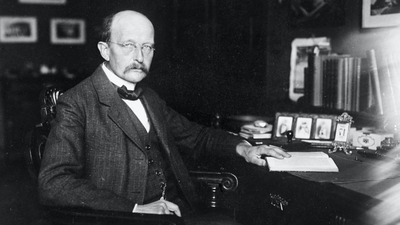
Few scientists have reshaped humanity’s understanding of the universe as profoundly as Max Planck. Celebrated as the father of quantum theory, the German physicist not only revolutionised modern physics but also left behind timeless reflections on science, philosophy and the limits of human knowledge. One of his most quoted observations is: “Science cannot solve the ultimate mystery of nature. And that is because, in the last analysis, we ourselves are part of the mystery that we are trying to solve.” The quote continues to resonate with scientists, students and philosophers alike because it captures an enduring truth: while science has unlocked countless secrets of the natural world, there are still fundamental questions about existence, consciousness and reality that remain unanswered. As today’s “Quote of the Day”, Planck’s words remind us that curiosity and humility must go hand in hand in the pursuit of knowledge.
Quote of the day by Max Planck
“Science cannot solve the ultimate mystery of nature. And that is because, in the last analysis, we ourselves are part of the mystery that we are trying to solve.”— Max Planck
Who was Max Planck?
Max Karl Ernst Ludwig Planck was born on April 23, 1858, in Kiel, Germany, into a family with a strong academic tradition. From an early age, he displayed an exceptional aptitude for mathematics and physics. He went on to study at the Universities of Munich and Berlin, where he developed an interest in theoretical physics.Planck’s greatest contribution came in 1900, when he proposed that energy is emitted and absorbed in tiny, discrete packets known as quanta. At the time, scientists believed energy was continuous, so his proposal challenged one of the fundamental assumptions of classical physics. Although Planck initially viewed the idea as a mathematical solution to a scientific problem, it soon became the foundation of quantum theory, a field that transformed physics and paved the way for technologies such as semiconductors, lasers, magnetic resonance imaging (MRI) and quantum computing.In recognition of his groundbreaking work, Planck was awarded the 1918 Nobel Prize in Physics. Today, he is remembered as one of the greatest physicists in history, with the prestigious Max Planck Society in Germany carrying forward his legacy by supporting cutting-edge scientific research.
What does the quote mean?
At first glance, Planck’s quote may seem to suggest that science has failed. In reality, it conveys the opposite. It acknowledges the immense achievements of science while recognising that some mysteries may always remain beyond complete human understanding.Science is built on observation, experimentation and evidence. It excels at explaining how natural processes work, from the motion of planets to the behaviour of atoms. However, Planck argued that science may never fully explain the “ultimate mystery” because human beings are not detached observers looking at the universe from the outside. We are participants within it.This means our understanding is inevitably shaped by the limits of our perception, our tools and our own existence. Questions such as why the universe exists, whether consciousness can be fully explained through physical laws, or whether reality extends beyond what we can observe continue to inspire scientific and philosophical debate.Rather than discouraging scientific inquiry, Planck’s quote celebrates the endless search for knowledge. It reminds us that every answer often leads to new questions.
Why is the quote still relevant today?
More than a century after Planck introduced quantum theory, science has achieved extraordinary breakthroughs. Researchers have detected gravitational waves, captured images of black holes, sequenced the human genome and developed artificial intelligence systems capable of solving increasingly complex problems.Yet some of the biggest mysteries remain unsolved. Scientists still do not know what dark matter is, despite believing it makes up most of the universe’s matter. Dark energy, thought to drive the accelerating expansion of the universe, remains equally mysterious. The exact nature of consciousness, one of humanity’s oldest questions, also continues to puzzle neuroscientists and philosophers alike.Quantum mechanics itself, the field Planck helped create, remains one of the most successful yet philosophically puzzling theories in science. It accurately predicts experimental results but raises profound questions about reality, observation and probability.In this context, Planck’s words feel as relevant today as they did decades ago. They remind us that scientific progress is not simply about finding final answers but about continually expanding the boundaries of human understanding.
The intersection of science and philosophy
Unlike some scientists who viewed science and philosophy as separate disciplines, Planck believed they could complement one another. Throughout his career, he often reflected on questions about knowledge, truth and humanity’s place in the universe.His quote illustrates this intersection. It recognises that science is an incredibly powerful method for uncovering facts about the natural world while also acknowledging that some questions extend into philosophy. Ideas about existence, consciousness and meaning cannot always be resolved through experiments alone.This perspective has influenced generations of thinkers, encouraging scientists to remain intellectually curious while recognising the limitations of their methods.
Max Planck’s lasting legacy
Max Planck’s influence extends far beyond his scientific discoveries. His work laid the foundation for the quantum revolution, inspiring physicists including Albert Einstein, Niels Bohr, Werner Heisenberg and Erwin Schrödinger. Nearly every modern electronic device, from smartphones and computers to medical imaging systems, relies on principles that emerged from quantum theory.Beyond physics, Planck’s reflections on science continue to inspire educators, researchers and students around the world. His writings encourage people to pursue knowledge with both confidence and humility, recognising that discovery is an ongoing process rather than a final destination.As today’s Quote of the Day demonstrates, Planck’s words remain timeless because they capture an essential truth about science itself. The more humanity learns about the universe, the more we realise how much remains unknown. Instead of seeing that uncertainty as a limitation, Planck saw it as an invitation to keep exploring, questioning and learning. More than a century after he transformed physics, his insight continues to inspire anyone driven by curiosity about the world and our place within it.