









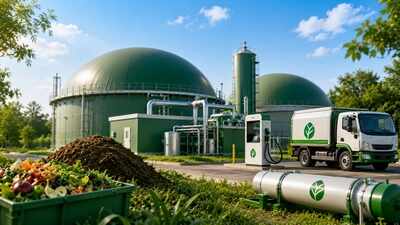
In a bid towards energy security, the Union Cabinet on Thursday approved a Rs 23,731 crore GOBARdhan scheme for bio gas. GOBARdhan or the Galvanizing Organic Bio- Agro Resources Dhan scheme aims to push for the production of compressed bio-gas.The move assumes significance in the backdrop of the ongoing Middle East crisis which has exposed India’s vulnerability to natural gas imports. India at present imports around 50% of its natural gas consumption. The Strait of Hormuz disruption impacted 55–60% of India’s LNG imports. The government sees compressed bio-gas as a domestic solution.
GOBARdhan scheme: All you want to know
The scheme has six pillars: assured offtake, price stability, capex support, pipeline infra development, credit guarantee, and challenge fund for innovation.The scheme aims to rapidly expand compressed biogas production, with a focus on converting agricultural and municipal waste into fuel to curb reliance on imported fossil fuels and support India’s shift towards cleaner energy.The initiative will run from fiscal 2027 through fiscal 2036 and is designed to increase domestic compressed biogas output by almost ten times. According to the government, the programme will achieve this through measures including assured offtake, administered pricing, capital support, pipeline connectivity and improved financing access.The scheme will utilise agricultural residue, cattle dung, sugar industry by-products such as press mud, municipal organic waste and other forms of biomass to manufacture compressed biogas, which can be blended with the compressed natural gas used by vehicles.The initiative expands on existing efforts such as the Sustainable Alternative Towards Affordable Transportation (SATAT) programme, under which the government said more than 200 compressed biogas plants have already been commissioned.Under the new policy framework, city gas distribution companies will be required to procure compressed biogas to fulfil mandatory blending targets of 3 per cent in fiscal 2027, 4 per cent in fiscal 2028 and 5 per cent from fiscal 2029 onwards for compressed natural gas supplied for transport as well as piped natural gas delivered to households.To provide long-term revenue certainty for producers while ensuring consumer prices remain affordable, the government has fixed an administered price of Rs 2,110 per million British thermal units (MMBTU) for compressed biogas.Greenfield projects that meet the eligibility criteria will be entitled to capital assistance of up to Rs 2 crore for every tonne per day of installed compressed biogas capacity. Brownfield expansion projects will also be eligible to receive financial support under the scheme.The programme further includes financial assistance for developing pipeline infrastructure to connect compressed biogas plants with trunk pipelines and city gas distribution networks. It also incorporates a credit guarantee mechanism for eligible micro, small and medium enterprises, along with a dedicated challenge fund to promote feedstock aggregation, technology adoption and project development at the district level.According to the government, the scheme is expected to encourage private investment, generate additional income opportunities for farmers and rural entrepreneurs, improve the handling of agricultural and municipal waste, increase the production of organic manure and reduce greenhouse gas emissions.India has been steadily increasing the role of natural gas in its energy transition plans while working to cut dependence on imported liquefied natural gas by boosting domestic production of renewable gaseous fuels such as compressed biogas.