









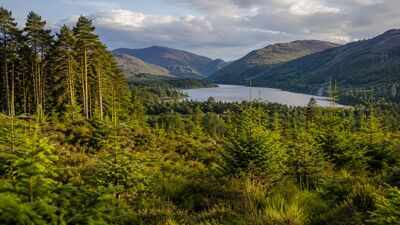
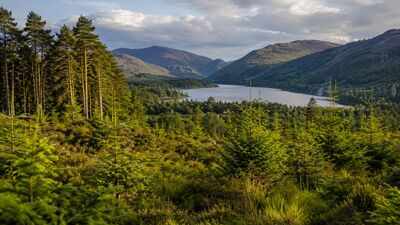
In 1986, at a conference on the global ecological crisis held in Findhorn, Scottish ecologist Alan Watson Featherstone stood before hundreds of delegates and made a public commitment. He promised to begin restoring the ancient Caledonian Forest, one of Britain’s last remnants of native pine woodland. At the time, the idea was ambitious. Much of the forest had been reduced over centuries through timber extraction, grazing by deer and sheep, and fragmented land management.What followed was not a short campaign but decades of steady work. Volunteers, conservation staff and supporters gradually turned that early promise into one of Scotland’s best-known woodland restoration projects. A major milestone came in 2012, when Trees for Life announced it had completed the planting of one million native trees, marking the successful conclusion of a long-running restoration programme before launching a fresh target of another million trees over the following five years.
How Alan Watson Featherstone began Scotland’s Caledonian Forest restoration
According to Trees for Life, Watson Featherstone’s connection with Scotland’s native woodland strengthened after he settled in the Findhorn Community in the late 1970s. Repeated visits to Glen Affric convinced him that the remaining Caledonian Forest could recover if natural regeneration was given the chance and grazing pressure was controlled.The charity explains that his public pledge in 1986 gradually evolved into practical conservation work. Initial efforts focused on protecting existing trees from browsing animals before expanding into fenced regeneration areas and large-scale planting in partnership with the Forestry Commission. By 1991, those early projects had earned national recognition when the initiative was named the UK’s Conservation Project of the Year.Volunteer involvement became central to the restoration effort, with thousands of people helping plant and care for native woodland across locations including Glen Affric, Glen Carron, Glen Urquhart, Skye and later Dundreggan Estate.
After planting one million native trees, Trees for Life launched a new Scotland restoration mission
As per the BBC, Trees for Life had completed its first project to plant one million native saplings. Rather than ending the work, the charity immediately announced a new goal: planting another one million native trees across Scotland within five years.Executive director Alan Watson Featherstone explained why the organisation intended to continue expanding woodland restoration. “We have set ourselves this challenge as a response to the threats posed by environmental degradation globally and human-induced climate change,” he told BBC News.He also described the wider vision behind the planting programme. “At the same time it is part of a positive vision of re-establishing world-class wild landscapes rich in wildlife in Scotland.” The Highlands, with extensive open land and relatively low population density, offered particularly favourable conditions for large-scale native tree restoration.
How Dundreggan Estate became the heart of Scotland’s Caledonian Forest restoration
A significant part of the charity’s long-term work centred on Dundreggan Estate near Loch Ness. Trees for Life purchased the estate in 2008 for around £1.65 million, to transform former sporting land into a recovering native forest.The estate developed into much more than a location for planting. According to Trees for Life, it now hosts a specialist nursery capable of growing more than 60,000 native trees each year, including several rare Caledonian Forest species. Those young trees support restoration projects both on the estate and elsewhere across the Highlands.The landscape also proved valuable for wildlife. Biological surveys carried out at Dundreggan uncovered populations of rare and threatened invertebrates, including the strawberry spider, azure hawker dragonfly, juniper shield bug and blood-red slave-making ants. The discoveries reinforced the idea that restoring woodland benefits far more than trees alone.
How Scotland’s Caledonian Forest restoration is rebuilding a resilient native ecosystem
Planting large numbers of saplings was only one measure of success. The wider ambition has always been to help native woodland function as a healthy ecosystem capable of supporting diverse wildlife while regenerating naturally over time.The study published in the journal Forest Ecology, titled “Ecology and management history drive spatial genetic structure in Scots pine”, has suggested that Scots pine populations in the Scottish Highlands retain strong genetic diversity despite historical forest management. Combining sustainable management with conservation practices that maintain large, effective populations is important for preserving long-term forest resilience.That broader ecological recovery reflects the original vision behind Watson Featherstone’s pledge four decades ago. The first million native trees have already been planted, the restoration project was completed, and the work has continued well beyond that milestone as Scotland’s remaining fragments of Caledonian Forest gradually expand once again.