









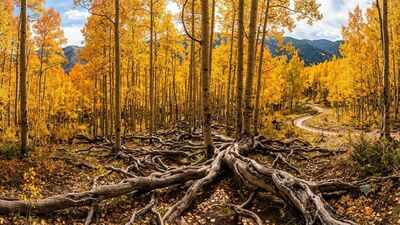
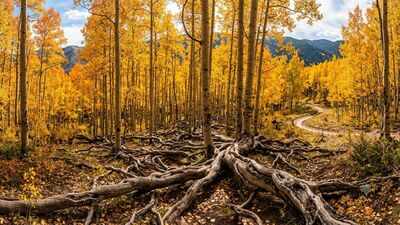
At first sight, Pando appears to be an ordinary forest of thousands of trembling aspen trees stretching across Utah’s Fishlake National Forest. As reported by PBS, the reality beneath the ground is far more unusual. Those estimated 47,000 trunks are not separate trees competing for space, but parts of a single living organism connected by one enormous root system. Sharing the same genetic identity, Pando has expanded across roughly 106 acres and is believed to weigh around 6,000 tonnes, making it one of the largest organisms on Earth by mass. For thousands of years, this ancient aspen colony has quietly survived changing climates and shifting landscapes. Today, however, its future depends on whether it can continue producing new generations of trees.
Why Pando’s thousands of trees are all part of a single giant living organism
The name Pando comes from Latin and means “I spread”, a fitting description for an organism that has gradually expanded across a vast area of Utah’s high-elevation landscape.The thousands of trees visible above ground are individual stems, each growing upward from the same underground network. They rise, shed leaves and age like normal aspens, but genetically they are all copies of one another. The roots beneath the surface connect them into a single biological system that has persisted for thousands of years.Unlike a traditional forest made up of many unrelated trees, Pando functions as one organism. When one stem dies, the root system can produce new shoots nearby, allowing the colony to continue renewing itself.Scientists estimate that Pando’s root system may be at least 16,000 years old, although its exact age remains difficult to determine. The visible trunks are much younger, with many surviving for only a few decades before being replaced.
The massive organism hidden beneath Utah’s forest floor
Pando’s enormous size is easy to underestimate because most of the organism is hidden. The individual trees may not appear unusual when viewed separately, but together they create one of the largest known living organisms on the planet, according to the study published in bioRxiv titled ‘Mosaic of Somatic Mutations in Earth’s Oldest Living Organism, Pando’. The colony covers around 106 acres near Fish Lake in central Utah. Its estimated weight of approximately 6,000 tonnes places it among the heaviest organisms ever identified, far exceeding the size of most individual trees.Aspens are capable of creating large clonal colonies because they can reproduce through their root systems. New stems emerge from underground connections rather than from seeds alone, allowing a single genetic individual to spread over wide areas.This method of growth has helped Pando survive for millennia. The organism has endured ice ages, droughts, wildfires and major environmental changes that transformed the surrounding landscape.
How scientists discovered Pando’s true identity
For much of history, Pando was simply viewed as an aspen grove. Its unusual nature became clear only after researchers began examining the relationship between the trees.The stems were found to share the same genetic makeup, revealing that what looked like thousands of separate trees was actually one massive clone. This discovery changed the way scientists understood the area, turning a familiar woodland into a rare example of long-term biological survival.Pando belongs to a group of organisms known as clonal colonies, where many visible parts originate from a single parent organism. Similar examples exist elsewhere, but few match Pando’s combination of size, age and complexity.The colony provides researchers with an opportunity to study how a single organism can persist across thousands of years while responding to environmental changes.
When an ancient organism struggles to create new generations
Although Pando has survived for thousands of years, its ability to renew itself has become a growing concern. The main challenge is not the loss of older trees but the shortage of young replacements.New shoots continue to emerge from the root system, but many do not survive long enough to become mature trees. Grazing animals such as deer and elk often feed on the young growth before it can develop.Historically, predators helped regulate animal populations, while natural disturbances such as wildfires created conditions that encouraged new aspen growth. Changes to these natural patterns have altered the balance around Pando.The result is a forest that still appears healthy from a distance but may be struggling beneath the surface. Older stems remain visible, yet fewer younger trees are growing to replace them.
Human efforts to protect an ancient organism
Conservation has been mainly aimed at ensuring new shoots live. Some parts of the tree colony have been fenced off to avoid grazing in the areas to ensure shoots can grow without being eaten several times. Such fenced regions have experienced positive signs of regeneration, giving the researchers some idea on how they can manage the tree colony to restore its health.The conservation of Pando is not an attempt to conserve just one weird tree in isolation. The Pando lives in an ecosystem with wildlife, soil, water bodies and other types of plants. Its conservation must entail conservation of the conditions for functioning of the whole forest environment. The researchers keep on monitoring changes in growth, climate, and root health among others.