









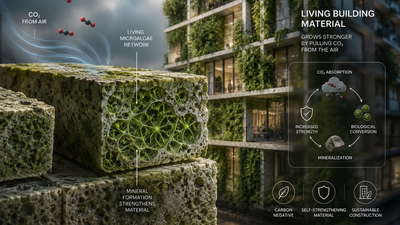
However, the construction industry accounts for a great part of the global CO₂ footprint due to massive emissions of carbon dioxide while producing cement and concrete. Although some success has been achieved by architects and engineers in the creation of alternatives, there is still no such type of sustainable building material that would not only lower but also absorb the CO₂ from the air.At ETH Zurich, however, the scientists managed to create the completely new solution. The new material consists of live components and uses the cyanobacteria’s ability to convert CO₂ into minerals. Published in Nature Communications, the study shows how the material not only stores carbon but also gradually strengthens itself as minerals accumulate within its structure.
How living microbes transform carbon dioxide into stone
The research group used living cyanobacteria, which are microorganisms that perform photosynthesis, and embedded them into a specially developed 3D-printed hydrogel. This material maintains the life of these microorganisms because it provides water and nutrition to them and at the same time allows light and carbon dioxide to enter the cells of the organisms.By performing the process of photosynthesis, these microorganisms take in CO2 from the surroundings; however, this is not where the role of these microorganisms ends. In addition to performing photosynthesis, these microorganisms facilitate the formation of minerals such as calcium carbonate, which is usually found in limestone, chalk and seashells.As the mineral deposits continue forming in the hydrogel, the strength of the material gets enhanced while the carbon is captured into the material in the form of a mineral.
The living material remained active for more than a year
One of the biggest problems in developing living material is maintaining the viability of the microorganisms for long enough to make them do something useful. In order to solve this problem, the scientists engineered their hydrogel to have an internal structure that ensures efficient flow of light, water, and nutrients through it.The study found that the cyanobacteria remained metabolically active for more than a year, continuously carrying out photosynthesis and mineralisation during that time. The research demonstrated that the material stores carbon through two complementary mechanisms: temporary storage inside living biomass and long-term storage as solid calcium carbonate minerals.Because much of the captured carbon becomes incorporated into mineral deposits, it remains locked inside the material instead of easily returning to the atmosphere.
A step towards buildings that actively remove carbon
The researchers believe the technology could eventually be incorporated into building façades, architectural panels and other non-load-bearing structures that continuously absorb carbon throughout their lifetime.The use of 3D printing also allows the material’s internal geometry to be carefully optimised, improving light penetration, nutrient transport and microbial activity. This makes it possible to maximise carbon capture while maintaining the material’s structural integrity.According to the ETH Zurich research team, the next generation of buildings would not only be low-carbon buildings but would also act like living beings that would absorb carbon dioxide from the atmosphere and at the same time become stronger with the natural creation of minerals within themselves.