







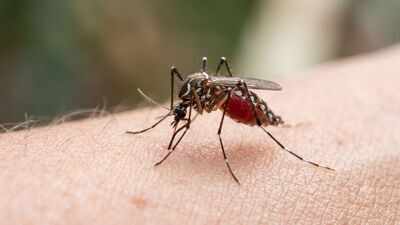
Deep inside Brazil’s Atlantic Forest, far from crowded towns and city streets, scientists found a surprising pattern in the insects they were studying. Mosquitoes living in protected forest areas appeared to have been feeding on humans more often than expected, despite being surrounded by natural habitat. The discovery has raised questions about how environmental change may be altering the relationship between mosquitoes, wildlife and people.The shift does not appear to be happening because mosquitoes suddenly changed their behaviour overnight. Instead, researchers suggest that the loss of animal habitats and shrinking wildlife populations may be gradually pushing some species towards human hosts.
DNA analysis revealed a surprising mosquito feeding pattern
The investigation took place in two protected areas in Brazil’s Rio de Janeiro state: Sítio Recanto Preservar and the Guapiaçu Ecological Reserve. Scientists used light traps to collect female mosquitoes, which require blood meals to develop their eggs.Rather than simply counting mosquito numbers, the team examined what the insects had recently eaten. DNA from blood inside the mosquitoes was analysed to identify the animals they had bitten before being captured.According to the BBC Science Focus, out of 145 mosquitoes collected, only 24 provided blood samples that could be successfully identified. The insects are delicate, and many samples were damaged before laboratory testing could be completed.Even with the limited number of usable samples, the results stood out. Most of the identifiable blood meals came from humans, despite some traps being placed deep within forest areas where people were rarely present.The finding surprised the team because mosquitoes inside protected forests would normally be expected to rely more heavily on wild animals.
Why disappearing wildlife could change mosquito behaviour
Mosquitoes do not usually depend on humans alone. Many species feed on a range of animals, including mammals and birds, depending on what is available in their surroundings.But forests across the world are becoming increasingly fragmented. In Brazil, much of the Atlantic Forest has already been cleared, leaving remaining sections separated by roads, farmland and urban development. The result is fewer wild animals in some areas and a changing environment for the species that depend on them.Dr Sergio Machado, one of the study’s authors, suggested that mosquitoes may increasingly turn towards humans when their usual hosts become harder to find. Over time, repeated contact with people could favour mosquitoes that are better adapted to human environments.The change would not happen instantly. Mosquito populations evolve over generations, but environmental pressure can influence which traits become more common.
A growing concern for mosquito-borne diseases
The concern surrounding this shift is linked to the diseases mosquitoes can carry. Species that feed frequently on humans have greater opportunities to spread infections between people.Mosquitoes are responsible for transmitting illnesses including dengue and Zika virus. Brazil has experienced major dengue outbreaks in recent decades, with the disease returning after a long period of absence and becoming a significant public health issue.Globally, mosquito-borne diseases are estimated to cause around one million deaths each year, making changes in mosquito behaviour a subject of close attention for scientists and health officials.The study focused on a specific region of Brazil, so it does not prove that all mosquito populations are changing in the same way. However, scientists say similar pressures may exist in other places where natural habitats are being reduced.
Climate change may add another pressure
Habitat loss is not the only factor affecting mosquitoes. Rising temperatures can influence their development, breeding cycles and ability to survive in new conditions.Increased temperatures can cause certain species of mosquitoes to breed faster and become active for extended periods during the year. In combination with increased expansion of human habitation close to the degraded ecosystem, it can lead to more chances of interactions between mosquitoes and humans.Climate and land use have a complicated relationship with the spread of disease. A warming Earth does not necessarily dictate the location of transmission of mosquito-transmitted diseases, but changes in the environment can affect the balance between species.
Protecting forests could help reduce future risks
For the scientists involved in the study, protecting remaining forests is one way to reduce the pressure driving these changes.Healthy ecosystems support a wider range of wildlife, meaning mosquitoes have more natural hosts available instead of relying increasingly on humans. Conservation, in this sense, is also connected to public health.The team plans to continue monitoring mosquito behaviour in Brazil’s Atlantic Forest and develop improved methods for collecting larger numbers of samples. A clearer picture of how mosquitoes move between forests and nearby communities could help explain how environmental changes influence disease risks.