












For years, “no screen time” has become something of a parenting badge of honour. Many parents proudly announce that their child has never touched a phone or tablet, believing that complete avoidance is the gold standard of raising healthy children.But is banning screens really the best approach?
28 Jul 2026 | 16:25
Do you think social media has changed the parent-teen relationship?
According to Dr. Mahesh Balsekar, pediatrician and neonatologist at Narayana Health SRCC Children’s Hospital, the answer is more nuanced. Speaking on The Secret Sauce podcast, he said that the conversation around children’s screen use has changed significantly. Instead of treating screens as the villain, parents should focus on how they fit into a child’s overall lifestyle.
Why calling screens ‘poison’ may backfire
Dr. Balsekar believes that some parents unintentionally create a negative and confusing message when they treat screens as something completely forbidden. “I’ve heard parents say no screen time, no screen time as though it’s some poison. And the child’s wondering what’s wrong, you know, that you’re on the screen all the time and why can’t I be on the screen?”His observation highlights a contradiction many children notice. Parents often spend hours on their own devices while expecting children to stay away from them entirely. For a young child, that inconsistency can be difficult to understand. Rather than seeing screens as forbidden objects, Dr. Balsekar suggests helping children understand when, why and how they should be used.
The parenting conversation has changed
For a long time, discussions around children’s digital habits focused almost entirely on one question: How many hours is too much?Dr. Balsekar says that this way of thinking is evolving. “So now the whole approach has changed, not only to the duration, which is important, but the content.” Time still matters, he says, but it is no longer the only measure of healthy screen use. Parents also need to pay attention to what children are watching and how screens fit into the rest of their day.
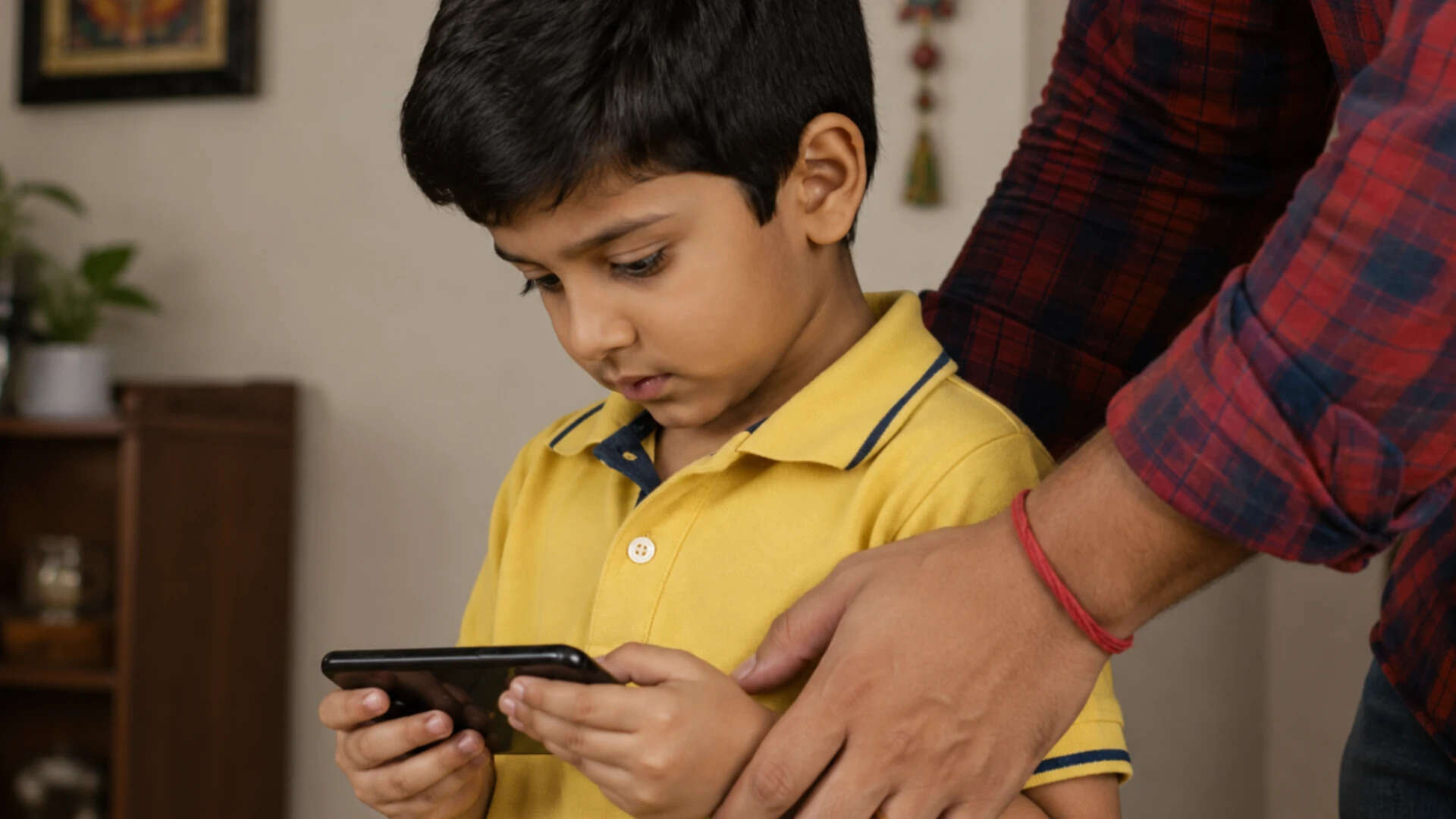
AI-generated image
Look at the whole child, not just the screen
Perhaps the most important takeaway from Dr. Balsekar’s advice is that screen time should never be judged in isolation. “And screen time is seen as a part of the whole lifestyle.”Instead of counting every minute a child spends on a device, he encourages parents to step back and ask bigger questions about their child’s overall development. “Is the child reading adequately? Is the child playing adequately? Is the child sleeping adequately? Is the child socialising adequately?”These questions shift the focus from fear to balance. A child who enjoys books, runs around outdoors, gets enough sleep, spends time with friends and family, and then watches an educational programme for a while is very different from a child whose entire day revolves around a screen. In other words, screens should be viewed as one piece of the puzzle- not the whole picture.
Not all screen time is the same
Another important point Dr. Balsekar makes it clear that all screen time should not be treated equally. A child mindlessly watching endless videos alone is having a very different experience from one who is exploring an educational app with a parent or watching an age-appropriate documentary together. As he explains: “And if all these other requirements for child development are met, then screen if it is used in reasonable amounts with good content and with parental supervision and involvement.” This is where many parenting conversations often fall short. Parents tend to focus on the clock rather than the quality of the experience.
The power of ‘co-viewing’
One of Dr. Balsekar’s strongest recommendations is something known as co-viewing. “It’s called co-viewing.”Instead of handing over a phone to keep a child occupied, parents can use screens together with them. He explains: “So if the parent sits with a young child and uses the screen like a tool or like a book and shows the child and teaches what’s happening and explains, then it can be a positive influence.” In this approach, the screen becomes less of a babysitter and more of a learning aid. Parents pause videos, ask questions, explain unfamiliar ideas, encourage curiosity and build conversations around what the child is watching. The interaction- not the screen itself- becomes the most valuable part of the experience.Dr. Balsekar’s message is not that children should have unrestricted access to screens. Nor is he suggesting that parents ignore digital habits altogether. Instead, he encourages a more balanced parenting approach- one that focuses on raising healthy, well-rounded children rather than winning the race to the lowest screen-time number. Perhaps the biggest takeaway from Dr. Balsekar’s advice is this: parenting is not about eliminating every screen from a child’s life. It is about making sure screens never replace the experiences that matter most. As he reminds parents, the goal is no longer just limiting screen time. It is creating a lifestyle where technology has its place- but childhood comes first.