









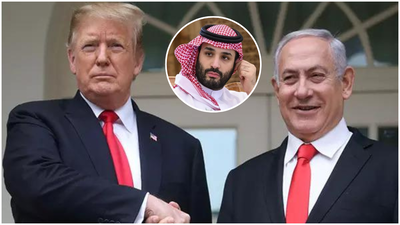
US President Donald Trump has abruptly raised the diplomatic stakes on his administration’s landmark civilian nuclear deal with Saudi Arabia, declaring the pact will proceed only if Riyadh joins the Abraham Accords and normalizes relations with Israel, a condition that was not publicly articulated when the agreement was unveiled a day earlier.In a Truth Social post on Thursday, Trump sought to reassure critics that the agreement would not enable Saudi Arabia to develop nuclear weapons while simultaneously using the deal to revive his signature Middle East diplomatic initiative.“The Civil Nuclear Deal (There will be no enrichment of material!) being made between the Department of Energy and Saudi Arabia… will be approved, but is totally subject to Saudi Arabia joining the very respected and successful Abraham Accords,” Trump wrote, adding, “The United States is not opposed to Civil (Non-Enriched) Nuclear Facilities.”The new caveat surprised diplomats because Energy Secretary Chris Wright had signed the agreement with Saudi Energy Minister Prince Abdulaziz bin SalmanSaudi officials only a day earlier without publicly announcing that normalization with Israel was a prerequisite.The move appears aimed at placating critics in Congress and Israel who had questioned why Washington was extending sensitive nuclear cooperation without extracting a major geopolitical concession.It also allows Trump to frame the agreement as an extension of the Abraham Accords, one of the signature foreign-policy achievements of his first term.Whether Riyadh accepts the condition is another matter. Saudi Arabia has maintained that recognition of Israel remains contingent on meaningful progress toward the creation of a Palestinian state.The devastation in Gaza since the October 2023 Hamas attacks has hardened public opinion across the Arab world, making normalization politically more difficult for the Saudis despite quiet security cooperation with Israel against shared regional threats.Most analysts regard Saudi entry into the Abraham Accords in the near term as unlikely unless accompanied by Israeli concessions on the Palestinian issue.The agreement is already facing intense scrutiny on Capitol Hill, where congressional approval will be required. Trump acolytes and supporters of the deal argue that keeping Saudi Arabia’s nuclear ambitions tied to American technology and oversight is preferable to allowing Riyadh to turn toward China or Russia for nuclear cooperation.They also contend that limiting the program to civilian purposes strengthens US influence in the Gulf.Critics, however, warn that the deal risks undermining decades of US non-proliferation policy. Trita Parsi, executive vice president of the Quincy Institute, called it evidence of “a weaker American bargaining position, not a stronger one,” arguing that Washington is offering more while receiving less as Gulf states diversify their strategic partnerships.He also warned that the agreement could complicate future negotiations with Iran by weakening Washington’s argument against uranium enrichment elsewhere.Retired US Army officer and political commentator Fred Wellman was even more scathing, writing on social media: “I’m old enough to remember when Republicans were losing their minds that a Muslim was being elected to head NYC just 25 years after 9/11… Now they are literally handing nuclear secrets and technology to the country that raised the attackers because Trump’s family is bought and paid for by the Saudi Royal family.“Trump’s latest intervention may have been intended to quiet critics by linking the nuclear pact to a broader diplomatic prize.Instead, it has complicated both objectives. Riyadh has shown no sign of abandoning its long-standing position on Palestinian statehood, while Congress is now poised to debate not just the wisdom of sharing nuclear technology with Saudi Arabia but also whether a signed international agreement can be fundamentally rewritten after the fact – a typically Trump approach that involves constantly re-litigating signed agreements.