












The Earth revolves in a cosmic system which is surrounded by billions of asteroids often referred to as ‘fossils’ of our solar system. While these rocks are rich in resources, they represent a significant threat to humanity. In response, China has developed an ambitious planetary defence strategy that aims to do more than just observe these celestial rocks. Speaking at the third Deep Space Exploration (Tiandu) International Conference in Hefei, ‘Wu Weiren’(chief designer of China’s lunar exploration program and an academician of the Chinese Academy of Engineering), gave an overview of the country’s asteroid exploration and defense strategy.Led by senior scientists from the ‘Chinese Academy of Sciences’ and the ‘China national space administration,’ the country is developing a ‘fly-along–impact–fly-along’ mission model. This innovative approach involves slamming a heavy projectile into an asteroid at 26 times the speed of sound. By combining cutting-edge engineering with existing rocket technology, China aims to safeguard humanity’s future.
What is China’s hypersonic asteroid hammer
Chinese scientists have proposed a revolutionary concept called the ‘Assembled Kinetic Impactor (AKI).’ Imagine if we wanted to move a heavy boulder, would we rather throw a small stone at it or hit it with the entire truck? The AKI concept chooses the ‘truck.’Instead of detaching the final stage of the launch vehicle, the spacecraft remains attached to the rocket’s upper stage. By keeping this heavy 6.5-tonne piece of rocket booster attached, the total mass of the impactor increases significantly. This ‘assembled’ weight allows for a much more powerful thrust to the asteroid, making the mission far more efficient than using the spacecraft only.
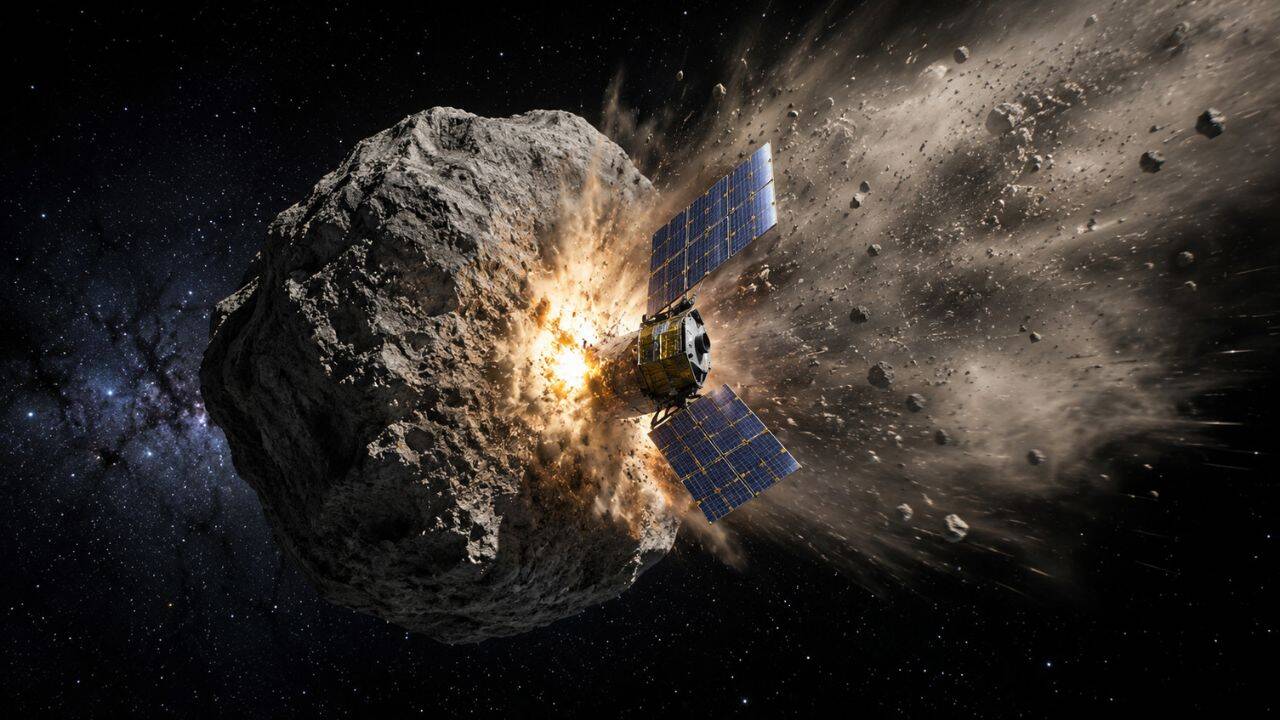
Image Credit: AI generated
Why is ‘speed’ the most important factor in this space defence mission
To change an asteroid’s path, you need ‘mass and speed.’ China’s planned mission aims for an impact velocity of over ‘9 km/sec.’ That is roughly Mach 26 (twenty-six times the speed of sound at sea level).The reason for going this fast is because kinetic energy increases dramatically as speed goes up. By hitting an asteroid at this hypersonic speed, the impact can create a ‘splash’ of debris from the asteroid. This will probably push the asteroid further away from its original path. Scientists believe that hitting a target at 9 km/s provides a much more realistic test of our ability to break up a dangerous rock or push it safely away from Earth.
How does the ‘Long March 5’ rocket help in this mission
The muscle behind this plan is the ‘Long March 5 (CZ-5) rocket,’ China’s largest and most powerful launch vehicle at present. Its performance is comparable to the world’s most famous heavy lifters, like the Delta IV Heavy. In the AKI mission design, the final stage of CZ-5 serves a dual purpose. First, it pushes the spacecraft toward the asteroid; then, instead of detaching itself away from the spacecraft, it becomes the primary heavy tool used for the impact.In general space missions, any leftover fuel in a rocket stage is vented to prevent explosions. However, for the AKI mission, scientists propose carrying that extra fuel in the spacecraft instead. This ensures every unit of the rocket’s mass is utilised to hit the asteroid.
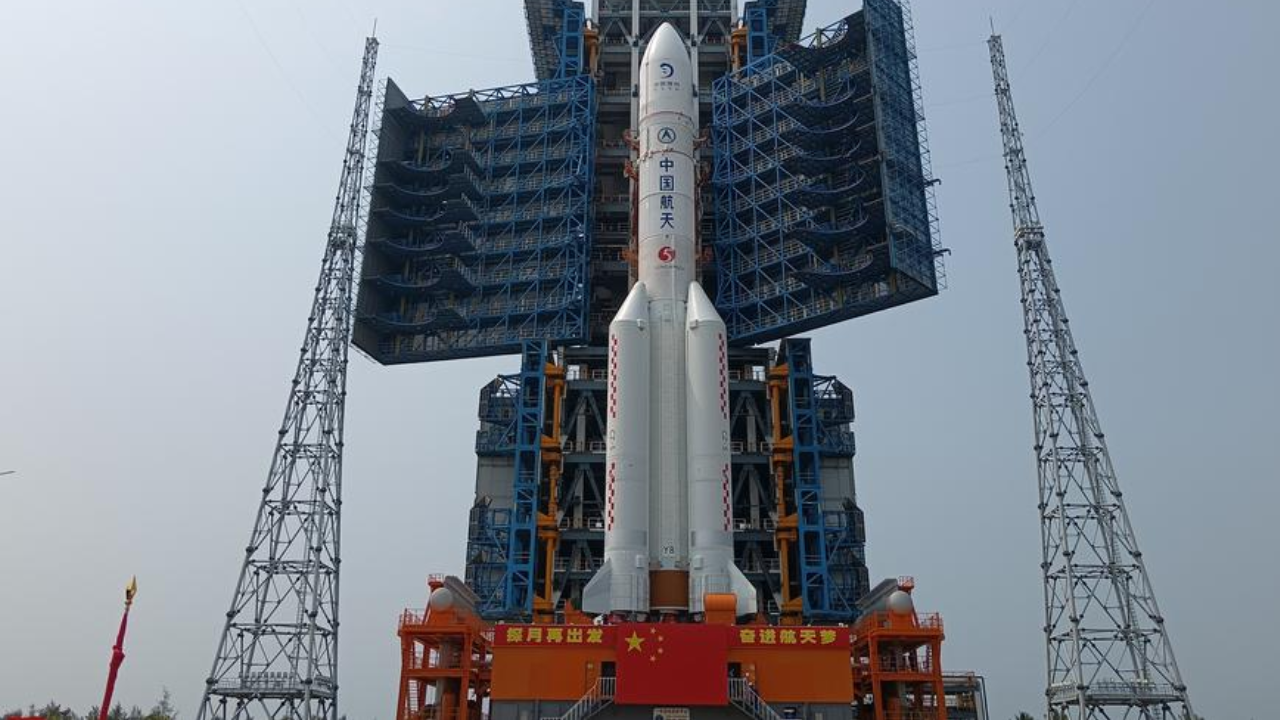
Image Credit: Xinhua
Can we really deflect large asteroids in time
One of the biggest worries in planetary defence is the ‘lead-time’ (time between planning a space mission and its actual execution). For a large asteroid like Bennu, which is nearly 500 metres wide, standard methods might require 75 separate launches and a ‘25-year’ warning to move it safely.However, simulations published by Chinese researchers suggest the AKI method could reduce the number of launches by two-thirds. With this high-mass, high-speed approach, China could defend the earth against a Bennu-like asteroid within a 10-year launch lead-time. For smaller asteroids (around 140 metres wide), a single Long March 5 rocket using the AKI method could provide enough push to eliminate the threat entirely.

Image Credit: European Space Agency
Who decides the rules for hitting asteroids and other space missions
Space is often called the ‘province of all mankind,’ but hitting a celestial body raises serious legal questions. According to the Outer Space Treaty, nations have a responsibility to inform the international community about the results of their space activities, especially those that could ‘harm’ the Earth’s environment. If a mission fails, who would be responsible?International law generally holds the ‘launching state’ liable for damage caused by its space objects on Earth. Because an asteroid deflection mission is for the benefit of everyone, some experts suggest that the United Nations Security Council (UNSC) might need to provide a ‘legal cover’ for such missions to ensure global cooperation. China’s strategy insists on this international spirit, aiming for a mission where one spacecraft observes the hit while the other strikes, allowing the whole world to assess the results accurately.

Image Credit: By ITU – https://www.flickr.com/photos/itupictures/16661050412, CC BY 2.0, https://commons.wikimedia.org/w/index.php?curid=150238379
Is our planet finally becoming safe from cosmic threats
China’s announcement of this mission marks a new chapter in how we see our universe. We are no longer the passive observers waiting for a disaster; we are becoming active defenders. By building a national defence system that includes early warning networks and high-speed interceptors, China is contributing to a global safety net. (just like Tony Stark says in ‘Avengers: Age of Ultron’: “I see a suit of armour around the world”)While the technology is complex, the goal is simple: to ensure that if a threat is discovered, a plan is already in place. As we move toward 2030, the vision of a ‘Mach 26’ interceptor serves as a powerful reminder of human resourcefulness.