
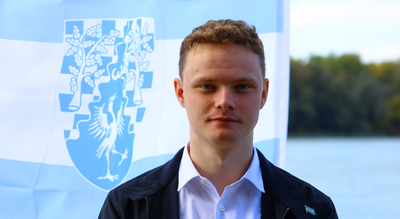
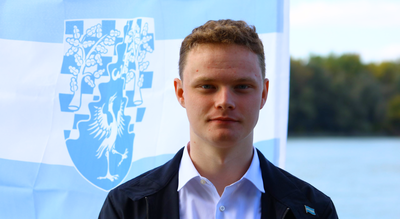
In an era when nearly every piece of land on Earth belongs to a recognised state, the idea of starting a new country can sound almost impossible. Yet Daniel Jackson, a 20-year-old with British and Australian citizenship, insists he has done exactly that. Jackson is the self-declared president of the Free Republic of Verdis, a tiny patch of forest and sand along the Danube River between Serbia and Croatia that he says qualifies as terra nullius — land claimed by no country. His project has attracted thousands of online supporters, a volunteer government and even its own passports. But Jackson himself cannot enter the territory he claims to rule. After attempting to settle the land in 2023, he says Croatian authorities removed him and imposed a lifetime ban, leaving the would-be president running his micronation from exile.
The disputed land between Serbia and Croatia
The legal argument behind Verdis begins with a technical dispute about borders along the Danube River, which forms much of the boundary between Croatia and Serbia. Historically, the border followed the course of the river. Over time, however, the Danube’s channel shifted, leaving both countries interpreting the boundary differently. Croatia argues that the border should follow historic cadastral maps, while Serbia considers the boundary to be the central line of the Danube. Because of this disagreement, several small pockets of land fall outside both countries’ claims. Under international law, such places can sometimes be described as “terra nullius”, a Latin term meaning “nobody’s land” — territory not claimed by any sovereign state. Two areas along this disputed stretch have been described this way. One is Gornja Siga, where Czech politician Vít Jedlička proclaimed the libertarian micronation Liberland in 2015. The other is Pocket 3, the sandy, forested strip Jackson claims as Verdis. Jackson explains the logic behind the claim simply: “This piece of land was unclaimed, as neither Croatia nor Serbia wanted it,” he says. “Croatia insists this piece of land is part of Serbia, whereas Serbia considers its border to be the central line of the Danube. “That allowed the oldest active claimants under international law, which is Verdis in this case, to be rightful to the land.”
A teenager’s experiment in nation-building
The idea began years earlier, when Jackson was still in school. Born in Australia to British parents, he spent his childhood in Melbourne and attended Waverley Christian College, a private school in the city. He was just 14 years old when he and a group of friends started searching maps online for unusual geographic oddities. “It was a bit of an experiment – we wanted to do something unique. And I thought: let’s make it a reality,” Jackson later said. Some of his collaborators were friends from school; others were people from south-east Europe he had met online. Together they discovered the uninhabited territory along the Danube and decided to try turning it into a country.
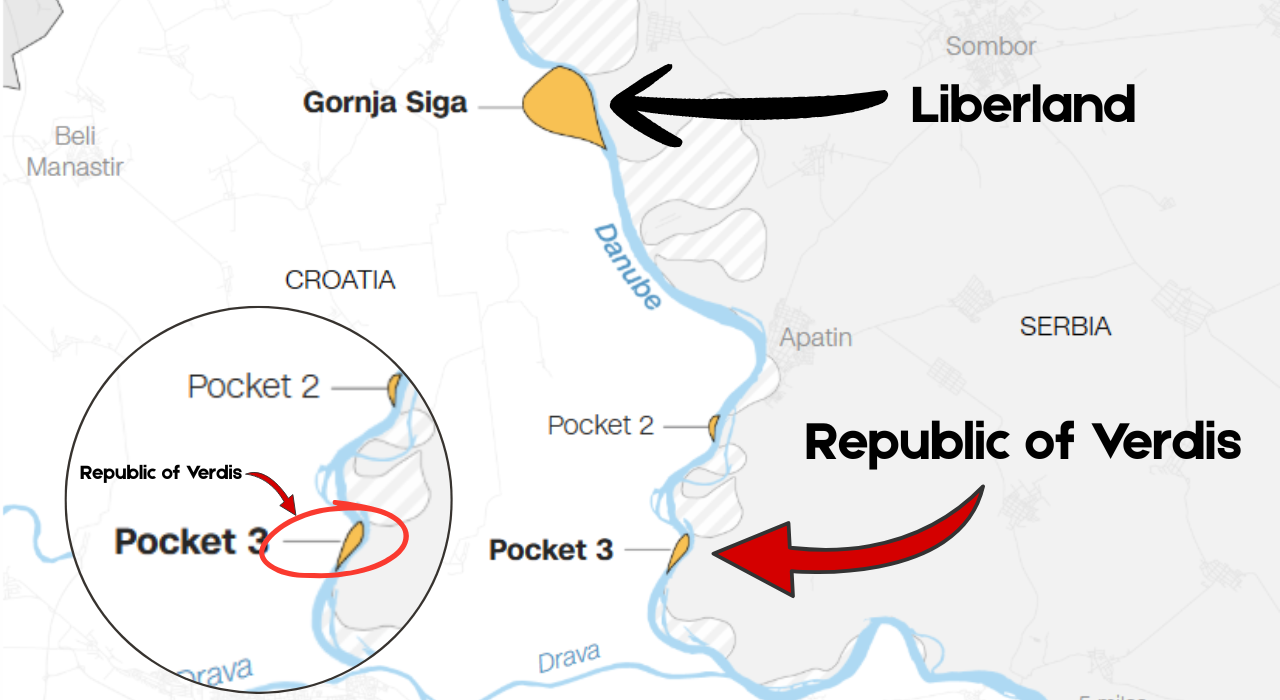
The self-proclaimed Free Republic of Verdis is located on Pocket 3 along the Danube River, near Pocket 1 where Liberland is situated.
The group named it Verdis, derived from the Latin word “viridis,” meaning green, reflecting their emphasis on environmental protection. The land itself is small, around 124 acres, roughly half a square kilometre. In size, it is just a fraction larger than Vatican City, the smallest internationally recognised country in the world, and about the size of 75 football fields. Aside from forest and scrubby riverbank, the territory has never been permanently inhabited.
Declaring the Free Republic of Verdis
Jackson formally declared the Free Republic of Verdis in 2019, when he was elected president by his fellow supporters. From there, the group began building the trappings of statehood. They created a flag, pale blue and white horizontal stripes, and designed a coat of arms combining symbols from both Serbian and Croatian culture. The emblem includes a white stork as the national bird, oak trees representing unity and strength, wavy lines symbolising the Danube, and symbols reflecting both Serbian and Croatian heritage. A government was also formed, including ministers responsible for foreign affairs, internal affairs, infrastructure and defence, along with volunteer ambassadors and officials. Two offices were established, one in the United Kingdom and another in Serbia, staffed by volunteers helping run the project. The micronation has also drafted basic laws, written a constitution, and begun issuing passports and identity cards, though none are recognised internationally.
Citizenship, e-residents and a Gen Z following
Much of Verdis’ growth has taken place online. Jackson says the project has attracted thousands of supporters, particularly among younger internet users interested in alternative governance and digital citizenship. So far, around 3,000 people have applied to become Verdisians, many through an e-Residency pathway that allows supporters to participate digitally in the state’s institutions.
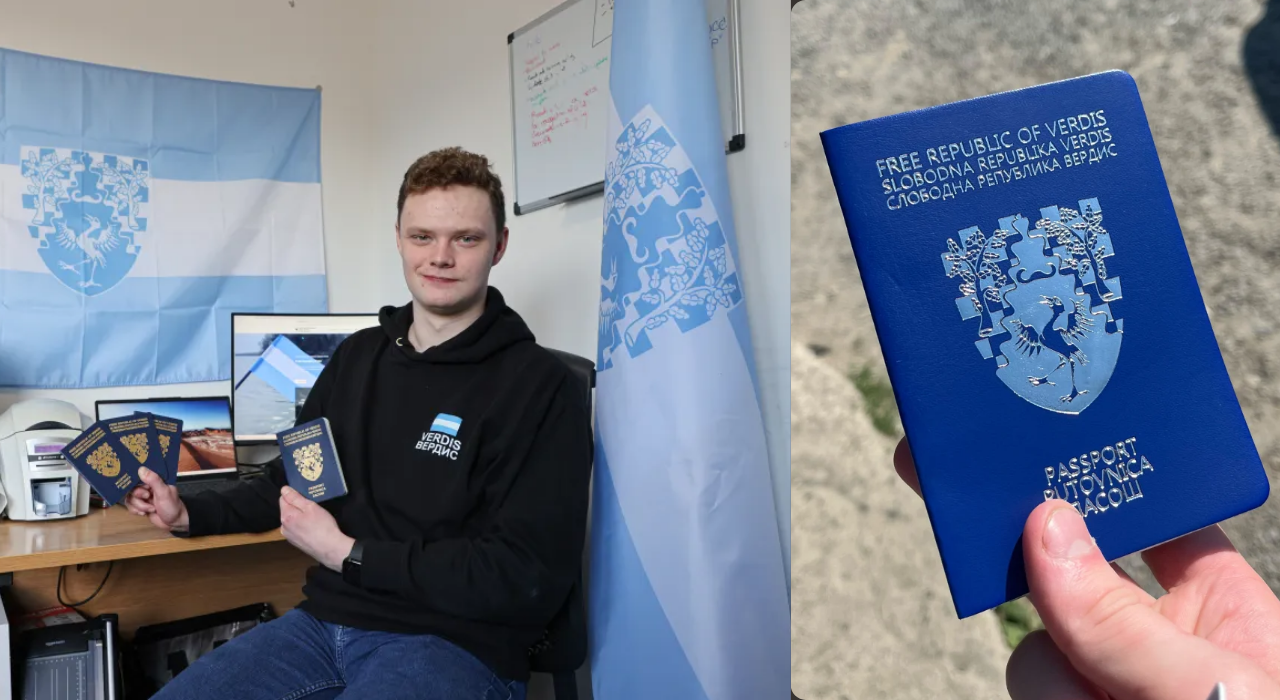
Daniel Jackson at his Verdis embassy in Dover, KentCredit: Gary Stone via The Sun
According to Verdis officials, the number of physical citizens, people issued passports and identity cards, stood at around 400 by late 2025. The e-Residency programme has its own application process. Prospective members must first purchase an e-Resident Plus plan costing €50 per year, hold it for at least 11 months, and then apply for citizenship. Applicants must either obtain support from two existing Verdisian citizens or provide a DBS background check, remain active in Verdis forums, commit to relocating to the territory in the future and pay a €300 processing fee. Applicants can also be fast-tracked if they make significant contributions to the project or are considered “extremely beneficial to the country’s development.”
The first attempt to settle the land
For several years, Verdis existed largely online. But in October 2023, Jackson and a group of supporters attempted to physically occupy the territory. They travelled along the Danube and planted their blue-and-white flag on the land, launching what they described as the “settlement phase” of their nation-building effort. A schedule had been planned so that different groups of Verdis citizens would rotate through the territory over the following months, ensuring a continuous presence. But the effort lasted barely a day. “It was short-lived,” Jackson later told CNN Travel. According to him, Croatian police arrived the next morning, dismantled the camp and detained the settlers for questioning. “They broke the camp apart,” he said. The group says they were held for around 12 hours before being deported. Most participants received three-month bans from Croatia, but Jackson and his vice-president Hector Bowles, who divides his time between Dover and Bulgaria, were issued lifetime bans on the grounds they were considered “a threat to homeland security.”
Croatia’s response
Croatia’s government has rejected the idea that the land qualifies as terra nullius. In a statement to CNN, the Croatian foreign ministry described the Verdis project, along with the Liberland claim nearby, as “provocative actions without any basis in law.” The ministry said Croatia was simply fulfilling its obligation to protect its external border and the Schengen Area, Europe’s passport-free travel zone. Officials also rejected the idea that disputed borders automatically create unclaimed territory. Both Croatia and Serbia, the ministry said, “share an understanding of and respect for a fundamental principle of international law: the fact that a pending delimitation does not render any space a terra nullius (‘no man’s land’) open to occupation by a third party.”
Life in exile
Today Jackson runs Verdis from the United Kingdom, describing himself as effectively “in exile.” He lives with a family friend in Dover, working remotely as a freelance game developer for the online platform Roblox while continuing to organise Verdis’ government. Funding for the project comes from a mix of donations, merchandise sales and a citizenship-by-investment scheme. In one instance, cryptocurrency enthusiasts raised more than $37,000 through an unaffiliated digital token known as $Verdis. The government also pays ministers’ travel costs when they attend meetings or attempt to visit the territory. But reaching Verdis itself has become increasingly difficult. Jackson says Croatian authorities have installed cameras along the coastline, and patrol boats quickly intercept vessels approaching the land. “If you even hover your boat for 10 minutes in the territorial waters, a Croatian police boat will be on its way very quickly,” he says. Some of Verdis’ boats have also disappeared following the 2023 deportation, which Jackson suspects were seized by Croatian authorities.
Protests and continuing tensions
Supporters of Verdis have also staged demonstrations. Members of the micronation have organised protests outside the Croatian embassy in London, accusing authorities of blocking access to the territory. Jackson says nationalist groups in the Balkans have also posted videos online showing the Verdis flag being burned. Despite the setbacks, he insists the project is far from over. “I still believe that sooner or later we will be back on the land and Croatia will have to respect international law, including Verdis’ territorial integrity,” he told CNN Travel. “We will never give up on our goal. We hope to have positive relations with Croatia in the future. We want to work with them.”
A country that exists mostly online, for now
For now, Verdis operates with a temporary government while Jackson remains unable to access the territory he claims. The group recently opened a second embassy in Novi Sad, Serbia, hoping to build support among younger Serbs and Croats interested in the idea of a neutral microstate promoting peaceful coexistence. Jackson himself says he does not intend to remain president forever. His long-term plan is to eventually step down and become a citizen of Verdis, leaving the leadership to someone else once the country is established. “They haven’t tried to annex us and I think they’re irritated we haven’t given up the claim to the land,” he said of Croatian authorities. “Maybe they’re worried we’re going to become a lawless state.” For Jackson, the question is not whether Verdis will exist, but when. “We’ve held protests outside the Croatian embassy, they’re trying to blank us out as much as possible,” he says. But he remains convinced the experiment will continue. “It’s a matter of time.”